Thought-propelled wheelchair developed in Italy
Mar 06, 2009
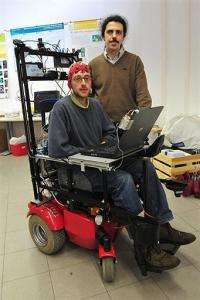
Professor Matteo Matteucci (R) and Ph.d student Bernardo Dal Seno (C), wearing a skullcap mounted with electrodes and wired to a computer as he sits on a special wheel chair at the Politecnico di Milan department in Milan. Italian researchers have developed a wheelchair that obeys mental signals sent to a computer, they said Friday.

Italian researchers have developed a wheelchair that obeys mental signals sent to a computer, they said Friday.

The researchers at Milan's Polytechnical Institute artificial intelligence and robotics laboratory took three years to develop the system, Professor Matteo Matteucci told AFP.

The user is connected to a computer with electrodes on his or her scalp, and sends a signal by concentrating for a few seconds on the name of the desired destination -- kitchen, bedroom, bathroom -- displayed on a screen.

The computer then guides the wheelchair to the selected room using a preset programme.

"We don't read minds, but the brain signal that is sent," Matteucci said.

The chair is equipped with two laser beams that can detect obstacles.

The Milan lab is already in contact with companies that could produce a commercial prototype aimed at quadriplegics, Matteucci said, adding that it could take between five and 10 years.

Such a wheelchair would cost only 10 percent more than a classic motorised wheelchair, according to the institute.

Research to develop the so-called Brain Computer Interface began in the early 1980s around the world.

Matteucci said a handful of other researchers were working on similar projects to his, including the Federal Polytechnic School in Lausanne, Switzerland.

"Eventually, a research consortium should be set up that will use all these projects as a basis for finding the best approach," he said.

"We've now started work on getting the chair to operate outdoors using a GPS," Matteucci added.

(c) 2009 AFP

Explore further: Sensitive bomb detector to rove in search of danger

add to favorites email to friend print save as pdf

Related Stories

Physicist Stephen Hawking visits LA stem cell lab

Apr 10, 2013

Stephen Hawking toured a stem cell laboratory Tuesday where scientists are studying ways to slow the progression of Lou Gehrig's disease, a neurological disorder that has left the British cosmologist almost ...

Making mobile robots work together

Feb 11, 2013

The danger that icebergs represent to both shipping and to the underwater cables that traverse the ocean floors is very real. It's tricky for satellites to identify icebergs, and almost impossible to accurately ...

Recommended for you

Sensitive bomb detector to rove in search of danger

May 24, 2013

European researchers have developed and tested a light-weight device capable of detecting extremely minute quantities of explosives from up to 20 metres away, providing an invaluable law-enforcement tool ...

How soon could car seats enter the 3-D comfort zone?

May 23, 2013

New 3D textiles made of recyclable polyester fibres could contribute help cars be easier to recycle. But recycling technology has yet to progress in separating seat material from other car components.

NASA: Austin, calling Austin. 3-D pizzas to go

May 22, 2013

(Phys.org) —The idea of living with 3-D printed food is neither unthinkable nor new; designers and futurists have been looking to 3-D printing as food's next frontier. In 2012, there was news that the Thiel ...

User comments : 0

More news stories

Yahoo, pay-TV operators among Hulu bidders

Online video site Hulu is again up for sale, with Yahoo and pay TV operators DirecTV and Time Warner Cable among the seven bidders, according to a person with direct knowledge of the matter.

Radiation leak at Japan lab; small impact expected

An atomic research lab in northern Japan has reported a radiation leak that may have affected about 50 people, though none were hospitalized and no impact was expected outside the facility, the lab's operator ...

Drones may violate international law

(Phys.org) —As President Obama gives a speech on national security—including defending U.S. use of drones to combat terrorism—Leila Sadat, JD, international law expert and professor of law at Washington University in ...

Google eyes emerging markets networks

Google has become deeply involved in a series of projects to build and operate wireless networks in emerging markets including sub-Saharan Africa and Southeast Asia, a report said Friday.

Heart failure accelerates male 'menopause'

Heart failure accelerates the aging process and brings on early andropausal syndrome (AS), according to research presented today at the Heart Failure Congress 2013. AS, also referred to as male 'menopause', was four times ...

Feds fight morning-after pill age ruling in NY

(AP)—Department of Justice lawyers have again asked a federal appeals court in New York to delay lifting age restrictions and prescription requirements on an emergency contraceptive popularly known as the morning-after ...