New barrier coating offers savings for aluminium smelters
Feb 23, 2009
New barrier coating offers savings for aluminium smelters
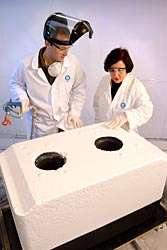
CSIRO project officer Enzo Gulizia and Dr Mahnaz Jahedi inspect the surface of a freshly coated carbon anode, intended for use in a trial at an aluminium smelter.

(PhysOrg.com) -- A barrier coating developed through CSIRO’s Light Metals Flagship offers aluminium smelters significant annual savings in reduced consumption of petroleum coke alone.

Smelter trials indicate that the low-cost coating prevents air burn oxidation and extends the operational life of carbon anodes used in high-temperature electrolytic cells.

Use of the coating was shown to produce a net reduction in carbon usage of 0.02 Kg carbon/Kg aluminium produced.

“Our coating can provide considerable savings for the companies operating the more than one hundred smelters that produce aluminium at present,” said Dr Mahnaz Jahedi of CSIRO Materials Science and Engineering.

Dr Jahedi presented the results of the project at a recent meeting of The Minerals, Metals and Materials Society in San Francisco.

Carbon anodes are made from petroleum coke, and in the extreme heat of aluminium electrolysis cells, the exposed top and sides of the anodes can oxidise spontaneously due to air burn.

Air burn can spread rapidly between anodes, and necessitates more frequent interruptions to the smelting process to replace anodes.

The CSIRO coating performed significantly better than conventional aluminium spray coating.

“The trials demonstrated that the coated anodes don’t develop air burn, and last longer in the smelter cells as a result,” said Dr Jahedi.

The trials were designed to test the efficacy of the coating by placing coated anodes in positions in the electrolytic cells found to be particularly prone to air burn.

“None of the coated anodes had to be removed due to air burn during the trials,” Dr Jahedi said.

Uncoated anodes placed in similar positions needed to be replaced more frequently due to severe air burn.

The cost-effective coating also proved durable during trials, remaining undamaged during transport of anodes to the smelter and during in-plant handling.

“The coating did not melt or crack while the anodes were in use. The trials showed no safety issues with application or use of the coating in smelters.”

The coating is simple to apply, and adheres well to the carbon anode.

The next stage of in-plant trials will use several hundred coated anodes and is expected to provide a complete assessment of the productivity improvements offered by the coating.

CSIRO plans to license the coating technology to smelters, and invites expressions of interest in the technology.

Provided by CSIRO

Explore further: Army ground combat systems adopts tool for choosing future warfighting vehicles

add to favorites email to friend print save as pdf

Related Stories

Stanford's battery-life research steps into economy class

Oct 25, 2012

(Phys.org)—Looking for better battery designs and solutions is a priority pursuit for many scientists, and the Batteries for Advanced Transportation Technologies (BATT) Program is always on the lookout for worthy contributions. ...

New technology: Ultra-fast boriding saves time, cleaner

Sep 06, 2012

(Phys.org)—Growing up in Turkey, Ali Erdemir and Osman Eryilmaz would sometimes play with the borax deposits near the mountains by their homes—but only later would they discover that borax would underlie ...

LG Chem cable batteries may reshape mobile designs

Sep 02, 2012

(Phys.org)—LG Chem says it has a cable-type lithium-ion battery that is so flexible it can be tied in knots and worn as a bracelet or woven into textiles. For mobile device designers, the eventual commercial ...

Recommended for you

Student-built innovations to help improve and save lives

May 20, 2013

Nanyang Technological University (NTU) students have developed new and practical life-saving innovations inspired from everyday problems, including improving the safety of cyclists on the roads and keeping ...

GPS solution provides 3-minute tsunami alerts

May 17, 2013

Researchers have shown that, by using global positioning systems (GPS) to measure ground deformation caused by a large underwater earthquake, they can provide accurate warning of the resulting tsunami in ...

User comments : 0

More news stories

Green conversion of heat to electricity

Soon, it will be possible to produce electricity from heat over 30 degrees emitted from a waste incinerator, refinery, or data processor. The start-up Osmoblue has just confirmed the feasibility of this new ...

Study shows where scene context happens in our brain

In a remote fishing community in Venezuela, a lone fisherman sits on a cliff overlooking the southern Caribbean Sea. This man –– the lookout –– is responsible for directing his comrades on the water, ...

New rice contamination reported in China

Authorities are investigating rice mills in southern China following tests that found almost half of the staple grain in one of the country's largest cities was contaminated with a toxic metal.