The secretive immune system of the salmon
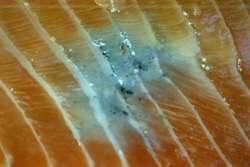
During his doctoral thesis, Erlend Haugarvoll discovered new aspects of the salmon immune system. His research looked at the immune cells in the gills of salmon and at immune responses to vaccination. A special type of tissue, rich in immune cells, was found in the gills, and new properties of immune cells that produce brown pigment were discovered.
Successful salmon farming in Norway and other countries depends on the use of vaccination. Vaccination gives salmon good protection against several diseases, but has serious side-effects. Inflammatory reactions at the injection site can lead to reduced growth rate, reduced meat quality and deformities, raising both economical and ethical around current vaccination regimes. In order to improve resistance to disease in salmon, it is important to find alternative vaccination methods and to acquire more knowledge of how salmon react to vaccination.
Haugarvoll and his colleagues discovered in salmon gill a tissue extremely rich in immune cells. Salmon gills have extremely thin mucous membranes, and they absorb oxygen from the water while keeping out potentially damaging microbes. The fish are therefore dependent on good disease resistance in this organ. The discoveries made by Haugarvoll may prove extremely useful when new vaccines, free from damaging side effects, are developed.
Some fish immune cells contain the pigment melanin, which is the same substance that darkens the skin of people and animals. These cells have been called melanomacrophages and it has been assumed they play a central role in the defence of fish against microbes. The work of Haugarvoll and his associates showed that melanomacrophages in salmon produce their own melanin. There is also reason to believe that this pigment has an important role in the salmon defence system.
Vaccination is a very effective way of protecting animals against infectious disease and has nearly removed the need for antibiotics in Norwegian salmon farming. In his doctorate, Haugarvoll investigated currently unknown sides of fish immune defence, and his work gives hope that vaccines may be developed that can be applied externally.
Cand. med. vet. Erlend Haugarvoll defended his thesis for the degree of Doctor of Philosophy, entitled " Novel leukocyte localisations and characteristics in the Atlantic salmon", on December 16, 2008, at the Norwegian School of Veterinary Science.
Source: Norwegian School of Veterinary Science


