C1XS catches first glimpse of X-ray from the moon
(PhysOrg.com) -- The C1XS X-ray camera, jointly developed by the UK's STFC Rutherford Appleton Laboratory and the Indian Space Research Organisation (ISRO), has successfully detected its first X-ray signature from the Moon. This is the first step in its mission to reveal the origin and evolution of our Moon by mapping its surface composition.
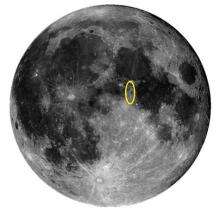
In orbit around the Moon on the Chandrayaan-1 spacecraft, C1XS detected the X-ray signal from a region near the Apollo landing sites on December 12th 2008 at 02:36 UT. The solar flare that caused the X-ray fluorescence was exceedingly weak, approximately 20 times smaller than the minimum C1XS was designed to detect.
"C1XS has exceeded expectations as to its sensitivity and has proven by its performance that it is the most sensitive X-ray spectrometer of its kind in history," said Ms. Shyama Narendranath, Instrument Operations Scientist at ISRO.
The X-ray camera collected 3 minutes of data from the Moon just as the flare started and the camera finished its observation. The signal reveals the X-ray fingerprint of a part of the lunar surface. As the mission continues, C1XS will build up a detailed picture of the ingredients that have gone into the Moon - our eighth continent.
Mr Barry Kellett, instrument scientist from STFC's Space Science and Technology Department said "Despite the small quantity of data, our initial analysis and modelling shows that C1XS has identified the chemistry of this area of the Moon".
Professor Manuel Grande, Principal Investigator, Aberystwyth University, concluded, "The quality of the flare signal detected from the Moon clearly demonstrates that C1XS is in excellent condition and has survived the passage of Chandrayaan-1 through the Earth's radiation (or van Allen) belts with very little damage. This is excellent news for the rest of the Chandrayaan-1 mission".
Professor Richard Holdaway, Director of STFC's Space Science and Technology Department, said, "We are thrilled that C1XS has started its mission so successfully and is exceeding expectations. This sophisticated instrument will not only help us better understand the origin of the Earth-Moon system but will ensure that the UK plays an important role in this international activity."
Background Information
The camera - C1XS (pronounced "kicks") - was designed and built at STFC Space Science and Technology Department at the Rutherford Appleton Laboratory in collaboration with Indian Space Research Organisation (ISRO). It is an X-Ray Spectrometer that uses X-rays to map the surface composition of the Moon and will help scientists to understand its origin and evolution, as well as quantifying the mineral resources that exist there.
Chandrayaan-1 is the first lunar mission from ISRO and also its first mission with international partners. It is designed to orbit the Moon and carries 11 scientific instruments including radar and particle detectors as well as instruments that will make observations in the visible, near infrared and soft and hard X-rays.
In order to be able to achieve its scientific goal of mapping elements on the Moon, C1XS requires the Sun to generate many X-ray flares. Unfortunately, the present solar minimum of activity, which should have ended in early 2008, is still in effect now at the beginning of 2009. As the instrument has been shown to be more sensitive than expected this will extend the range of flares that will produce useful science.
Source: Science and Technology Facilities Council


