Researchers control the assembly of nanobristles into helical clusters
Jan 08, 2009
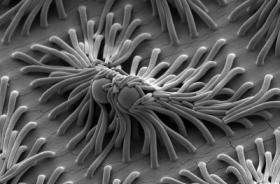
Illustration of the adhesive and particle trapping potential of the helically assembling bristle. Shown: Low-magnification SEM showing the capture of the 2.5-mm polystyrene spheres. Scale bar, 10 mm. Courtesy of Aizenberg lab at the Harvard School of Engineering and Applied Sciences

(PhysOrg.com) -- From the structure of DNA to nautical rope to distant spiral galaxies, helical forms are as abundant as they are useful in nature and manufacturing alike. Researchers at the Harvard School of Engineering and Applied Sciences (SEAS) have discovered a way to synthesize and control the formation of nanobristles, akin to tiny hairs, into helical clusters and have further demonstrated the fabrication of such highly ordered clusters, built from similar coiled building blocks, over multiple scales and areas.

The finding has potential use in energy and information storage, photonics, adhesion, capture and release systems, and as an enhancement for the mixing and transport of particles. Lead authors Joanna Aizenberg, Gordon McKay Professor of Materials Science at SEAS and the Susan S. and Kenneth L. Wallach Professor at the Radcliffe Institute for Advanced Study, and L Mahadevan, Lola England de Valpine Professor of Applied Mathematics at SEAS, reported the research in the January 9 issue of Science.

"We demonstrated a fascinating phenomenon: How a nanobristle immersed in an evaporating liquid self-assembles into an ordered array of helical bundles. This is akin to the way wet, curly hair clumps together and coils to form dreadlocks—but on a scale 1000 times smaller," said Aizenberg.
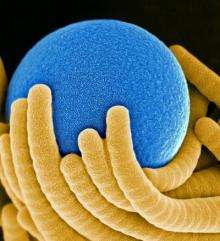
Bristles hugging a polystyrene sphere. Courtesy of Aizenberg lab at the Harvard School of Engineering and Applied Sciences


To achieve the "clumping" effect, the scientists used an evaporating liquid on a series of upright individual pillars arrayed like stiff threads on a needlepoint canvas. The resulting capillary forces—the wicking action or the ability of one substance to draw another substance into it—caused the individual strands to deform and to adhere to one another like braided hair, forming nanobristles.

"Our development of a simple theory allowed us to further characterize the combination of geometry and material properties that favor the adhesive, coiled self-organization of bundles and enabled us to quantify the conditions for self-assembly into structures with uniform, periodic patterns," said Mahadevan.

By carefully designing the specific geometry of the bristle, the researchers were able to control the twist direction (or handedness) of the wrapping of two or more strands. More broadly, Aizenberg and Mahadevan, who are both core members of the recently established Wyss Institute for Biologically Inspired Engineering at Harvard, expect such work will help further define the emerging science and engineering of functional self-assembly and pattern formation over large spatial scales.

Potential applications of the technique include the ability to store elastic energy and information embodied in adhesive patterns that can be created at will. This has implications for photonics in a similar way to how the chirally-ordered and circularly-polarizing elytral filaments in a beetle define its unique optical properties.

The finding also represents a critical step towards the development of an efficient adhesive or capture and release system for drug delivery and may be used to induce chiral flow patterns to enhance the mixing and transport of various particles at the micron- and submicron sale.

"We have teased apart and replicated a ubiquitous form in nature by introducing greater control over a technique increasingly used in manufacturing while also creating a micro-physical manifestation of the terrifying braids of the mythical Medusa," said Mahadevan.

"Indeed, our helical patterns are so amazingly aesthetic that often we would stop the scientific discussion and argue about mythology, modern dreadlocks, alien creatures, or sculptures," added Aizenberg.

Provided by Harvard University

Explore further: 3D printing tiny batteries

add to favorites email to friend print save as pdf

Related Stories

A folding ceramic

Mar 28, 2013

(Phys.org) —A sophisticated nanostructure renders a wafer-thin paper made of electrically conductive vanadium pentoxide fibres both tough and pliable.

Turning viruses into molecular Legos

Oct 19, 2011

Researchers at the University of California, Berkeley, have turned a benign virus into an engineering tool for assembling structures that mimic collagen, one of the most important structural proteins in nature. ...

Recommended for you

3D printing tiny batteries

9 hours ago

(Phys.org) —3D printing can now be used to print lithium-ion microbatteries the size of a grain of sand. The printed microbatteries could supply electricity to tiny devices in fields from medicine to communications, ...

World's most powerful microscope ready for research

15 hours ago

(Phys.org) —The world's most powerful microscope, which resides in a specially constructed room at the University of Victoria, has now been fully assembled and tested, and has a lineup of scientists and businesses eager ...

Future looks bright for carbon nanotube solar cells

15 hours ago

(Phys.org) —In an approach that could challenge silicon as the predominant photovoltaic cell material, University of Wisconsin-Madison materials engineers have developed an inexpensive solar cell that exploits ...

A breakthrough in plasmonics

Jun 17, 2013

EPFL scientists have discovered how optical signal transmission can be controlled, paving the way for the integration of plasmonics with conventional electronic circuits.

User comments : 1

Adjust slider to filter visible comments by rank

Display comments: newest first

KBK
not rated yet Jan 08, 2009
The place the situation falls down in communication of idea or concept as a named metaphor, is to call the wicking effect separate from the quantum atomic function that creates it. This effectively creates a barrier to understanding the phenomena itself in the context of all atomic or quantum phenomena at such levels. Yes it is a macro function that is outlined here, but understanding the effect in the greater context is ill served by it's separate naming -alone.

More news stories

3D printing tiny batteries

(Phys.org) —3D printing can now be used to print lithium-ion microbatteries the size of a grain of sand. The printed microbatteries could supply electricity to tiny devices in fields from medicine to communications, ...

Future looks bright for carbon nanotube solar cells

(Phys.org) —In an approach that could challenge silicon as the predominant photovoltaic cell material, University of Wisconsin-Madison materials engineers have developed an inexpensive solar cell that exploits ...

Hybrid material as gold-leaf substitute

(Phys.org) —A team of researchers headed by Professor Raffaele Mezzenga has created a hybrid material out of gold and milk proteins that looks like a wafer-thin gold leaf. Thanks to its properties, it could ...

World's most powerful microscope ready for research

(Phys.org) —The world's most powerful microscope, which resides in a specially constructed room at the University of Victoria, has now been fully assembled and tested, and has a lineup of scientists and businesses eager ...