Clothing with a brain: 'Smart fabrics' that monitor health
Dec 08, 2008
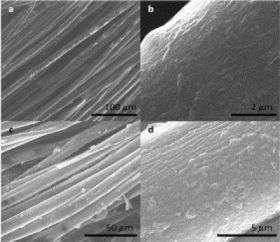
Researchers have developed a cost-effective procedure of making disease-detecting wearable fabrics, "smart fabrics." Above are microscopic images of the E-fibers. Credit: Credit: American Chemical Society

Researchers in United States and China are reporting progress toward a simple, low-cost method to make "smart fabrics," electronic textiles capable of detecting diseases, monitoring heart rates, and other vital signs.

A report on these straight-out-of-science-fiction-fibers, made of carbon nanotubes, is scheduled for the December 10 issue of ACS' Nano Letters.

In the new study, Nicholas A. Kotov, Chuanlai Xu, and colleagues point out that electronic textiles, or E-textiles, already are a reality. However, the current materials are too bulky, rigid, and complex for practical use. Fabric makers need simpler, more flexible materials to make E-fibers practical for future applications, they say.

The scientists describe development of cotton fibers coated with electrolytes and carbon nanotubes (CNT) — thin filaments 1/50,000 the width of a single human hair. The fibers are soft, flexible, and capable of transmitting electricity when woven into fabrics.

In laboratory tests, the researchers showed that the new E-fibers could light up a simple light-emitting diode when connected to a battery. When coated with certain antibodies, the fibers detected the presence of albumin, a key protein in blood — a function that could be used to detect bleeding in wounded soldiers. The fabrics could also help monitor diseases and vital signs, they say.

Article: "Smart Electronic Yarns and Wearable Fabrics for Human Biomonitoring made by Carbon Nanotube Coating with Polyelectrolytes", pubs.acs.org/stoken/presspac/presspac/full/10.1021/jf8016095

Provided by American Chemical Society

Explore further: Hybrid material as gold-leaf substitute

add to favorites email to friend print save as pdf

Related Stories

Recommended for you

Hybrid material as gold-leaf substitute

Jun 18, 2013

(Phys.org) —A team of researchers headed by Professor Raffaele Mezzenga has created a hybrid material out of gold and milk proteins that looks like a wafer-thin gold leaf. Thanks to its properties, it could ...

Antioxidant with a long shelf life

Jun 17, 2013

(Phys.org) —Scientists from ETH Zurich have developed a nanomaterial that protects other molecules from oxidation. Unlike many such active substances in the past, the ETH-Zurich researchers' antioxidant ...

Fast pollutant degradation by nanosheets

Jun 17, 2013

(Phys.org) —Waste from textile and paint industries often contains organic dyes such as methylene blue as pollutants. Photocatalysis is an efficient means of reducing such pollution, and molybdenum trioxide ...

Unzipped nanotubes unlock potential for batteries

Jun 13, 2013

(Phys.org) —Researchers at Rice University have come up with a new way to boost the efficiency of the ubiquitous lithium ion (LI) battery by employing ribbons of graphene that start as carbon nanotubes.

Nanoparticle opens the door to clean-energy alternatives

Jun 13, 2013

(Phys.org) —Cheaper clean-energy technologies could be made possible thanks to a new discovery. Research team members led by Raymond Schaak, a professor of chemistry at Penn State University, have found ...

User comments : 0

More news stories

Hybrid nanostructures: Getting to the core

Material scientists expect the new multifunctional properties of hybrid nanostructures will transform the development of high-performance devices, including batteries, high-sensitivity sensors and solar cells. ...

3D printing tiny batteries

(Phys.org) —3D printing can now be used to print lithium-ion microbatteries the size of a grain of sand. The printed microbatteries could supply electricity to tiny devices in fields from medicine to communications, ...

Future looks bright for carbon nanotube solar cells

(Phys.org) —In an approach that could challenge silicon as the predominant photovoltaic cell material, University of Wisconsin-Madison materials engineers have developed an inexpensive solar cell that exploits ...

World's most powerful microscope ready for research

(Phys.org) —The world's most powerful microscope, which resides in a specially constructed room at the University of Victoria, has now been fully assembled and tested, and has a lineup of scientists and businesses eager ...

Seeing data

More data are being created, consumed, and transported than ever before, and in all areas of society, including business, government, health care, and science. The hope and promise is that this influx of ...

Diabetes key to transplant success, research finds

(Medical Xpress)—Better management of diabetes could dramatically improve outcomes for lung transplant patients, with new research showing that those without diabetes lived twice as long as transplant recipients ...