Researchers make new electronics -- with a twist
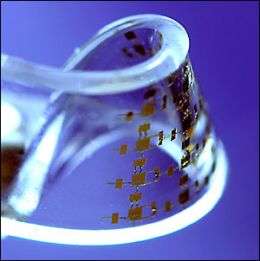
They've made electronics that can bend. They've made electronics that can stretch. And now, they've reached the ultimate goal -- electronics that can be subjected to any complex deformation, including twisting.
Yonggang Huang, Joseph Cummings Professor of Civil and Environmental Engineering and Mechanical Engineering at Northwestern University's McCormick School of Engineering and Applied Science, and John Rogers, the Flory-Founder Chair Professor of Materials Science and Engineering at the University of Illinois at Urbana-Champaign, have improved their so-called "pop-up" technology to create circuits that can be twisted. Such electronics could be used in places where flat, unbending electronics would fail, like on the human body.
Their research is published online by the Proceedings of the National Academy of Sciences (PNAS).
Electronic components historically have been flat and unbendable because silicon, the principal component of all electronics, is brittle and inflexible. Any significant bending or stretching renders an electronic device useless.
Huang and Rogers developed a method to fabricate stretchable electronics that increases the stretching range (as much as 140 percent) and allows the user to subject circuits to extreme twisting. This emerging technology promises new flexible sensors, transmitters, new photovoltaic and microfluidic devices, and other applications for medical and athletic use.
The partnership -- where Huang focuses on theory, and Rogers focuses on experiments -- has been fruitful for the past several years. Back in 2005, the pair developed a one-dimensional, stretchable form of single-crystal silicon that could be stretched in one direction without altering its electrical properties; the results were published by the journal Science in 2006. Earlier this year they made stretchable integrated circuits, work also published in Science.
Next, the researchers developed a new kind of technology that allowed circuits to be placed on a curved surface. That technology used an array of circuit elements approximately 100 micrometers square that were connected by metal "pop-up bridges."
The circuit elements were so small that when placed on a curved surface, they didn't bend -- similar to how buildings don't bend on the curved Earth. The system worked because these elements were connected by metal wires that popped up when bent or stretched. The research was the cover article in Nature in early August.
In the research reported in PNAS, Huang and Rogers took their pop-up bridges and made them into an "S" shape, which, in addition to bending and stretching, have enough give that they can be twisted as well.
"For a lot of applications related to the human body -- like placing a sensor on the body -- an electronic device needs not only to bend and stretch but also to twist," said Huang. "So we improved our pop-up technology to accommodate this. Now it can accommodate any deformation."
Huang and Rogers now are focusing their research on another important application of this technology: solar panels. The pair published a cover article in Nature Materials this month describing a new process of creating very thin silicon solar cells that can be combined in flexible and transparent arrays.
Source: Northwestern University


