World's biggest computing grid launched
Oct 03, 2008
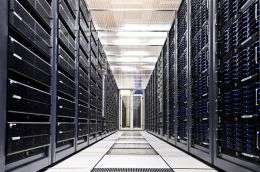
The CERN Computer Centre in March 2008. (Courtesy CERN)

(PhysOrg.com) -- The world’s largest computing grid is ready to tackle mankind’s biggest data challenge from the earth’s most powerful accelerator. Today, three weeks after the first particle beams were injected into the Large Hadron Collider (LHC), the Worldwide LHC Computing Grid combines the power of more than 140 computer centers from 33 countries to analyze and manage more than 15 million gigabytes of LHC data every year.

The United States is a vital partner in the development and operation of the WLCG. Fifteen universities and three U.S. Department of Energy (DOE) national laboratories from 11 states contribute their power to the project.

“The U.S. has been an essential partner in the development of the vast distributed computing system that will allow 7,000 scientists around the world to analyze LHC data, complementing its crucial contributions to the construction of the LHC,” said Glen Crawford of the High Energy Physics program in DOE’s Office of Science. DOE and the National Science Foundation support contributions to the LHC and to the computing and networking infrastructures that are an integral part of the project.

U.S. contributions to the Worldwide LHC Computing Grid are coordinated through the Open Science Grid, a national computing infrastructure for science. The Open Science Grid not only contributes computing power for LHC data needs, but also for projects in many other scientific fields including biology, nanotechnology, medicine and climate science.

“Particle physics projects such as the LHC have been a driving force for the development of worldwide computing grids,” said Ed Seidel, director of the National Science Foundation’s Office of Cyberinfrastructure. “The benefits from these grids are now being reaped in areas as diverse as mathematical modeling and drug discovery.”

“Open Science Grid members have put an incredible amount of time and effort in developing a nationwide computing system that is already at work supporting America’s 1,200 LHC physicists and their colleagues from other sciences,” said Open Science Grid Executive Director Ruth Pordes from DOE’s Fermi National Accelerator Laboratory.

Dedicated optical fiber networks distribute LHC data from CERN in Geneva, Switzerland to eleven major “Tier-1” computer centers in Europe, North America and Asia, including those at DOE’s Brookhaven National Laboratory in New York and Fermi National Accelerator Laboratory in Illinois. From these, data is dispatched to more than 140 “Tier-2” centers around the world, including twelve in the United States.

“Our ability to manage data at this scale is the product of several years of intense testing,” said Ian Bird, leader of the Worldwide LHC Computing Grid project. “Today’s result demonstrates the excellent and successful collaboration we have enjoyed with countries all over the world. Without these international partnerships, such an achievement would be impossible.”

“When the LHC starts running at full speed, it will produce enough data to fill about six CDs per second,” said Michael Ernst, director of Brookhaven National Laboratory’s Tier-1 Computing Center. “As the first point of contact for LHC data in the United States, the computing centers at Brookhaven and Fermilab are responsible for storing and distributing a great amount of this data for use by scientists around the country. We’ve spent years ramping up to this point, and now, we’re excited to help uncover some of the numerous secrets nature is still hiding from us.”

Physicists in the U.S. and around the world will sift through the LHC data torrent in search of tiny signals that will lead to discoveries about the nature of the physical universe. Through their distributed computing infrastructures, these physicists also help other scientific researchers increase their use of computing and storage for broader discovery.

“Grid computing allows university research groups at home and abroad to fully participate in the LHC project while fostering positive collaboration across different scientific departments on many campuses,” said Ken Bloom from the University of Nebraska-Lincoln, manager for seven Tier-2 sites in the United States.

Provided by Brookhaven National Laboratory

Explore further: Researchers provide first-ever academic study of journalists' and private citizens' use of drones

add to favorites email to friend print save as pdf

Related Stories

Recommended for you

Tech companies eye security that goes beyond passwords

44 minutes ago

In late February, a thief or thieves cracked into Evernote's digital vault filled with log-ins, passwords and email addresses belonging to 50 million users. It was a shocking cyberattack considering the Redwood City, Calif., ...

Intelligent glasses designed for professors

Jun 17, 2013

Scientists at la Universidad Carlos III of Madrid (UC3M) have developed a system based on augmented reality that, thanks to intelligent glasses, enables a professor to see notes or comments on the contents ...

New EU cars will dial for help in case of a crash

Jun 13, 2013

The EU wants all new passenger cars fitted out by October 2015 with a life-saving automatic dial-up system so emergency workers can speed to the site of a crash as swiftly as possible.

User comments : 11

Adjust slider to filter visible comments by rank

Display comments: newest first

Falcon
not rated yet Oct 03, 2008
OK if my math is right ( which it probably isn't) that is 14,648.4375 terabytes a year. All i have to say to that is wow...
thales
2.3 / 5 (3) Oct 03, 2008
On August 29, 1997, Skynet became self-aware. Maybe they got the date wrong, that's all I'm sayin'.
KB6
3 / 5 (2) Oct 03, 2008
thales:
It takes more than shear number-crunching ability to become "self-aware", much more. Otherwise AI would be, in principle, really easy.
googleplex
5 / 5 (2) Oct 03, 2008
No doubt we will have that computing power on our desks/phones in a few years. I would be interested to know how this compares to the blue brain project by IBM.
At some point soon computers will become sentient. The tech singularity approaches and I hope it is sooner than 2045 as predicted by Kurzweil et al.
AdseculaScientiae
5 / 5 (1) Oct 03, 2008
I hope so too googleplex, it's quite inevitable if you ask me.. Íf we will not make it before we reach 2050, something must have gone awfully wrong with the world. Let's hope it doesn't. What do you think the social and technological implications will be when the tech singularity comes? I find that really fascinating and mindboggling to philosophize about.

thales
3 / 5 (2) Oct 03, 2008
KB6:

It was a joke more than anything, but in principal, some think it is possible. As the article states, this is a "vast distributed computing system". The idea is that a powerful computer network might achieve emergent awareness, just as our neural network has.

Here's a Wikipedia link: http://en.wikiped...rocesses

Having said all that, I don't think there's any real possibility of this network achieving self-awareness. This project IS working towards artifical awareness though:

http://singinst.org/

If you, like me, don't like clicking random links in a forum, just google "singularity institute". It's the first result.
KB6
5 / 5 (1) Oct 03, 2008
I agree that it's possible. It's just that I think it's going to take a lot more than conventional digital computing and coding to do it.
Nevertheless
not rated yet Oct 03, 2008
I'm with KB6 on this; number-crunching is a prerequisite; however, there are many mysteries that I cannot see being encompassed by multi-flops, such as how does green differ from red and where does the subjective experience of time's passage come from.

But that's okay since we'll be here to interface with the multi-flop machines when they do reach the petaflop region and beyond.
Jarry
not rated yet Oct 04, 2008
I hope so too googleplex, it's quite inevitable if you ask me.. If we will not make it before we reach 2050, something must have gone awfully wrong with the world. Let's hope it doesn't. What do you think the social and technological implications will be when the tech singularity comes? I find that really fascinating and mindboggling to philosophize about.


Maybe the elite who have access to the highest technology will achieve their trans-human utopia, while subjugating the vast majority of lowly homo sapiens who don't.
SmartK8
not rated yet Oct 05, 2008
Jarry: On the other side why such trans-human elite should control the lower class. For money ? I don't think so. Food and drink ? Now come on. Power ? What kind of feeling of power gives you having an ant colony toy in your house ?
ancible
not rated yet Oct 05, 2008
@SmartK8: Computronium

More news stories

Tech companies eye security that goes beyond passwords

In late February, a thief or thieves cracked into Evernote's digital vault filled with log-ins, passwords and email addresses belonging to 50 million users. It was a shocking cyberattack considering the Redwood City, Calif., ...

Multiview 3-D photography made simple

Computational photography is the use of clever light-gathering tricks and sophisticated algorithms to extract more information from the visual environment than traditional cameras can.

Validating maps of the brain's resting state

Kick back and shut your eyes. Now stop thinking. You have just put your brain into what neuroscientists call its resting state. What the brain is doing when an individual is not focused on the outside world ...

Prehistoric rock art maps cosmological belief

It is likely some of the most widespread and oldest art in the United States. Pieces of rock art dot the Appalachian Mountains, and research by University of Tennessee, Knoxville, anthropology professor Jan ...