Meat-eating dinosaur from Argentina had bird-like breathing system
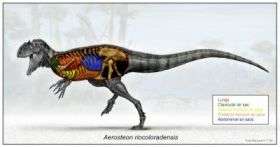
The remains of a 30-foot-long predatory dinosaur discovered along the banks of Argentina's Rio Colorado is helping to unravel how birds evolved their unusual breathing system.
University of Michigan paleontologist Jeffrey Wilson was part of the team that made the discovery, to be published Sept. 29 in the online journal Public Library of Science ONE and announced at a news conference in Mendoza, Argentina.
The discovery of this dinosaur builds on decades of paleontological research indicating that birds evolved from dinosaurs.
Birds have a breathing system that is unique among land animals. Instead of lungs that expand, birds have a system of bellows, or air sacs, which help pump air through the lungs. This novel feature is the reason birds can fly higher and faster than bats, which, like all mammals, expand their lungs in a less efficient breathing process.
Wilson was a University of Chicago graduate student working with noted dinosaur authority Paul Sereno on the 1996 expedition during which the dinosaur, named Aerosteon riocoloradensis ("air bones from the Rio Colorado") was found. Although the researchers were excited to find such a complete skeleton, it took on even more importance as they began to understand that its bones preserved hallmark features of a bird-like respiratory system.
Arriving at that understanding took some time. Laboratory technicians spent years cleaning and CT-scanning the bones, which were embedded in hard rock, to finally reveal the evidence of air sacs within Aerosteon's body cavity. Previously, paleontologists had found only tantalizing evidence in the backbone, outside the cavity with the lungs.
Wilson worked with Sereno and the rest of the team to scientifically describe and interpret the find. The vertebrae, clavicles, and hip bones bear small openings that lead into large, hollow spaces that would have been lined with a thin layer of soft tissue and filled with air in life. These chambers result from a process called pneumatization, in which outpocketings of the lungs (air sacs) invade the bones. Air-filled bones are the hallmark of the bellows system of breathing in birds and also are found in sauropods, the long-necked, long-tailed, plant-eating dinosaurs that Wilson studies.
"In sauropods, pneumaticity was key to the evolution of large body size and long necks; in birds it was key to the evolution of a light skeleton and flight," Wilson said. "The ancient history and evolutionary path of this feature is full of surprising turns, the explanations for which must account for their presence in a huge predator like Aerosteon and herbivores like Diplodocus, as well as in a chicken."
In the PLoS ONE paper, the team proposes three possible explanations for the evolution of air sacs in dinosaurs: development of a more efficient lung; reduction of upper body mass in tipsy two-legged runners; and release of excess body heat.
Sereno, a National Geographic Explorer-in-Residence, said he is especially intrigued by heat loss, given that Aerosteon was likely a high-energy predator with feathers but without the sweat glands that birds possess. At approximately 30 feet in length and weighing as much as an elephant, Aerosteon might well have used an air system under the skin to rid itself of unwanted heat.
Source: University of Michigan


