Scientists take the sharpest image ever made with light
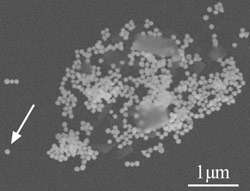
(PhysOrg.com) -- A team of scientists from the Technische Universität Dresden (Germany) and the ESRF in Grenoble (France) has produced the image of an object at the highest resolution ever achieved with X-ray light. A 100-nanometre gold particle fixed on a substrate was reconstructed with 5 nanometre resolution. Contrary to other techniques, X-ray imaging works also in real-life environments like chemical processing or in the presence of high magnetic fields. The team reports its findings in the newest issue of Phys. Rev. Lett. dated 5 September 2008 (published online 29 August 2008).
Anyone who buys a camera knows that money spent on the lens is never wasted as a bad lens never delivers sharp images. A “good” lens to make images with X-rays is a big challenge as this must be manufactured 1.000 times better in quality than the lens of an optical camera or microscope. For this reason, the potential for high-resolution imaging with X-rays could not been exploited fully to date.
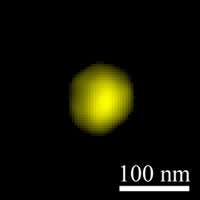
The trick is not to use a lens at all to record the image. Instead, the object is illuminated by a light beam and only “diffracted” light is recorded. Diffraction is the scattering of light at sharp edges and small obstacles, a good illustration of which is the spreading of automobile headlight beams by fog or fine dust particles. If the light has special laser-like properties, diffraction generates a regular pattern from which the shape of the object can be reconstructed by a computer programme. Many synchrotrons across the world offer this technique, called “coherent X-ray diffraction imaging”, but the intensity and quality of coherent X-ray beams limit the resolution to 30-40 nm.
The team from TU Dresden and the ESRF made a big step forward, pushing the resolution, i.e. the detail resolved in the image, from some tens of nanometres to five nanometres—which is 100 times sharper than what a very good optical microscope can achieve.
This was possible as the scientists improved both the quality and the intensity of the coherent X-ray beam as they focused an incoming 15.25 keV beam to a diameter of just 100 nanometres, whilst maintaining its shape pencil-like in order to guarantee laser-like properties. During ten minutes, the beam illuminated a single nanoparticle, after which a detailed diffraction pattern made it possible to render an image of the particle.
In the future of the ESRF, the technique of coherent diffraction imaging will take a big role. The Purple Book, the document describing the ESRF’s Upgrade Programme 2008-2017, highlights coherent diffraction imaging as a tool to be developed extensively. The technique is non-destructive and can assess the shape, size, strain and composition of individual nanostructures like quantum dots in semiconductors or nanoparticles in catalytic converters. Improved detector techniques and future free-electron laser sources would even make possible to take images of biological macromolecules which otherwise are too sensible to radiation damage.
Coherent X-ray diffraction is not the only technique to achieve nanometre resolution. Transmission electron microscopy, for example, yields the highest resolutions. It requires, however, thin samples to be put into vacuum. X-ray techniques can be used in nearly any possible environment, such as chemical reactors or high magnetic fields, and are also suited to study how a sample changes with the environment.
As the next step, the team plans to further push the resolution towards the nanometre-limit and to apply their record-breaking technique to answer some real-world scientific questions.
Optical microscopy has a logical extension towards smaller wavelengths and higher resolution: X-ray microscopy, because X-rays at modern light sources like the ESRF with an energy of 15 keV or more make it possible, in principle, to take images at the atomic scale.
However, the resolution of direct X-ray microscopy techniques is limited by the inherent imperfections of the X-ray optics. As the imperfections of an imaging lens must be smaller than the wavelength, a perfect X-ray optic would feature qualities better than an atomic diameter—an impossible challenge.
Coherent X-ray diffraction imaging circumvents this limitation as it does not use lenses for imaging but reconstructs images from diffraction patterns generated by illumination of the object with coherent X-rays. This shifts the challenge to the production of highly coherent X-ray beams with enough intensity that even tiny objects diffract enough photons to reconstruct an image.
This reconstruction is performed by an iterative feedback algorithm where initial assumptions on the phase of the light are eliminated as the result converges during consecutive iterations. The need for lengthy calculations is the main reason why coherent diffraction imaging is not used with visible light.
Citation: To be published in Physical Review Letters; C. G. Schroer, P. Boye, J. M. Feldkamp, J. Patommel, A. Schropp, A. Schwab, S. Stephan, M. Burghammer, S. Schoder, and C. Riekel; "Coherent x-ray diffraction imaging with nanofocused illumination".
Provided by European Synchrotron Radiation Facility


