Paranal receives new mirror
Apr 17, 2008
The VISTA Mirror and Telescope
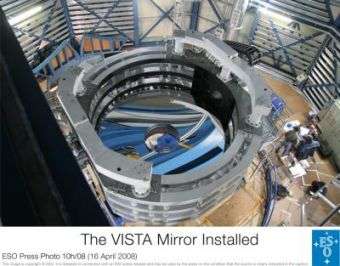
The 4.1-m coated VISTA mirror inside the telescope at Paranal. Credit: ESO

A 4.1-metre diameter primary mirror, a vital part of the world's newest and fastest survey telescope, VISTA (the Visible and Infrared Survey Telescope for Astronomy) has been delivered to its new mountaintop home at Cerro Paranal, Chile. The mirror will now be coupled with a small camera for initial testing prior to installing the main camera in June. Full scientific operations are due to start early next year. VISTA will form part of ESO's Very Large Telescope facility.

The mirror arrived over the Easter weekend at the Paranal Observatory where the telescope is being assembled at an altitude of 2518m, in Chile's Atacama Desert.

VISTA Project Manager Alistair McPherson from STFC's UK Astronomy Technology Centre (UK ATC) accompanied the mirror on its journey to Chile: "This is a major milestone for the VISTA project. The precious mirror was loaded on to a plane in a special cradle that used tennis balls to cushion it from impact for its arduous journey across three continents. "

"The mirror had a difficult four-day journey, by air and by road. It arrived in perfect condition and now that it has been coated, we will install the mirror in the telescope with a small test camera for about four weeks testing. We plan to install the main camera in June," said the Project Scientist on VISTA, Will Sutherland of Queen Mary, University of London, UK.

The VISTA 4.1-metre diameter primary mirror is the most strongly curved large mirror ever polished to such a precise and exacting surface accuracy - deviations from a perfect surface of less than 1/3000th of the thickness of a human hair. On arrival at Cerro Paranal it was safely craned into the telescope dome where it was washed and coated with a thin layer of protected silver in the facility's coating plant. Silver is the best metal for the purpose since it reflects over 98% of near-infrared light, better than the more commonly used aluminium. To date, the reflectivity produced by the silver coating- a relatively new venture - is well above that specified and exceeds all other telescopes.

VISTA will survey large areas of the southern sky at near infrared wavelengths (2 to 4 times the wavelength of visible light) to study objects that are not seen easily in optical light either because they are too cool (such as brown dwarfs), or are surrounded by interstellar dust which infrared light penetrates much better than optical, or whose optical light is redshifted into the near infrared by the expansion of the Universe. Amongst other things VISTA's surveys will help our understanding of the nature and distribution and origin of known types of stars and galaxies, map the 3-D structure of our galaxy, and help determine the relation between the 3-D structure of the universe and the mysterious 'dark energy' and dark matter'. Samples of objects will be followed up in detail with further observations by other telescopes and instruments such as the nearby Very Large Telescope.

"The delivery of the last component of VISTA is a significant milestone and we are delighted with the progress made since the mirror arrived. Now astronomers can really look forward to being able to perform unparalleled observing of our Southern skies," said Richard Wade, President of the ESO Council and STFC Chief Operating Officer.

Source: ESO

Explore further: Hubble reveals the ring nebula's true shape

add to favorites email to friend print save as pdf

Related Stories

VISTA stares deeply into the blue lagoon

Jan 05, 2011

This new infrared image of the Lagoon Nebula was captured as part of a five-year study of the Milky Way using ESO's VISTA telescope at the Paranal Observatory in Chile. This is a small piece of a much larger ...

VISTA reveals the secret of the unicorn (w/ Video)

Oct 06, 2010

(PhysOrg.com) -- A new infrared image from ESO’s VISTA survey telescope reveals an extraordinary landscape of glowing tendrils of gas, dark clouds and young stars within the constellation of Monoceros ...

European Extremely Large Telescope site chosen

Apr 26, 2010

On April 26, 2010, the ESO Council selected Cerro Armazones as the baseline site for the planned 42-meter European Extremely Large Telescope (E-ELT). Cerro Armazones is a mountain at an altitude of 3060 meters ...

Recommended for you

Hubble reveals the ring nebula's true shape

6 hours ago

(Phys.org) —The Ring Nebula's distinctive shape makes it a popular illustration for astronomy books. But new observations by NASA's Hubble Space Telescope of the glowing gas shroud around an old, dying, ...

A hidden population of exotic neutron stars

10 hours ago

(Phys.org) —Magnetars – the dense remains of dead stars that erupt sporadically with bursts of high-energy radiation - are some of the most extreme objects known in the Universe. A major campaign using ...

Very Large Telescope celebrates 15 years of success

16 hours ago

(Phys.org) —With this new view of a spectacular stellar nursery ESO is celebrating 15 years of the Very Large Telescope—the world's most advanced optical instrument. This picture reveals thick clumps ...

Fragile mega-galaxy is missing link in history of cosmos

May 22, 2013

Two hungry young galaxies that collided 11 billion years ago are rapidly forming a massive galaxy about 10 times the size of the Milky Way, according to UC Irvine-led research published Wednesday in the journal ...

User comments : 0

More news stories

A hidden population of exotic neutron stars

(Phys.org) —Magnetars – the dense remains of dead stars that erupt sporadically with bursts of high-energy radiation - are some of the most extreme objects known in the Universe. A major campaign using ...

Hubble reveals the ring nebula's true shape

(Phys.org) —The Ring Nebula's distinctive shape makes it a popular illustration for astronomy books. But new observations by NASA's Hubble Space Telescope of the glowing gas shroud around an old, dying, ...

NASA head views progress on asteroid lasso mission

Surrounded by engineers, NASA chief Charles Bolden inspected a prototype spacecraft engine that could power an audacious mission to lasso an asteroid and tow it closer to Earth for astronauts to explore.

Controlling mood through the motions of mitochondria

(Medical Xpress)—Regulating the distribution of power in neurons is done by a system that makes the national electric grid look simple by comparison. Each neuron has several thousand mitochondria confined ...

A quantum simulator for magnetic materials

Physicists understand perfectly well why a fridge magnet sticks to certain metallic surfaces. But there are more exotic forms of magnetism whose properties remain unclear, despite decades of intense research. ...