Cornell robot fails to break a record, but students learn
Apr 03, 2008
Cornell robot fails to break a record, but students learn
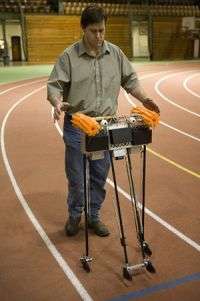
Jason Cortell, manager of the the Biorobotics and Locomotion Lab, follows the Cornell Ranger, on a test walk. The robot's body hides complex computer controls that sense the position of the legs to decide when to swing them forward and how to adjust the pivoting feet. Photo: Jason Koski

Engineering education needs to include a few rough spots to be worthwhile. An attempt to set an unofficial world record for how far a robot could walk failed the night of March 30, but the team will keep trying.

The Cornell Ranger, a robot developed by a team of students working with Andy Ruina, professor of theoretical and applied mechanics, fell down after about 4.75 laps -- about .95 kilometers ( .59 miles) -- around the running track in Barton Hall. An earlier version of the same robot had already set a record by free-walking a bit over 1 kilometer, about .62 miles. (Another robot has walked 2.5 kilometers (1.55 miles) on a treadmill, Ruina noted.)

Ruina was hoping for 10 or more kilometers, more than 6 miles, depending on how long the robot's battery charge would last. The Ranger, like other robots developed in Ruina's lab, is designed for maximum energy-efficiency. Although its four-legged design makes it look a bit like a walking sawhorse, it mimics human walking technique, using energy only to push off with its pivoting toes, but depending on gravity and forward motion to swing its legs forward.

The goal of the research, Ruina said, is not only to advance robotics but also to learn more about the mechanics of walking so the information can be applied to rehabilitation and prosthetics for humans.

After a promising start, the robot literally stubbed its toe after failing to tilt one of its feet upward as the leg came forward. With that, the team of students went into an intense diagnostic session, reviewing telemetry that showed the signals sent by the robot's computer controller to its motors and switches, watching video of the fall and taking new video as the robot was repeatedly tested. The problem was eventually diagnosed as a loose connection in the wires leading to a sensor that measures the angle of the legs relative to the ground.

"I'm actually sort of glad this happened," Ruina said as he watched the students cluster around a laptop to review the robot's programming. "They need to learn that failures are a part of engineering in the real world."

Source: Cornell University

Explore further: Medical robot lets doctors beam in to check on patients

add to favorites email to friend print save as pdf

Related Stories

Robot gliders roam seas

May 03, 2013

(Phys.org) —Once the robotic gliders scour the ocean searching for potential harm to sea life, the data is sent to David Caron, professor of biological sciences in USC Dornsife, and other marine biologists. ...

NASA rover prototype set to explore Greenland ice sheet

May 01, 2013

(Phys.org) —NASA's newest scientific rover is set for testing May 3 through June 8 in the highest part of Greenland. The robot known as GROVER, which stands for both Greenland Rover and Goddard Remotely ...

What lies beneath: NASA Antarctic sub goes subglacial

Mar 01, 2013

(Phys.org)—When researcher Alberto Behar from NASA's Jet Propulsion Laboratory in Pasadena, Calif., joined an international Antarctic expedition last month on a trek to investigate a subglacial lake, he ...

Recommended for you

Review: HP Sleekbook 15 combines size, style

6 hours ago

My experience with Windows 8 has been limited to a few devices, including the Microsoft Surface, so I was happy to get the opportunity to review the Hewlett-Packard Pavilion Sleekbook 15, a fairly inexpensive ...

First Look: New Xbox elegant, but much unknown

May 22, 2013

Will gamers want One? After four years of development, Microsoft unveiled the Xbox One entertainment console and touted it as an all-in-one solution for playing games, watching TV and doing everything in ...

The new consoles from Microsoft, Nintendo and Sony

May 21, 2013

Microsoft is the last of the three big video game console makers to unveil its latest gaming system. Tuesday's unveiling comes nearly eight years after the Xbox 360 went on sale. It follows last fall's de ...

User comments : 1

Adjust slider to filter visible comments by rank

Display comments: newest first

Johnson442
not rated yet Apr 04, 2008
As the old saying goes: "Do it right, learn a little. Do it wrong, learn a lot!"

More news stories

Review: HP Sleekbook 15 combines size, style

My experience with Windows 8 has been limited to a few devices, including the Microsoft Surface, so I was happy to get the opportunity to review the Hewlett-Packard Pavilion Sleekbook 15, a fairly inexpensive ...

Expectations high for next Xbox

It's almost time for a new Xbox. Eight years have passed since Microsoft unveiled the Xbox 360, double the amount of time between the original Xbox debut in 2001 and its high-definition successor's launch ...

First Look: New Xbox elegant, but much unknown

Will gamers want One? After four years of development, Microsoft unveiled the Xbox One entertainment console and touted it as an all-in-one solution for playing games, watching TV and doing everything in ...

Galaxies fed by funnels of fuel

(Phys.org) —Computer simulations of galaxies growing over billions of years have revealed a likely scenario for how they feed: a cosmic version of swirly straws.

Google eyes emerging markets networks

Google has become deeply involved in a series of projects to build and operate wireless networks in emerging markets including sub-Saharan Africa and Southeast Asia, a report said Friday.