'Nitty-Gritty' but Vital Data Helps Field Rescue Robots
Feb 06, 2008
'Nitty-Gritty' but Vital Data Helps Field Rescue Robots
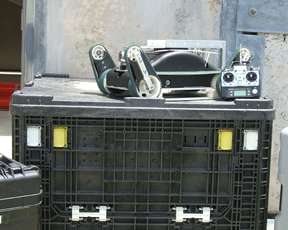
Urban search and rescue robot and its control unit sit atop one of the packing crates stipulated in a new ASTM International standard designed to help first responders manage storage and transportation logistics. Credit: NIST

A new ASTM International standard for urban search and rescue robots and components tackles humble logistics problems that, left unsolved, could hamper the use of life-saving robots in major disasters.

The advance, formally agreed to recently, is one result of a three-year National Institute of Standards and Technology coordinated effort with first responders and robot manufacturers to develop urban search and rescue robot consensus standards. The new standard details specific ways to describe requirements for the storage, shipping and deployment of urban search and rescue robots.

Sensor-laden robots, ranging from ball-shaped survey devices that can be thrown into disaster sites to radio-operated crawlers capable of exploring ruins and even rotary-winged aerial reconnaissance drones, are recognized as holding tremendous potential as additions to the responder’s toolkit.

The new voluntary standard reflects a priority expressed in a series of NIST-coordinated workshops to accelerate the development and deployment of such urban search and rescue robots and components. Federal Emergency Management Agency (FEMA) regional task force members and other first responders, technology developers and robot vendors said that access to standardized information concerning urban search and rescue robot logistics attributes would help response team managers integrate the devices into their operations.

A standard data form lists information relevant to robots that would be deployed for 10 days without re-supply for the first 72 hours. Seemingly mundane but essential information—the number and types of cases required for packing the robot and all associated components (such as sensors, tethers, operator control stations spare parts and specialized tools), for instance—should enable logistics managers to allocate appropriate warehouse space as well as transportation accommodations for shipment to and from the disaster site.

Estimates on the time required to unpack, set up and repair units also will help potential users estimate a realistic time to deployment. Finally data on the actual weight of the robots and its components should allow users to plan how to transport the devices to the worksite from the base of operations.

Further information on NIST’s urban search and rescue robot performance standards project, which is sponsored by the Department of Homeland Security (DHS) Science and Technology Directorate, can be found at www.isd.mel.nist.gov/US&R_Robot_Standards . Additional information on the new standard, ASTM E2592-07, “Standard Practice for Evaluating Cache Packaged Weight and Volume of Robots for Urban Search and Rescue,” can be found at www.astm.org .

Source: NIST

Explore further: How soon could car seats enter the 3-D comfort zone?

add to favorites email to friend print save as pdf

Related Stories

Harnessing robot research a searching task

Mar 25, 2013

A new laboratory dedicated to technologies at the cutting edge of an emerging field of robotics could radically improve the way search and rescue operations are conducted. The Monash Swarm Robotics Laboratory ...

Smart robotic drones advance science (w/ Video)

Oct 04, 2012

(Phys.org)—Chengyu Cao sees a day in the not-so-distant future when intelligent robots will be working alongside humans on a wide range of important tasks from advancing science, to performing deep sea ...

New high standards for emergency wireless devices

Jul 30, 2012

First responders rely increasingly on wireless communication devices, and in emergencies they cannot afford major signal loss or delay caused by attenuation, interference, or reflection. Because lives are ...

Foldable robot scooter wows at Tokyo Motor Show

Dec 01, 2011

A foldable robot scooter controlled by a smart phone wowed visitors to the Tokyo Motor Show on Thursday as its makers unveiled what they hope will be the future of urban driving.

Recommended for you

How soon could car seats enter the 3-D comfort zone?

14 hours ago

New 3D textiles made of recyclable polyester fibres could contribute help cars be easier to recycle. But recycling technology has yet to progress in separating seat material from other car components.

NASA: Austin, calling Austin. 3-D pizzas to go

May 22, 2013

(Phys.org) —The idea of living with 3-D printed food is neither unthinkable nor new; designers and futurists have been looking to 3-D printing as food's next frontier. In 2012, there was news that the Thiel ...

User comments : 0

More news stories

Google Drive sports new view and scan enhancements

(Phys.org) —Google Drive has a new look and functions. The makeover in Google Drive features scanning and interface enhancements that put the user into "card" mode. The enhancements make it easy for the ...

Solar Kettle allows for boiling water off the grid

(Phys.org) —A company called Contemporary Energy has unveiled a new device it calls the Solar Kettle. It looks very much like a normal coffee thermos, but has flaps on one side that open to allow for collecting ...

Review: Google music plan solid, serendipitous

Google's new music service offers a lot of eye candy to go with the tunes. The song selection of around 18 million tracks is comparable to popular services such as Spotify and Rhapsody, and a myriad of playlists ...

Controlling mood through the motions of mitochondria

(Medical Xpress)—Regulating the distribution of power in neurons is done by a system that makes the national electric grid look simple by comparison. Each neuron has several thousand mitochondria confined ...

A quantum simulator for magnetic materials

Physicists understand perfectly well why a fridge magnet sticks to certain metallic surfaces. But there are more exotic forms of magnetism whose properties remain unclear, despite decades of intense research. ...