HiRISE Camera Views the Mars Rover 'Spirit' at 'Home Plate'
Nov 26, 2007
HiRISE Camera Views the Mars Rover 'Spirit' at 'Home Plate'
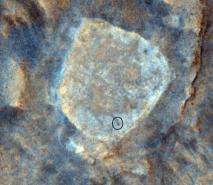
The Mars rover "Spirit" is indicated by a circle on "Home Plate" in this new image of Gusev Crater on Mars. This detail is part of a much larger image the HiRISE camera took on Sept. 27, 2007. The rover has since driven north. (Photo: NASA/JPL/University of Arizona)

The High Resolution Imaging Science Experiment, or HiRISE, camera onboard NASA's Mars Reconnaissance Orbiter has taken a new color image of the feature dubbed "Home Plate" in Gusev Crater on Mars.

The Mars Exploration Rover "Spirit" shows up inside the perimeter of Home Plate, where it was when HiRISE took the image on Sept. 27, 2007, at 2:19 p.m. local Mars time, HiRISE team member Ken Herkenhoff of the U.S. Geological Survey, Flagstaff, said.

Spirit is driving toward the safe, north-facing slopes on the north side of Home Plate, which is toward the top of the image. There it will be positioned to tilt its solar panels toward the sun for the long Martian winter. Home Plate is a flat, raised feature that is probably a remnant of a deposit emplaced by an ancient eruption, Herkenhoff added.

The new color image of Home Plate was created using the camera's blue-green and red channels, Herkenhoff said. At the time, the camera was flying about 270 kilometers, or about 168 miles, over the surface. At that distance, the camera could resolve objects about 81 centimeters, or about 32 inches, across. The sun was about 56 degrees above the horizon in the winter afternoon sky.

The HiRISE image of Home Plate and others are on the HiRISE Website, hirise.lpl.arizona.edu . HiRISE operations are based at The University of Arizona in Tucson. Professor Alfred S. McEwen of the Lunar and Planetary Laboratory is principal investigator for the experiment.

The HiRISE camera is the most powerful camera ever to orbit another planet. It has taken thousands of black-and-white images, and hundreds of color images, since it began science operations in 2006.

A single HiRISE image will often be a multigigabyte image that measures 20,000 pixels by 50,000 pixels, which includes a 4,000-by-50,000 pixel region in three colors. It can take a computer up to three hours to process such an image.

Source: University of Arizona

Explore further: Billion-pixel view of Mars comes from Curiosity rover

add to favorites email to friend print save as pdf

Related Stories

Tracing the canals of Mars

Oct 07, 2011

In a remarkable discovery, images taken over the past five years by the High Resolution Imaging Science Experiment (HiRISE) camera aboard NASA’s Mars Reconnaissance Orbiter, which circles Mars to photograph ...

Testing Mars missions in Morocco

Mar 11, 2011

“This site is called Moon 2,” says Gian Gabriele Ori of the International Research School of Planetary Sciences (IRSPS). He pauses, looks around, and then says with a laugh, “I don’t remember ...

Recommended for you

China astronauts float water blob in kids' lecture

3 hours ago

Astronauts struck floating martial arts poses, twirled gyroscopes and manipulated wobbling globes of water during a lecture Thursday from China's orbiting space station that's part of efforts to popularize ...

Metamorphosis of moon's water ice explained

17 hours ago

Using data gathered by NASA's Lunar Reconnaissance Orbiter (LRO) mission, scientists believe they have solved a mystery from one of the solar system's coldest regions—a permanently shadowed crater on the ...

User comments : 0

More news stories

NASA image: Rare clear view of Alaska

(Phys.org) —On most days, relentless rivers of clouds wash over Alaska, obscuring most of the state's 6,640 miles (10,690 kilometers) of coastline and 586,000 square miles (1,518,000 square kilometers) ...

Dusty surprise around giant black hole

(Phys.org) —ESO's Very Large Telescope Interferometer has gathered the most detailed observations ever of the dust around the huge black hole at the centre of an active galaxy. Rather than finding all of ...

China astronauts float water blob in kids' lecture

Astronauts struck floating martial arts poses, twirled gyroscopes and manipulated wobbling globes of water during a lecture Thursday from China's orbiting space station that's part of efforts to popularize ...

Has motorization in the US reached its peak?

(Phys.org) —Fewer light vehicles are on America's roads today than five years ago, thanks possibly to increases in telecommuting and public transportation, says a University of Michigan researcher.