Dawn Mission Status: Spacecraft Tests Ion Engine
Oct 10, 2007
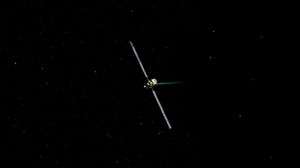
Artist's concept of Dawn spacecraft
Artist's concept of Dawn spacecraft. Image credit: NASA/JPL

NASA's Dawn spacecraft successfully completed the first test of its ion propulsion system over the weekend. The system is vital to the success of Dawn's 8-year, 1.6 billion-mile (3-billion-kilometer) journey to asteroid Vesta and dwarf planet Ceres.

"Dawn is our baby and over the weekend it took some of its first steps," said Dawn project manager Keyur Patel of NASA's Jet Propulsion Laboratory in Pasadena, Calif. "We have two months more checkout and characterization remaining before Dawn is considered mission operational, but this is a great start."

Members of the Dawn mission control team have been sending up commands and checking out spacecraft systems ever since its successful launch on Sept. 27. The first test firing of one of Dawn's three ion engines was the culmination of several days of careful preparation.

On Saturday, Oct. 6 at 6:07 p.m. Pacific Daylight Time (9:07 p.m. Eastern Daylight Time), the ion propulsion system began thrusting. Over the next 27 hours, spacecraft controllers and navigators at JPL monitored the engine's performance as it was put through its paces.

"We evaluated the engine's capabilities at five different throttle levels," said Jon Brophy, the Dawn project's ion propulsion manager at JPL. "From flight idle through full throttle, the engine performed flawlessly."

Dawn's ion engines are extremely frugal powerhouses. The 27 hours of thrusting from the ion engine resulted in the consumption of less than .28 kilograms (10 ounces) of the spacecraft's xenon fuel supply -- less than the contents of a can of soda. Dawn's fuel tank carries 425 kilograms (937 pounds) of xenon propellant. Over their lifetime, Dawn's three ion propulsion engines will fire cumulatively for about 50,000 hours (over five years) -- a record for spacecraft.

Dawn will begin its exploration of asteroid Vesta in 2011 and the dwarf planet Ceres in 2015. These two icons of the asteroid belt have been witness to so much of our solar system's history. By utilizing the same set of instruments at two separate destinations, scientists can more accurately formulate comparisons and contrasts.

Dawn's science instrument suite will measure shape, surface topography, tectonic history, elemental and mineral composition, and will seek out water-bearing minerals. In addition, the Dawn spacecraft itself and how it orbits both Vesta and Ceres will be used to measure the celestial bodies' masses and gravity fields.

Source: NASA

Explore further: US space chief updates on asteroid lasso mission (Update)

add to favorites email to friend print save as pdf

Related Stories

Comet Lemmon, Now in STEREO

Apr 25, 2013

An icy interloper was in the sights of a NASA spacecraft this past weekend. Comet 2012 F6 Lemmon passed through the field of view of NASA's HI2A camera as seen from its solar observing STEREO Ahead spacecraft. ...

Dawn is in silent pursuit of Ceres

Apr 03, 2013

In the depths of the main asteroid belt between Mars and Jupiter, far from Earth, far even from any human-made object, Dawn remains in silent pursuit of dwarf planet Ceres.

Vesta in Dawn's rear view mirror

Sep 11, 2012

(Phys.org)—NASA's Dawn mission is releasing two parting views of the giant asteroid Vesta, using images that were among the last taken by the spacecraft as it departed its companion for the last year.

Dawn craft to depart asteroid for dwarf planet

Sep 05, 2012

One asteroid down, one to go. After spending a year gazing at Vesta, NASA's Dawn spacecraft was set to cruise toward the most massive space rock in the asteroid belt between Mars and Jupiter—a voyage that ...

Dawn spacecraft prepares for trek toward dwarf planet

Aug 30, 2012

(Phys.org)—NASA's Dawn spacecraft is on track to become the first probe to orbit and study two distant solar system destinations, to help scientists answer questions about the formation of our solar system. ...

Dawn Engineers Assess Reaction Wheel

Aug 14, 2012

Engineers working on NASA's Dawn spacecraft are assessing the status of a reaction wheel -- part of a system that helps the spacecraft point precisely -- after onboard software powered it off on Aug. 8. ...

Recommended for you

Dark, massive asteroid to fly by Earth on May 31

2 hours ago

It's 1.7 miles long. Its surface is covered in a sticky black substance similar to the gunk at the bottom of a barbecue. If it impacted Earth it would probably result in global extinction. Good thing it is ...

Research team explains 'Lazarus' comets

6 hours ago

Astronomers from the University of Antioquia have discovered a graveyard of comets. These once-dormant comets, dubbed by astronomers as "The Lazarus comets," are now rejuvenated.

NASA ships sensors for seafaring satellite to France

6 hours ago

(Phys.org) —Three NASA-built instruments that are integral components of the next in a series of U.S./European ocean altimetry satellites have arrived in France for integration with their spacecraft in ...

Trip into space with DiCaprio costs $1.55m

7 hours ago

Leonardo DiCaprio is going to get closer to stars of a different kind as he heads into space aboard the Virgin Galactic, and a well-heeled bidder at the Cannes Film Festival has paid 1.2 million euros (1.5 million) to be ...

User comments : 1

Adjust slider to filter visible comments by rank

Display comments: newest first

vh51198
not rated yet Oct 11, 2007
This is a great article. However, please correct the unit conversion error in the picture caption - 1.6 billion km is not equivalent to 3 billion miles. The correct conversion in 994,193,907.6 miles.
Thanks, V

More news stories

Dark, massive asteroid to fly by Earth on May 31

It's 1.7 miles long. Its surface is covered in a sticky black substance similar to the gunk at the bottom of a barbecue. If it impacted Earth it would probably result in global extinction. Good thing it is ...

Source of life running out: water scientists

The majority of people on Earth people will face severe water shortages within a generation or two if pollution and waste continues unabated, scientists warned at a conference in Bonn Friday.

Facial-recognition technology proves its mettle

(Phys.org) —In a study that evaluated some of the latest in automatic facial recognition technology, researchers at Michigan State University were able to quickly identify one of the Boston Marathon bombing ...