September 19, 2007 feature
Artists 'draw on air' to create 3D illustrations
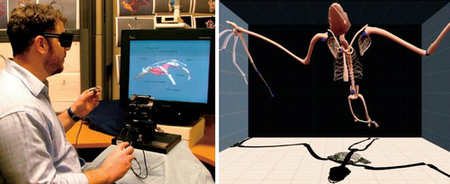
By putting on a virtual reality mask, holding a stylus in one hand and a tracking device in the other, an artist can draw 3D objects in the air with unprecedented precision. This new system is called “Drawing on Air,” and researchers have designed the interface to be intuitive and provide the necessary control for artists to illustrate complicated artistic, scientific, and medical subjects.
Computer scientists Daniel Keefe (who’s also an artist), Robert Zeleznik, and David Laidlaw from Brown University have presented Drawing on Air in a recent issue of IEEE Transactions on Visualization and Computer Graphics.
The technique introduces two new strategies, using one hand or two hands, to give artists the tools they need for drawing different types of curves, and for viewing and editing their work. While other drawing techniques that use virtual reality allow artists to draw rough sketches, the researchers hope that Drawing on Air will take the technology to a new level with its ability to achieve a higher degree of control.
“First, think about a curve found in some interesting 3D shape—the handlebar of a road bike is a good example because it follows a smooth 3D curve,” Keefe explained to PhysOrg.com. “Ok, now take your index finger and try to trace that curve out in the air in front of you. If you were able to leave a trail of paint behind your finger as it moves through the air, what you would notice from this exercise is that drawing a nice shape is really hard to do. First, you would probably notice that your drawing is quite wobbly. Second, you would probably find that the 3D proportion of the form is off.”
Keefe explained how Drawing on Air uses drawing guidelines, force feedback, and two-handed interaction to help artists draw this type of curve more precisely. The system then transfers the 3D drawing into the computer for use in 3D modeling, design, and illustration programs.
Drawing on Air’s two-handed method is based on the “tape drawing” technique, which is a highly controlled, two-handed method for drawing in 2D. Artists hold a stylus in one hand for drawing and a tracker (hooked up to the virtual reality setup) in the other hand for defining the direction of the line. The artist coordinates the movement of both hands to examine the work from different angles and draw accordingly.
While the two-handed method provides more control for experts, the researchers explain that a one-handed method is easier to learn, and is also more appropriate for drawing circular shapes because the artist’s arms don’t need to cross. In the one-hand method, the artist defines the direction of the line and draws the line with the same hand. The researchers describe the drawing operation as a pen being dragged behind the artist’s stylus as if on a tow rope. This drag enables the user to establish a drawing direction before actually drawing.
In both versions, artists can stylize their curves while drawing by dynamically adjusting line thickness and color. Haptic effects enable artists to intuitively adjust line thickness by applying pressure against an imaginary 3D surface, making drawing in the air feel similar to pushing a paintbrush against paper. Artists can easily switch back and forth between the two variations, and can also edit their work with the system’s features.
In a trial with 12 trained artists, results showed that Drawing on Air was easy to learn and provided sufficient control to illustrate complex 3D subjects with variety. For example, biologists studying bat flight find accurate 3D illustrations very valuable, since bats have a flexible wing membrane and curved bones that actually bend during flight. Artists in the trial successfully drew bats based on data from a bat flying in a wind tunnel, revealing the details of the animal’s anatomy in motion, and simplifying the uninteresting parts of the body.
“If we can boost the precision with which scientists can interact with their 3D data using a computer, then many more scientific uses for virtual reality technology may become possible,” Keefe said.
He said that another exciting part of this technology is that “once you have this ability to sketch in the air, there are so many different artistic directions you can go with it.”
“We're not too far from this sort of thing being available to consumers,” he added. “Right now, the cost is prohibitive, but with the advent of technologies like camera-based 3D tracking, I would expect the cost to create two-handed input systems like this to come down from thousands of dollars to hundreds of dollars in the next few years.”
Citation: Keefe, Daniel F., Zeleznik, Robert, and Laidlaw, David H. “Drawing on Air: Input Techniques for Controlled 3D Line Illustration.” IEEE Transactions on Visualization and Computer Graphics, vol. 13, no. 5, September/October 2007.
Copyright 2007 PhysOrg.com.
All rights reserved. This material may not be published, broadcast, rewritten or redistributed in whole or part without the express written permission of PhysOrg.com.


