Software enables 'thoroughly modern milling'
Sep 04, 2007
Software enables 'thoroughly modern milling'
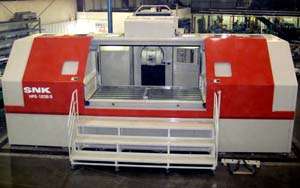
Software developed using a concept discovered at WUSTL may be used to optimize high-speed machining processes, leading to lighter, stronger, and more accurate parts for the aircraft or medical device industry. Credit: WUSTL

An engineer at Washington University in St. Louis has helped find a way to "cut the chatter" in high-speed machining of aluminum and titanium aircraft parts.

Chatter in milling is an instability that arises because the cutting tool vibrates, making oscillating patterns on the work piece. The tool goes over the patterns, making the tool vibrate even more, yielding deeper patterns in the work piece, worsening until eventually the chatter destroys the tool or work piece.

Now researchers including Philip V. Bayly, Ph.D., Washington University Hughes Professor of Mechanical Engineering, and Washington University alumnus Jerry Halley, of Tech Manufacturing, Wright City, Missouri, have developed software that predicts when chatter is going to occur as well as the accuracy of the cut. The software is based on a technique called time finite element analysis (TFEA).

Avoiding chatter allows much faster machining, makes the tool last longer, and increases the quality of the parts. Lighter, stronger, and more accurate parts lead to faster, more durable, and more affordable aircraft.

"This analytical technique helps get accurate machining processes and can play a major role in businesses creating higher quality parts that are less costly to make," said Bayly. "You can get a big pay off in stability and accuracy just by changing the speed at which the tools cut. That's one of the key things that TFEA finds out."

TFEA simulations are performed before the milling process, using a computer model of the machining system. The analysis predicts good and bad speeds for stability and accuracy of the cuts.

Bayly and several colleagues have applied for a patent on a concept that will take advantage of TFEA to design machining processes. The computations can be done so speedily that the hope is that the software will be used widely in advanced aerospace, automotive, and medical machine shops.

Source: Washington University in St. Louis

Explore further: Researchers use light projector and single-pixel detectors to create 3-D images

add to favorites email to friend print save as pdf

Related Stories

Social media tools can boost productivity

Aug 14, 2012

In this digital age, U.S. physicians still send and receive some 15 billion faxes a year. But not Dr. Howard Luks, chief of sports medicine and knee replacements at Westchester Medical Center in Valhalla, N.Y.

Google Dart debut sparks chatter of JavaScript coup

Oct 12, 2011

(PhysOrg.com) -- When the news appeared earlier this week that Google was unveiling a new programming language, Dart, for developers. tech blogs ignited with talk of how Google is staging a JavaScript coup. ...

Recommended for you

Student-built innovations to help improve and save lives

20 minutes ago

Nanyang Technological University (NTU) students have developed new and practical life-saving innovations inspired from everyday problems, including improving the safety of cyclists on the roads and keeping ...

GPS solution provides 3-minute tsunami alerts

May 17, 2013

Researchers have shown that, by using global positioning systems (GPS) to measure ground deformation caused by a large underwater earthquake, they can provide accurate warning of the resulting tsunami in ...

Innovative concrete to facilitate building rehabilitation

May 16, 2013

The Structural Technology Group of the Universitat Politècnica de Catalunya, BarcelonaTech (UPC), in collaboration with the company PROMSA, is participating in the rehabilitation of the Gaudí House Museum in Barcelona's P ...

User comments : 0

More news stories

German energy shift faces headwinds

Tense engineers have their eyes peeled on complex colour-coded diagrams on a wall-sized screen that makes their control room look like the inside of a spaceship.

Internet in 'coma' as Iran election looms

Iran is tightening control of the Internet ahead of next month's presidential election, mindful of violent street protests that social networkers inspired last time around over claims of fraud, users and ...

Engineers' nanoantennas improve infrared sensing

(Phys.org) —A team of University of Pennsylvania engineers has used a pattern of nanoantennas to develop a new way of turning infrared light into mechanical action, opening the door to more sensitive infrared ...

Mapping a route to stem cell therapies

Monash University researchers are shedding light on the complex processes that underpin the creation and differentiation of stem cells, bringing closer the promise of 'miracle' therapies.

Lymphatic fluid takes detour

When tumours metastasise, they can block lymphatic vessels, as researchers from ETH Zurich have discovered using a new method. The lymphatic fluid subsequently has to find a new path through the tissue. Such ...

Tiny ancient bandicoot shines light on future

(Phys.org) —A 20 million-year-old fossil skull identified as a 'pocket-sized' ancestor of the bandicoot will give insights into the future of Australia's modern endangered animals.