Innovative civil engineering application promises cleaner waters
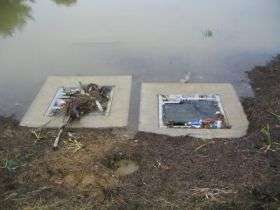
Streams, lakes, and bays may soon be cleaner thanks to an innovative approach to managing stormwater runoff being developed at Virginia Tech and funded by the U.S. Environmental Protection Agency.
A novel software application will help engineers and planners select the most efficient and site specific methods – called “Best Management Practices” (BMPs) – of controlling the amount of pollutants that enter the receiving waters through stormwater runoff.
Pollutants are washed off the roads, parking lots, or other surfaces by stormwater, and include toxic motor oil, pesticides, metals, bacteria, and trash. The Congressional Research Service reported in 2007 that up to 50 percent of water pollution problems in the United State are attributed to stormwater runoff.
The application is the product of collaboration between faculty and researchers from Virginia Tech’s Virginia Water Resources Research Center, the Center for Geospatial Information Technology in the College of Natural Resources, and the Via Department of Civil and Environmental Engineering in the College of Engineering.
The new BMPs selection approach, called Analytical Hierarchy Process (AHP), will factor in dozens of site-specific criteria such as soil types, land slopes, or maintenance accessibility before choosing the optimal BMPs for a particular location.
“This technique is expected to drastically reduce the BMP selection time and will also eliminate the human error from such a complex process,” says project coordinator Tamim Younos, water center associate director and research professor of water resources in the Department of Geography in the College of Natural Resources. Other project leaders include Randy Dymond, CGIT co-director, and David Kibler, professor of civil and environmental engineering.
Traditionally, the selection of BMPs has been done only by proficient stormwater experts guided by little more than vaguely written regulations, experience, and intuition. “They rely heavily on past knowledge, tradition, or even personal preference for particular methods of controlling stormwater runoff,” explains Kevin Young, research associate at CGIT.
Young adds that all too often personal bias has led to “cookie-cutter” solutions to very complex stormwater management needs, resulting in poor control of the pollutants.
A widely used, conventional BMP is to build detention ponds near commercial or residential areas, regardless of the actual construction site needs and conditions. “The stormwater is directed to a detention pond where gravity takes over, depositing sediment and some pollutants onto the bottom,” says Younos. “Pond overflow that still may contain dissolved pollutants reaches streams, rivers, and lakes, and possibly groundwater.”
Other types of BMPs are trenches and porous pavement that allow the stormwater to infiltrate the ground, vegetated wetlands, and sand filters that help sift the pollutants, or proprietary stormwater technologies such as hydrodynamic separators.
The new tool will be pilot-tested on Town of Blacksburg’s storm water system and the local Stroubles Creek watershed. The AHP software will be used by the research team to select BMPs within the watershed contributing runoff to Stroubles Creek, the town’s main receiving water body. Two existing computer models will then be used to simulate how efficient the selected BMPs are at removing the stormwater runoff pollutants.
“The best part about conducting a pilot test on Blacksburg is that the town will be able to implement our recommendations,” says Younos. “We are very pleased by the town’s enthusiasm and support for this project.” Other stakeholders include the New River Planning District Commission, Virginia Department of Environmental Quality, and Virginia Department of Conservation and Recreation.
Young discussed the principles of this novel approach to managing stormwater runoff in his Master’s thesis, under the guidance of the late professor G. V. Loganathan.
The software, expected to be available next year, will be free for use by all interested engineers and planners, localities, and BMP review authorities, and will be applicable in other states with geographic and climatic environments similar to Virginia.
Source: Virginia Tech


