Quantum light beams good for fast technology
Aug 24, 2007
Quantum light beams good for fast technology
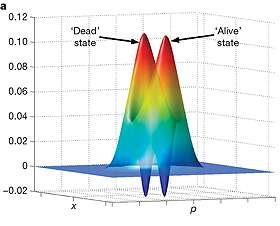
Dr Jeong's test results that prove quantum properties. Credit: UQ

Australian and French scientists have made another breakthrough in the technology that will drive next generation computers and teleportation. The researchers have successfully superposed light beams, which produces a state that appears to be both on and off at once.

Light beams that are simultaneously on and off are vital for the next-generation super computers which should be faster than current computers based on bits, that are either on or off.

Previously, only smaller light particles had been superposed and the group has also proved a quantum physics theory known as Schrödinger's cat.

This theory, named after an Austrian physicist Erwin Schrödinger, proposed that a large object such as a cat could be simultaneously alive and dead.

Researchers from The University of Queensland and University of Paris South have published the latest breakthrough in the international journal Nature.

UQ Centre for Quantum Computer Technology researcher Dr Hyunseok Jeong devised the scheme to generate and superpose the beams which was tested and proved by his French collaborators.

Dr Jeong said his group used special lasers, crystals, photon detectors, half-mirrors and other optical devices to generate and measure the superposition of light beams.

“It has been known to be extremely hard to generate Schrödinger cat states, particularly with traveling light,” Dr Jeong said.

“Even though one could generate such Schrodinger cat states, it would be extremely hard to observe them because in a very short time, they would be reduced to either alive or dead states.”

He said his group's research findings would help speed up the development of quantum information technologies such as quantum computers, quantum cryptography and quantum teleportation.

“Using Schrödinger cat states, quantum teleportation may be performed with nearly 100 percent success probability.”

Link: www.nature.com/nature/journal/v448/n7155/full/nature06054.html

Source: University of Queensland

Explore further: New X-ray method shows how frog embryos could help thwart disease

add to favorites email to friend print save as pdf

Related Stories

Space tourist is just one way to describe Simonyi

Apr 03, 2012

(AP) -- Charles Simonyi may still be described as a space tourist even though the Microsoft billionaire has no plans to take a third vacation on the International Space Station and hasn't hung out in outer ...

The James Webb Telescope will see Earth-like worlds

Oct 25, 2011

The James Web Space Telescope has been in the news a lot lately.  Often referred to as the replacement for the Hubble Space Telescope, its existence has been in jeopardy since a House committee voted ...

Mechanical micro-drum cooled to quantum ground state

Jul 06, 2011

Showcasing new tools for widespread development of quantum circuits made of mechanical parts, scientists from the National Institute of Standards and Technology have demonstrated a flexible, broadly usable ...

Physicists seek to quantify macroscopic quantum states

Jun 29, 2011

(PhysOrg.com) -- "Scientists have been interested in generating and observing macroscopic quantum superpositions in order to test quantum mechanics at the macroscopic scale," physicist Hyunseok Jeong of Seoul National University ...

Recommended for you

Bringing life into focus

May 17, 2013

Spinning-disk confocal microscopy is an optical imaging technique that can be used to generate detailed three-dimensional fluorescence images of living cells and their contents. Although a powerful tool for ...

World's smallest droplet

May 17, 2013

(Phys.org) —Physicists may have created the smallest drops of liquid ever made in the lab. That possibility has been raised by the results of a recent experiment conducted by Vanderbilt physicist Julia Velkovska and her ...

User comments : 0

More news stories

New principle may help explain why nature is quantum

Like small children, scientists are always asking the question 'why?'. One question they've yet to answer is why nature picked quantum physics, in all its weird glory, as a sensible way to behave. Researchers ...

Heat-related deaths in Manhattan projected to rise

Residents of Manhattan will not just sweat harder from rising temperatures in the future, says a new study; many may die. Researchers say deaths linked to warming climate may rise some 20 percent by the 2020s, ...

Honeybees trained in Croatia to find land mines

(AP)—Mirjana Filipovic is still haunted by the land mine blast that killed her boyfriend and blew off her left leg while on a fishing trip nearly a decade ago. It happened in a field that was supposedly ...

Mice, gerbils perish in Russia space flight

A number of mice and eight gerbils sent into space in a Russian capsule destined to find out how well organisms can withstand extended flights perished during their journey, scientists said Sunday as the ...