Understanding MEMS: DARPA Award to Create Computer-Aided Design Environment for Micro-Electromechanical Systems Devices
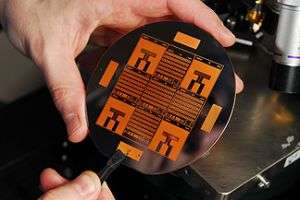
Researchers at the Georgia Institute of Technology have received a Defense Advanced Research Projects Agency (DARPA) award to participate in a multi-university research center that will develop a computer-aided design (CAD) environment for micro-electromechanical systems (MEMS) and nano-electromechanical systems (NEMS).
The new research center – to be called the Investigate Multi-physics Modeling and Performance Assessment-driven Characterization and Computation Technology (IMPACT) Center for Advancement of MEMS/NEMS VLSI – will be led by the University of Illinois at Urbana-Champaign and will include teams from Purdue University and Lehigh University as well as Georgia Tech. A consortium of companies – including BAE Systems, Inc., Innovative Design & Technology, MEMtronics Corp., Raytheon Co., Rockwell Collins Inc. and the Rogers Corp. – will also participate financially with DARPA in the center.
Georgia Tech’s share of the research will be conducted by a team associated with the Georgia Tech School of Electrical and Computer Engineering (ECE).
The research will seek to develop CAD systems that are based on physical models and therefore can conclusively predict the behavior of MEMS devices. Eventually engineers developing systems with MEMS devices could use a simple drag-and-drop interface to simulate not only the electrical effects of MEMS usage, but also thermal, mechanical and reliability aspects as well.
“This kind of predictive capability could greatly increase the speed with which MEMS-enabled microsystems can be developed,” said John Papapolymerou, an associate professor in ECE.
Initially, Papapolymerou said, Georgia Tech will receive about $1.25 million for a six-year effort. However, as more companies join the center, that amount is likely to increase, he added.
In the first year Georgia Tech’s efforts will focus on the fundamental physics of MEMS devices – particularly with respect to dielectric charging of MEMS switches, Papapolymerou said.
Although MEMS-enabled microsystems have the potential to revolutionize communications, sensors and signal-processing, he said, their capabilities have been limited by a lack of understanding of how physical phenomena govern MEMS-device functionality. It’s particularly unclear how much performance is degraded when MEMS devices are exposed to the operating conditions of a integrated circuit.
“When we have a better understanding of the fundamental physics of MEMS devices, we can then proceed to the higher-order models and levels that are required to develop a CAD program,” Papapolymerou said.
The ultimate goal of the IMPACT center, he said, will be to promote the availability of MEMS/NEMS-based micro- and nanosystems in military and commercial applications.
“This is meant to be a dynamic center,” Papapolymerou said. “The idea is going to be to expand this in the future, so we can also expand the number of research problems that we undertake.”
Source: Georgia Institute of Technology


