Bird sized airplane to fly like a swift
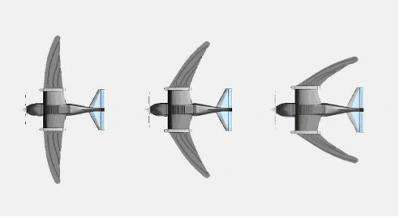
Nine Dutch Aerospace Engineering students at the Delft University of Technology, together with the Department of Experimental Zoology of Wageningen University, designed the RoboSwift.
RoboSwift is a micro airplane fitted with shape shifting wings, inspired by the common swift, one of nature’s most efficient flyers. The micro airplane will have unprecedented wing characteristics; the wing geometry as well as the wing surface area can be adjusted continuously. This makes RoboSwift more maneuverable and efficient. Resembling the common swift, RoboSwift will be able to go undetected while using its three micro cameras to perform surveillance on vehicles and people on the ground. Furthermore, it can be employed to observe swifts in flight, thus enabling new biological research.
The RoboSwift team presented the design on the yearly Design Synthesis symposium at TU Delft. The team will build the high-tech micro airplane in the following months; it is expected to fly in January 2008. The student team will build three RoboSwifts to participate in March 2008 in the First American-Asian Micro Air Vehicle competition in India.
RoboSwift will have a span of 50 cm span and 80 grams weight. It can follow a group of swifts up to 20 minutes and perform ground surveillance up to one hour thanks to its lithium-polymer batteries that power the electromotor, which drives a propeller. The propeller folds back during gliding to minimize air drag.
The unique morphing-wing design features are taken from the swift. Morphing means the wings can be swept back in flight by folding feathers over each other, thus changing the wing shape and reducing the wing surface area. RoboSwift also steers by morphing its wings. Doing so, the micro airplane can perform optimally, flying efficiently and highly maneuverable at very high and very low speeds, just like the swift.
The students found out that using only four feathers, much less than the bird uses, already provides the wing with sufficient morphing capacity; this feature makes actual production of the design feasible. Steering RoboSwift is done by asymmetrically morphing the wings. Sweeping one wing back further than the other creates a difference in lift on the wings that is used to roll and turn the micro plane in the air.
The team based the project on research performed by its tutor ir. David Lentink, who published a study into the swift’s flight characteristics in this year’s April issue of Nature.
During its life, a common swift flies a distance that goes up to five times the distance to the Moon and back. Lentink c.s. found the swift is such an able flyer because it continuously adjusts (‘morphs’) its wings to the prevailing flight conditions to fly more efficient and more maneuverable. Airplanes can do a lot, but so far they do not fly nearly as well as birds in terms of performance and efficiency. In a ‘standard’ civil aircraft, the wings are held a fixed position with respect to the fuselage during the full length of the flight. This is inefficient because flight conditions change in different flight phases. With their variable wings, birds can easily deal with the different conditions encountered during flight, thus increasing their flight efficiency and agility up to a factor three.
Although a few military aircraft, such as the F14 Tomcat and the English-German Tornado, are equipped with so-called swing wings, none of these aircraft significantly reduces the surface area of the wing, thus missing out on the benefits made possible by morphing. Also, these aircraft do not steer by means of the variable wing shape.
Source: Delft University of Technology


