Cosmonauts Outside Station for Second Spacewalk
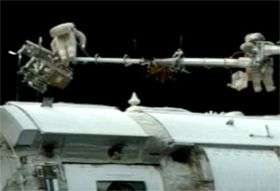
During the May 30 spacewalk, Flight Engineer Oleg Kotov (left) rides on the end of the Strela crane with a bundle of debris panels as Commander Fyodor Yurchikhin operates the controls. Image credit: NASA TV
Two International Space Station cosmonauts began a spacewalk of a little over five hours from the Pirs docking compartment airlock at 10:23 a.m. EDT Wednesday. They will install a section of Ethernet cable on the Zarya module, install additional Service Module Debris Protection (SMDP) panels on Zvezda, and deploy a Russian scientific experiment.
Five SMDP panels were installed by station Commander Fyodor Yurchikhin and Flight Engineer Oleg Kotov on May 30. During that 5-hour, 25-minute spacewalk they also rerouted a Global Positioning System antenna cable. On today's spacewalk they will install 12 additional panels. They also will install the Ethernet cable on the Zarya module and a Russian experiment called Biorisk on Pirs.
Yurchikhin again is the lead spacewalker, EV1, wearinig the Russian Orlan spacesuit with red stripes. Kotov, EV2, wears the suit with blue stripes. This is the second spacewalk for both.
Out of the airlock, the first task is to install the Russian scientific experiment, called Biorisk. It looks at the effects of microorganisms on structural materials used in space. They will attach it to the outside of Pirs.
After the cable installation, they will move aft to the forward end of the Zvezda Service Module. There they will remove one of two SMDP bundles remaining on the "Christmas Tree," an adaptor that initially had three bundles attached. It was stowed at the Unity Node on Pressurized Mating Adaptor No. 3 (PMA-3). Yurchikhin maneuvered Kotov, on the end of the Strela manually operated crane, to the Christmas Tree during the May 30 spacewalk.
Kotov retrieved it and stowed it on Zvezda, where they installed five SMDP panels. The aluminum panels vary in size but are about an inch thick. They typically measure about 2 by 3 feet and weigh 15 to 20 pounds. Initially, the spacewalkers will tether them to handrails.
Yurchikhin and Kotov will open the first bundle and install its panels on Zvezda's conical section, the area between Zvezda's large and small diameters, to join the five they installed May 30. Another six panels had been bolted into place there in 2002.
Once that is done, they'll open the remaining bag and install its six panels.
Six SMDP panels were installed during an Aug. 16, 2002, spacewalk by Expedition 5 Commander Valery Korzun and Flight Engineer Peggy Whitson. Those panels were delivered to the station by Endeavour during STS-111 in June 2002. The remaining three bundles and their adaptor were delivered by Discovery during STS-116 last December and attached to PMA-3 by spacewalkers Bob Curbeam and Sunita Williams.
With the installation of the SMDP panels completed, Yurchikhin and Kotov will move back to Pirs and return to the airlock. Hatch closure marking the end of the spacewalk is scheduled for a little after 3:40 p.m.
Flight Engineer Suni Williams will serve as intravehicular officer for the second spacewalk, as she did for the first.
Source: NASA
-
From lemons to lemonade: Reaction uses carbon dioxide to make carbon-based semiconductor,
33 comments
-
Thioridazine kills cancer stem cells in human while avoiding toxic side-effects of conventional cancer treatments,
3 comments
-
SpaceX private rocket blasts off for space station (Update),
42 comments
-
Landmark calculation clears the way to answering how matter is formed,
55 comments
-
Research team claims to have found evidence Lake Cheko is impact crater for Tunguska Event,
18 comments
-
Distance of planets from stars and revolution
13 hours ago
-
revamping general concept and cosmological principle
May 25, 2012
-
Transiting Exoplanet Light Curve
May 25, 2012
-
Math behind Theoretical Physics
May 24, 2012
-
Do we know whats at the center of galaxies yet?
May 23, 2012
-
Structure of the Milky Way?
May 20, 2012
- More from Physics Forums - General Astronomy
More news stories
Yale study concludes public apathy over climate change unrelated to science literacy
Are members of the public divided about climate change because they don't understand the science behind it? If Americans knew more basic science and were more proficient in technical reasoning, would public consensus match ...
13 hours ago |
4.8 / 5 (6) |
30
|
Land and sea species differ in climate change response: study
(Phys.org) -- Marine and terrestrial species will likely differ in their responses to climate warming, new research by Simon Fraser University and Australia’s University of Tasmania has found.
11 hours ago |
4 / 5 (5) |
9
|
10 million years needed to recover from mass extinction
It took some 10 million years for Earth to recover from the greatest mass extinction of all time, latest research has revealed.
Space & Earth / Earth Sciences
13 hours ago |
4.2 / 5 (5) |
5
|
Sophisticated simulations predict future warming
The chances of our planet being hit by a global warming of 3 degrees Celsius by 2050 is as likely as it being hit by an increase of 1.4 degrees, new research shows. Presented in the journal Nature Geoscience, the British study ...
Space & Earth / Earth Sciences
May 22, 2012 |
3.8 / 5 (11) |
51
Kyoto Protocol architect 'frustrated' by climate dialogue
UN climate talks are going nowhere, as politicians dither or bicker while the pace of warming dangerously speeds up, one of the architects of the Kyoto Protocol told AFP.
May 23, 2012 |
3.4 / 5 (8) |
44
Stunning image of smallest possible five-ringed structure
Scientists have created and imaged the smallest possible five-ringed structure about 100,000 times thinner than a human hair and you'll probably recognise its shape.
'Unzipped' carbon nanotubes could help energize fuel cells, batteries
Multi-walled carbon nanotubes riddled with defects and impurities on the outside could replace some of the expensive platinum catalysts used in fuel cells and metal-air batteries, according to scientists at ...
Change in developmental timing was crucial in the evolutionary shift from dinosaurs to birds: study
At first glance, it's hard to see how a common house sparrow and a Tyrannosaurus Rex might have anything in common. After all, one is a bird that weighs less than an ounce, and the other is a dinosaur that ...
Computer model used to pinpoint prime materials for efficient carbon capture
When power plants begin capturing their carbon emissions to reduce greenhouse gases and to most in the electric power industry, it's a question of when, not if it will be an expensive undertaking.
T cells 'hunt' parasites like animal predators seek prey, study shows
By pairing an intimate knowledge of immune-system function with a deep understanding of statistical physics, a cross-disciplinary team at the University of Pennsylvania has arrived at a surprising finding: T cells use a movement ...
Browser wars flare in mobile space
The browser wars are heating up again, but this time the fight is for dominance of the mobile Internet.