Scientists have developed a tiny, portable personal blood testing laboratory that sends data through mobile phone
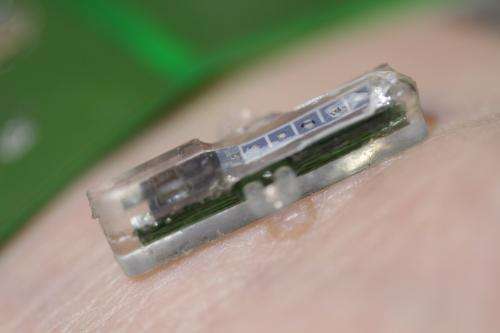
Humans are veritable chemical factories—we manufacture thousands of substances and transport them, via our blood, throughout our bodies. Some of these substances can be used as indicators of our health status. A team of EPFL scientists has developed a tiny device that can analyze the concentration of these substances in the blood. Implanted just beneath the skin, it can detect up to five proteins and organic acids simultaneously, and then transmit the results directly to a doctor's computer. This method will allow a much more personalized level of care than traditional blood tests can provide. Health care providers will be better able to monitor patients, particularly those with chronic illness or those undergoing chemotherapy. The prototype, still in the experimental stages, has demonstrated that it can reliably detect several commonly traced substances.
The research results will be published and presented March 20, 2013 in Europe's largest electronics conference, DATE 13.
Three cubic millimeters of technology
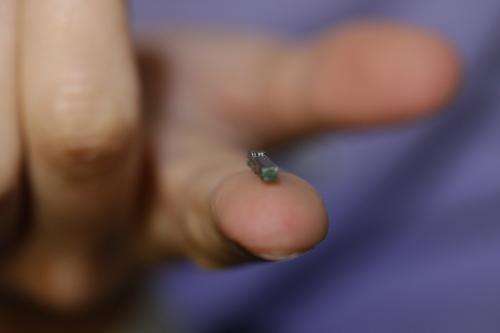
The device was developed by a team led by EPFL scientists Giovanni de Micheli and Sandro Carrara. The implant, a real gem of concentrated technology, is only a few cubic millimeters in volume but includes five sensors, a radio transmitter and a power delivery system. Outside the body, a battery patch provides 1/10 watt of power, through the patient's skin – thus there's no need to operate every time the battery needs changing.
Information is routed through a series of stages, from the patient's body to the doctor's computer screen. The implant emits radio waves over a safe frequency. The patch collects the data and transmits them via Bluetooth to a mobile phone, which then sends them to the doctor over the cellular network.
A system that can detect numerous substances
Great care was taken in developing the sensors. To capture the targeted substance in the body – such as lactate, glucose, or ATP – each sensor's surface is covered with an enzyme. "Potentially, we could detect just about anything," explains De Micheli. "But the enzymes have a limited lifespan, and we have to design them to last as long as possible." The enzymes currently being tested are good for about a month and a half; that's already long enough for many applications. "In addition, it's very easy to remove and replace the implant, since it's so small."
The electronics were a considerable challenge as well. "It was not easy to get a system like this to work on just a tenth of a watt," de Micheli explains. The researchers also struggled to design the minuscule electrical coil that receives the power from the patch.
Towards personalized chemotherapy
The implant could be particularly useful in chemotherapy applications. Currently, oncologists use occasional blood tests to evaluate their patients' tolerance to a particular treatment dosage. In these conditions, it is very difficult to administer the optimal dose. De Micheli is convinced his system will be an important step towards better, more personalized medicine. "It will allow direct and continuous monitoring based on a patient's individual tolerance, and not on age and weight charts or weekly blood tests."
In patients with chronic illness, the implants could send alerts even before symptoms emerge, and anticipate the need for medication. "In a general sense, our system has enormous potential in cases where the evolution of a pathology needs to be monitored or the tolerance to a treatment tested."
The prototype has already been tested in the laboratory for five different substances, and proved as reliable as traditional analysis methods. The project brought together eletronics experts, computer scientists, doctors and biologists from EPFL, the Istituto di Ricerca di Bellinzona, EMPA and ETHZ. It is part of the Swiss Nano-Tera program, whose goal is to encourage interdisciplinary research in the environmental and medical fields. Researchers hope the system will be commercially available within 4 years.
Provided by Ecole Polytechnique Federale de Lausanne


