The Wikipedia paradox: Who's telling the truth?
Feb 28, 2013

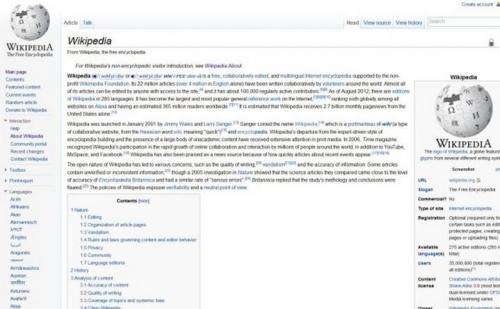
People are less likely to trust a poorly written article if the visual cues suggest it comes from Wikipedia. Presented with the same information in an alternative layout, their trust will be greater. The presence of serious factual errors has little or no effect on the trust placed in a Wikipedia article, even among experts on the subject in question. People who take a negative view of Wikipedia are less good at estimating whether an individual article is trustworthy or not. These are among the findings of the doctoral research carried out by Teun Lucassen at the University of Twente's CTIT research institute. Lucassen investigated how internet users assess the reliability of online information. He will defend his doctoral dissertation on 1 March.

Before the advent of the internet, the situation was clearer: information that appeared in print was likely to be correct because it had been checked by an editor or a journalist. But in the age of the , anyone can easily publish all kinds of information online, leaving the user with the challenge of determining how reliable it is.

In his doctoral research, Teun Lucassen investigated how users go about assessing the reliability of the information they find online. In doing so, he focused primarily on the widely consulted online encyclopaedia . Lucassen believes it is a particularly good place to start because of what he calls the 'Wikipedia Paradox': everyone knows that the information on Wikipedia is generally of high quality, but because of its open structure, you can never be entirely sure of the reliability of individual articles.

New model

In several smaller-scale studies, in which he manipulated Wikipedia articles, Lucassen looked at how users assess reliability. His PhD research resulted in a new scientific paradigm: the 3S model of trust in information. On the basis of personal user characteristics – domain expertise, information skills and with the source – the model describes how users assess the reliability of individual articles.

The three S's of the model stand for semantic features (the content), surface features (how information is presented, i.e. images and references) and source features (characteristics of the source, in this study usually Wikipedia). The study shows that everyone, depending on their personal profile, uses these aspects to assess the reliability of information. However, the extent to which they use each aspect depends very much on the three personal characteristics. For example, a user with less expertise on a given topic will place greater emphasis on how the information is presented and its source.

Teun Lucassen conducted his PhD research at the CTIT research institute and the Department of Cognitive Psychology and Ergonomics at the University of Twente.

Explore further: People with positive Wikipedia attitude better at assessing credibility

add to favorites email to friend print save as pdf

Related Stories

Study finds major U.S. newspapers are warming up to Wikipedia

Apr 12, 2011

(PhysOrg.com) -- Major newspapers in the United States are referencing Wikipedia more often and framing the online encyclopedia more positively in stories, according to a study by a pair of faculty researchers in the Virginia ...

Wikipedia hits defining moment in social Web era

Jul 14, 2012

Wikipedia, the public knowledge website, is more than a decade old and remains among the top 10 Internet sites in the world, but some say it is becoming old and dowdy. Others want to keep it that way.

Recommended for you

Google asks US secret court to lift gag order

4 hours ago

Google is asking the secretive Foreign Intelligence Surveillance Court to lift its long-standing gag order on how often the company is asked to turn over data about its customers to the U.S. government.

Mysterious Facebook event sparks online buzz

Jun 17, 2013

A mysterious Facebook event set for Thursday has sparked buzz that the leading social network could be adding video to Instagram smartphone picture-sharing service.

Report of British hacking raises hackles abroad

Jun 17, 2013

A newspaper report that British eavesdropping agency GCHQ repeatedly hacked into foreign diplomats' phones and emails has prompted an angry response from traditional rival Russia and provoked demands for ...

Explainer: What is a virtual private network (VPN)?

Jun 17, 2013

Have you ever wanted to exist in more than one place at the same time? The laws of physics suggest wormholes through space and time are hypothetical; but wormholes do exist in cyberspace and wonders can be ...

Report: UK spies hacked foreign diplomats

Jun 17, 2013

The Guardian newspaper says the British eavesdropping agency GCHQ repeatedly hacked into foreign diplomats' phones and emails when the U.K. hosted international conferences, even going so far as to set up ...

User comments : 8

Adjust slider to filter visible comments by rank

Display comments: newest first

JRi
1 / 5 (1) Feb 28, 2013
One can always check out the history of any wiki-article. If any modification has been done recently, I trust it less.
antialias_physorg
3.7 / 5 (3) Feb 28, 2013
The presence of serious factual errors has little or no effect on the trust placed in a Wikipedia article

Which seems intuitive. After all: you go to the article to get some information on the subject you know (too) little about.
So why would anyone expect that such a person could even spot factual errors?

everyone knows that the information on Wikipedia is generally of high quality, but because of its open structure, you can never be entirely sure of the reliability of individual articles.

To be fair: the same thing goes for print media. I do remember someone checking Encyclopedia Britannica (when there was still a print edition) vs. Wikipedia - and the number of severe/factual errors per article was roughly the same.
Doug_Huffman
1.7 / 5 (6) Feb 28, 2013
Believe nothing that one reads or hears without verifying it yourself unless it is Weltanschauung congruent.

The root problem is of [i]doxastic commitment[/i] (after Taleb) or skin-in-the-game. That is to say, lies and errors bear no personal cost to the anonymous author but arguably significant cost to society. That cost is seen in demotic ignorance, credentialism and authoritarianism.

For example, managers of finance continue to reap bonuses despite damage to individual investors. CEO's have no skin in the game.

Another; weather forecasters are not dismissed because of incompetent forecasts. Trust the farmer's forecast, bad ones will cost him.
natello
1.8 / 5 (5) Feb 28, 2013
Currently the Wikipedia is rather conservative source of information, which is essentially correct because of its name. But we apparently need a similarly structured database of all insights and ideas, unverified or forgotten experiments and thoughts, which would not only help the people in learning of well established facts, but it even helped them and motivate them in following of new perspective ideas. Such a database would indeed require a quite different contribution and moderation policy.
geokstr
1.7 / 5 (6) Feb 28, 2013
Currently the Wikipedia is rather conservative source of information, which is essentially correct because of its name.

You're joking, right?

Several years ago, one William Connolloy, with connections to East Anglia, was the sole editor there in charge of everything remotely connected to AGW. He personnally edited over 5,000 pages, deleted many others if they disagreed with his beliefs on the subject, and banned dozens of contributors if they weren't 100% on board with Global Climate Distruption (or whatever they're calling it this week.) The firestorm when this was discovered resulted in his being banned from Wiki.

During the run-up to the 2008 election, every page related to Obama and his very questionable associations was scrubbed of anything negative, and this editing is ongoing. Pages concerning conservatives are routinely filled with slime by leftists.

Conservative wiki, my derriere.
ValeriaT
3 / 5 (4) Feb 28, 2013
Conservative means consistent with mainstream opinion here - not traditional or liberal in political sense.
Q-Star
2.8 / 5 (4) Feb 28, 2013
But we apparently need a similarly structured database of all insights and ideas, unverified or forgotten experiments and thoughts, which would not only help the people in learning of well established facts, but it even helped them and motivate them in following of new perspective ideas.


We have that Zeph, it's called the Internet. Ya can access all the crank, crackpot, and pseudoscience ya could possibly read in one lifetime.

By the By: It comes with a very efficient search feature,,, I think it goes by the name "Google", but I could be mistaken, it might be called "Yahoo".

But don't take my word for it,,,, just type "Aether" into it and see the unlimited amount of source material for your ducks and waves ya'll find.

Such a database would indeed require a quite different contribution and moderation policy.


The Internet thingy I just told ya about? Well it does have a different contribution and moderation policy. We found ya, right?
natello
1 / 5 (1) Mar 01, 2013
We have that Zeph, it's called the Internet
I can say the very same about Wikipedia - why to maintain some centralized encyklopedia, when Google returns all informations quickly? Internet is indeed important, but we are facing the increasing ignorance of important finding from the side of mainstream science. The first magnetic motor was patented in 1828, the first cold fusion in 1926. Why these findings are ignored so long? One of reason is, the information about them is not easily accessible. And personally, I do consider cold fusion or magnetic motors more important for the future of human civilization than most of findings of basic research of mainstream science during last fifty years.

More news stories

Mozilla lab wants scientists to step out of analog age

(Phys.org) —Talk about big ideas. Not satisfied to rest on laurels of having brought forth the open source browser Firefox, Mozilla—defined by some as a global project, by others as one of the key open-source ...

3D printing tiny batteries

(Phys.org) —3D printing can now be used to print lithium-ion microbatteries the size of a grain of sand. The printed microbatteries could supply electricity to tiny devices in fields from medicine to communications, ...