Shark found to have bioluminescence on both dorsal spine and belly
Feb 22, 2013 by Bob Yirka report
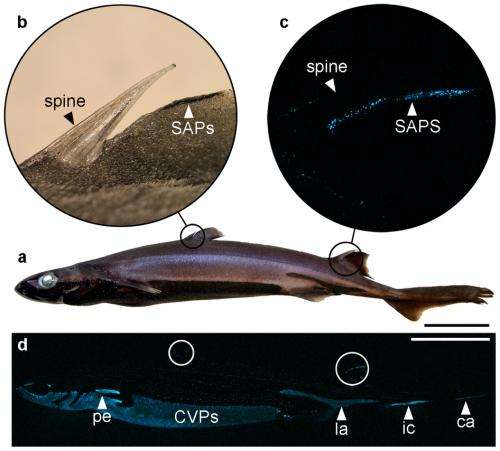
Spine-associated bioluminescent display. Credit: Scientific Reports, doi:10.1038/srep01308

(Phys.org)—A team of researchers studying velvet belly lantern sharks has discovered that the species has bioluminescent cells on both its belly and near its dorsal spines. The team describes their surprising findings in their paper published in the journal Nature.

Velvet belly lantern sharks live in the and the Atlantic Ocean, and are relatively small, growing to an average length of just two feet. Because of that, they are preyed upon by bigger fish. They typically swim at depths of more than 560 feet and sport bioluminescent cells on their bellies to prevent being seen by prey that swim beneath them (the light stops their shadows from appearing). What's surprising about them though, is that they also have the same light emitting cells just beneath spiny transparent on their backs. The researchers believe their purpose is to ward off predators by illuminating the thorny —which would make it a first such use of for any type of fish.

Velvet belly lantern sharks haven't been studied nearly as well as larger sharks, and because of that, little is known about them. To find out more, the researchers caught several of them off the coast of Norway and brought them back to their lab for testing. As part of that analysis they discovered the dual bioluminescence, which is a novelty itself. Intrigued, they looked a little deeper and tested the response of other fish (using computer models) to the illuminated spines and found that were able to see them from several meters away. Interestingly, they also found that the kinds of fish the shark preys on were only able to see the spines once they were just one or two meters away, which would, of course, be too late to avoid being eaten.

The researchers note that other species of shark have dorsal spines to ward off predators, but this is the first instance of them being illuminated to make sure predators can see them clearly. They add that it seems likely that the sharks also use the spines to communicate with one another or even to help with identification.

Explore further: New study shows small cookiecutter shark feeds on flesh of great white

More information: A deepwater fish with 'lightsabers' – dorsal spine-associated luminescence in a counterilluminating lanternshark, Scientific Reports 3, Article number: 1308 doi:10.1038/srep01308

Abstract
We report the discovery of light organs (photophores) adjacent to the dorsal defensive spines of a small deep-sea lanternshark (Etmopterus spinax). Using a visual modeling based on in vivo luminescence recordings we show that this unusual light display would be detectable by the shark's potential predators from several meters away. We also demonstrate that the luminescence from the spine-associated photophores (SAPs) can be seen through the mineralized spines, which are partially translucent. These results suggest that the SAPs function, either by mimicking the spines' shape or by shining through them, as a unique visual deterrent for predators. This conspicuous dorsal warning display is a surprising complement to the ventral luminous camouflage (counterillumination) of the shark.

Related Stories

Smalleye pigmy sharks' bellies shine

Apr 26, 2012

Smalleye pigmy sharks have an eye-catching party trick: Their bellies glow. However, instead of being a giveaway, Julien Claes and Jérôme Mallefet from Université catholique de Louvain, Belgium, have shown ...

White shark diets vary with age and among individuals

Sep 28, 2012

White sharks, the largest predatory sharks in the ocean, are thought of as apex predators that feed primarily on seals and sea lions. But a new study by researchers at the University of California, Santa ...

Recommended for you

Lovelorn frogs bag closest crooner

1 hour ago

What lures a lady frog to her lover? Good looks, the sound of his voice, the size of his pad or none of the above? After weighing up their options, female strawberry poison frogs (Oophaga pumilio) bag th ...

Honeybees trained in Croatia to find land mines

18 hours ago

(AP)—Mirjana Filipovic is still haunted by the land mine blast that killed her boyfriend and blew off her left leg while on a fishing trip nearly a decade ago. It happened in a field that was supposedly ...

Front-row seats to climate change

May 17, 2013

By day, insects provide the white noise of the South, but the night belongs to the amphibians. In a typical year, the Southern air hangs heavy from the humidity and the sounds of wildlife.

User comments : 1

Adjust slider to filter visible comments by rank

Display comments: newest first

C_elegans
5 / 5 (2) Feb 22, 2013
Fluorescent bacteria do all these great things that we can see.

It really makes you wonder what else that huge source of modifiable biomass in us is doing, or could do. Bacteria can create neurotransmitters, hormones and vitamins. Some desired effects might include bioengineered protection from poisons, toxins, digestion of new materials, bioactive compounds that battle infections. How are the fluorescent bacteria supported and maintained by the shark?

More news stories

Lovelorn frogs bag closest crooner

What lures a lady frog to her lover? Good looks, the sound of his voice, the size of his pad or none of the above? After weighing up their options, female strawberry poison frogs (Oophaga pumilio) bag th ...

Engineered microbes grow in the dark

Scientists at the University of California, Davis have engineered a strain of photosynthetic cyanobacteria to grow without the need for light. They report their findings today at the 113th General Meeting of the American ...

Why we need to put the fish back into fisheries

Overfishing has reduced fish populations and biodiversity across much of the world's oceans. In response, fisheries are increasingly reliant on a handful of highly valuable shellfish. However, new research by the University ...

Honeybees trained in Croatia to find land mines

(AP)—Mirjana Filipovic is still haunted by the land mine blast that killed her boyfriend and blew off her left leg while on a fishing trip nearly a decade ago. It happened in a field that was supposedly ...

Blame your parents for bunion woes

A novel study reports that white men and women of European descent inherit common foot disorders, such as bunions (hallux valgus) and lesser toe deformities, including hammer or claw toe. Findings from the Framingham Foot ...