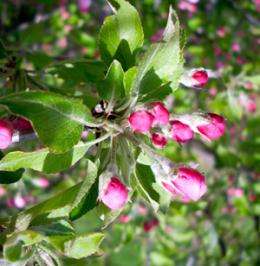
Previously unknown world of life found on common apple blossom
Feb 27, 2013 by Bill Hathaway
Credit: Ashley Shade, courtesy of Yale University

A succession of distinct but surprising microbial communities populate apple blossoms during the flowers' life cycle, suggesting that the bacteria have a carefully regulated relationship with the common fruit tree, say Yale scientists.

University researchers have pinpointed for the first time the identity of some of these microbes, including a form of bacteria previously known to exist in the human mouth and ocean.

"The dogma had been that the bacterial populations on these plants were the product of random environmental events, but when we took a closer we found that just isn't true; we see an orderly transition of specific groups of microorganisms, " said Jo Handelsman, professor of molecular, cellular and and senior author of the study.

The next step is to explore whether these populations interact with the to drive their development. "The microbiome in humans drives our health more than we ever anticipated," she said.

Explore further: Desert farming forms bacterial communities that promote drought resistance

More information: mbio.asm.org/content/4/2/e00602-12

add to favorites email to friend print save as pdf

Related Stories

You are not what you eat

Nov 16, 2010

The types of gut bacteria that populate the guts of primates depend on the species of the host as well as where the host lives and what they eat. A study led by Howard Ochman at Yale University examines the gut microbial ...

Recommended for you

A feline fungus joins the new species list

19 hours ago

(Phys.org) —A new species of fungus that causes life-threatening infections in humans and cats has been discovered by a University of Sydney researcher.

New way to improve antibiotic production

Jun 17, 2013

An antibiotic has been found to stimulate its own production. The findings, to be published in PNAS, could make it easier to scale up antibiotic production for commercialisation.

User comments : 0

More news stories

Origins of 'The Hoff' crab revealed (w/ Video)

The history of a new type of crab, nicknamed 'The Hoff' because of its hairy chest, which lives around hydrothermal vents deep beneath the Southern Ocean and Indian Ocean, has been revealed for the first ...

3D printing tiny batteries

(Phys.org) —3D printing can now be used to print lithium-ion microbatteries the size of a grain of sand. The printed microbatteries could supply electricity to tiny devices in fields from medicine to communications, ...