11 pre-Hispanic bodies found at Peru sports center
by Carla Salazar
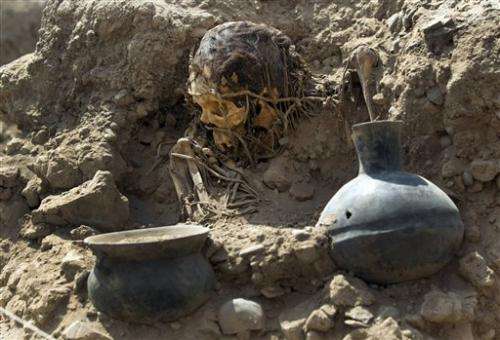
An excavated skull and artifacts lay unearthed at the sports complex where Peru's national soccer team practices in Lima, Peru, Tuesday, Feb. 26, 2013. According to Peru's Ministry of Culture, 11 pre-Inca tombs belonging to the Lima culture (200-700 AD) and Yschma (1100-1400 AD) were located inside the sports complex in the district of San Luis, where excavations started in Dec. 2012. (AP Photo/Martin Mejia)
Archaeologists studying a small site at Peru's main sports center have dug up eight skeletons dating from at least 700 years ago and three others twice that old.
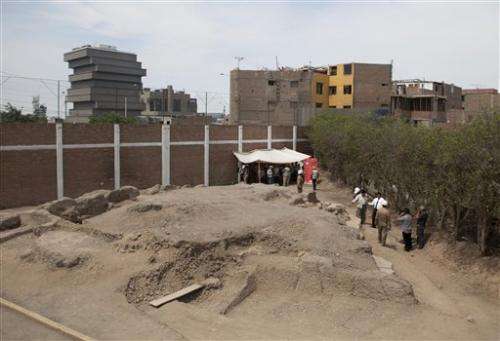
The discovery of pre-Hispanic remains was made at the Huaca Tupac Amaru B site at the National Sports Village. The 400-square-meter (yard) site sits just a few meters (feet) from the stadium where Peru's national soccer team trains.
Archaeologist Fernando Herrera, head of the project, told The Associated Press on Tuesday that three sets of remains were determined to belong to the Lima culture, which developed between A.D. 200 and 700. The eight other skeletons came from the more recent Yschma culture, between A.D. 1000 and 1400, he said.
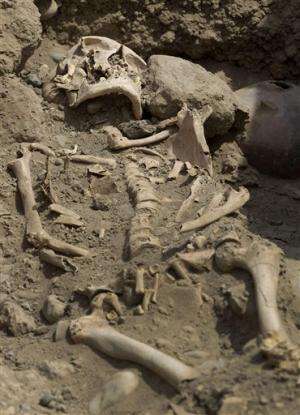
A skeleton lays unearthed in the sports complex where Peru's national soccer team practices in Lima, Peru, Tuesday, Feb. 26, 2013. According to Peru's Ministry of Culture, 11 pre-Inca tombs belonging to the Lima culture (200-700 AD) and Yschma (1100-1400 AD) were located inside the sports complex in the district of San Luis, where excavations started in Dec. 2012. (AP Photo/Martin Mejia)
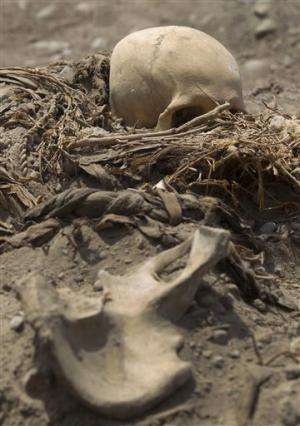
Each skeleton was found lying on a bed of woven reeds. The bodies were tied with braided rattan and covered by one or more cloths. They were buried with ceramics, textiles, fruit tree leaves, and tools used for agriculture, he said.
Herrera said the first skeleton was found in December and the others were recovered in January. The archaeological team thinks there may be more and is still searching the site, he said.
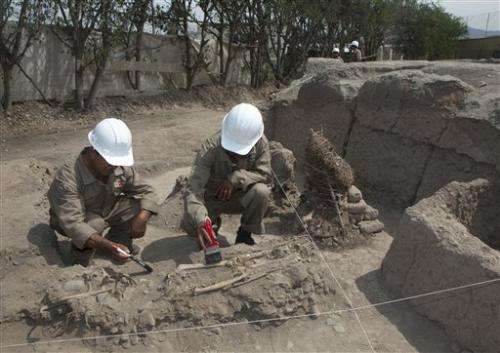
Archaeologists brush the bones of a skeleton, for the benefit of the media, during excavations to unearth ancient tombs discovered in the sports complex where Peru's national soccer team practices in Lima, Peru, Tuesday, Feb. 26, 2013. According to Peru's Ministry of Culture, 11 pre-Inca tombs belonging to the Lima culture (200-700 AD) and Yschma (1100-1400 AD) were located inside the sports complex in the district of San Luis, where excavations started in Dec. 2012. (AP Photo/Martin Mejia)
There are many archaeological sites in Lima, including the Huaca Pucllana in the Miraflores residential district that has a towering Lima culture pyramid.
Luis Felipa Villacorta, an archaeologist and historian who is director of the private Antonio Raimondi museum, said the find at the sports center will add to "the mosaic and image of the Lima culture that is very diffuse" compared to the Nazca and Moche civilizations that developed simultaneously in other parts of the coast of what is now Peru.
A skeleton lays unearthed in a recently excavated tomb in the sports complex where Peru's national soccer team practices in Lima, Peru, Tuesday, Feb. 26, 2013. According to Peru's Ministry of Culture, 11 pre-Inca tombs belonging to the Lima culture (200-700 AD) and Yschma (1100-1400 AD) were located inside the sports complex in the district of San Luis, where excavations started in Dec. 2012. (AP Photo/Martin Mejia)
Unfortunately not much is known of the Lima culture, he said, partly "because the city, the capital, has grown over it." In addition, there has been more interest in the "pre-Hispanic cultures that are outside the metropolitan area: the Moche, Nazca, Wari," he added.
Government officials and members of the press stand at the site where pre-hispanic tombs are being excavated, inside the sports complex where Peru's national soccer team practices, in Lima, Peru, Tuesday, Feb. 26, 2013. According to Peru's Ministry of Culture, 11 pre-Inca tombs belonging to the Lima culture (200-700 AD) and Yschma (1100-1400 AD) were located inside the sports complex in the district of San Luis, where excavations started in Dec. 2012. (AP Photo/Martin Mejia)
Copyright 2013 The Associated Press. All rights reserved. This material may not be published, broadcast, rewritten or redistributed.
Citation:
11 pre-Hispanic bodies found at Peru sports center (2013, February 27)
retrieved 27 April 2024
from https://phys.org/news/2013-02-pre-hispanic-bodies-peru-sports-center.html
This document is subject to copyright. Apart from any fair dealing for the purpose of private study or research, no
part may be reproduced without the written permission. The content is provided for information purposes only.