NASA sees Tropical Cyclone 15S form in So. Indian Ocean
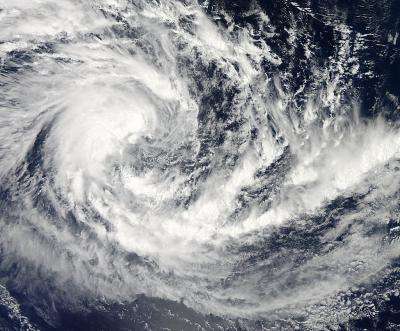
The fifteenth tropical cyclone of the Southern Indian Ocean season strengthened into a tropical storm today, Feb. 11, and NASA's Aqua satellite passed overhead hours after it reached tropical storm strength.
Tropical Cyclone 15S was born from the low pressure area designated as System 92S. System 92S developed on Feb. 9 and intensified into a tropical storm on Feb. 11 at 0300 UTC. At that time, Tropical Cyclone 15S had maximum sustained winds near 35 knots (40.2 mph/64.8 kph), making it a tropical storm. It was centered near 12.1 south latitude and 82.5 east longitude, about 650 nautical miles (748 miles/1204 km) east-southeast of Diego Garcia. Tropical Cyclone 15S is far from any land areas and is expected to strengthen and dissipate over open ocean.
On Feb. 11 at 0805 UTC the Moderate Resolution Imaging Spectroradiometer (MODIS) instrument aboard NASA's Aqua satellite captured a visible image of Tropical Cyclone 15S in the Southern Indian Ocean. The image showed that the center of the storm had continued consolidating and was obscured by central dense overcast. Imagery from the special sensor microwave/imager (SSM/I) instrument, a seven-channel, four-frequency passive microwave radiometer system aboard the DMSP satellite showed bands of strong thunderstorms were wrapping into the storm's well-defined center of circulation, an indication that the storm is strengthening.
Tropical Cyclone 15S was moving to the west-southwest at 10 knots (11.5 mph/18.5 kph). The tropical storm is forecast to move to the southwest, then turn south and strengthen to hurricane force within the next two days. The Joint Typhoon Warning Center expects that wind shear and cooler waters will weaken the storm after that time.
Provided by NASA's Goddard Space Flight Center


