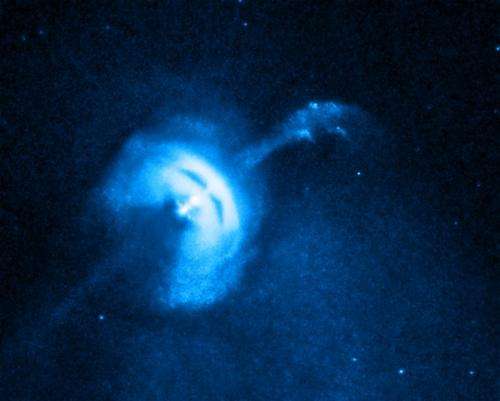
Vela Pulsar

Jan 08, 2013
Credit: X-ray: NASA/CXC/Univ of Toronto/M.Durant et al; Optical: DSS/Davide De Martin

(Phys.org)—This movie from NASA's Chandra X-ray Observatory shows a fast moving jet of particles produced by a rapidly rotating neutron star, and may provide new insight into the nature of some of the densest matter in the universe.

The star of this movie is the Vela pulsar, a neutron star that was formed when a massive star collapsed. The Vela pulsar is about 1,000 from Earth, spansis about 12 miles in diameter, and makes over 11 complete rotations every second, faster than a helicopter rotor. As the pulsar whips around, it spews out a jet of charged that race out along the pulsar's at about 70% of the . In this still image from the movie, the location of the pulsar and the 0.7-light-year-long jet are labeled.

The Chandra data shown in the movie, containing eight images obtained between June and September 2010, suggest that the pulsar may be slowly wobbling, or precessing, as it spins. The shape and the motion of the Vela jet look strikingly like a rotating helix, a shape that is naturally explained by precession, as shown in this animation [link to mathematica animation from Oleg K]. If the evidence for precession of the Vela pulsar is confirmed, it would be the first time that a jet from a neutron star has been found to be wobbling, or precessing, in this way.

One possible cause of precession for a spinning neutron star is that it has become slightly distorted and is no longer a perfect sphere. This distortion might be caused by the combined action of the fast rotation and "glitches", sudden increases of the pulsar's rotational speed due to the interaction of the superfluid core of the neutron star with its crust.

A paper describing these results will be published in The Astrophysical Journal on January 10, 2013.

This is the second Chandra movie of the Vela pulsar, with the original having been released in 2003. The first Vela movie contained shorter, unevenly spaced observations so that the changes in the jet were less pronounced and the authors did not argue that precession was occurring. However, based on the same data, Avinash Deshpande of Arecibo Observatory in Puerto Rico and the Raman Research Institute in Bangalore, India, and the late Venkatraman Radhakrishnan, argued in a 2007 paper that the Vela pulsar might be precessing.

The Earth also precesses as it spins, with a period of about 26,000 years. In the future Polaris will no longer be the "north star" and other stars will take its place. The period of the Vela precession is much shorter and is estimated to be about 120 days.

The supernova that formed the Vela pulsar exploded over 10,000 years ago. This optical image from the Anglo-Australian Observatory's UK Schmidt telescope shows the enormous apparent size of the supernova remnant formed by the explosion. The full size of the remnant is about eight degrees across, or about 16 times the angular size of the moon. The square near the center shows the Chandra image with a larger field-of-view than used for the movie, with the Vela pulsar in the middle.

Explore further: Has the speediest pulsar been found?

More information: chandra.si.edu/photo/2013/vela/
www.flickr.com/photos/nasamarshall/sets/72157606205297786/

Related Stories

A spinning neutron star is tied to a mysterious tail

Aug 18, 2011

(PhysOrg.com) -- A spinning neutron star is tied to a mysterious tail -- or so it seems. Astronomers using NASA's Chandra X-ray Observatory found that this pulsar, known as PSR J0357+3205 (or PSR J0357 for ...

Has the speediest pulsar been found?

Jun 28, 2012

(Phys.org) -- NASA's Chandra X-ray Observatory and ESA's XMM-Newton in space, and the Parkes radio telescope in Australia -- may have found the fastest moving pulsar ever seen.

X-rays discovered from young supernova remnant

Jul 31, 2012

(Phys.org) -- Over fifty years ago, a supernova was discovered in M83, a spiral galaxy about 15 million light years from Earth. Astronomers have used NASA's Chandra X-ray Observatory to make the first detection ...

Celestial bauble intrigues astronomers

Dec 20, 2011

(PhysOrg.com) -- With the holiday season in full swing, a new image from an assembly of telescopes has revealed an unusual cosmic ornament. Data from NASA's Chandra X-ray Observatory and ESA's XMM-Newton have ...

A pulsar's mysterious tail

Jul 14, 2011

(PhysOrg.com) -- A spinning neutron star is tied to a mysterious tail -- or so it seems. Astronomers using NASA's Chandra X-ray Observatory have found that this pulsar, known as PSR J0357+3205 (or PSR J0357 ...

Fermi telescope unveils a dozen new pulsars

Jan 06, 2009

(PhysOrg.com) -- NASA's Fermi Gamma-ray Space Telescope has discovered 12 new gamma-ray-only pulsars and has detected gamma-ray pulses from 18 others. The finds are transforming our understanding of how these ...

Recommended for you

Galaxy's Ring of Fire

2 hours ago

Johnny Cash may have preferred this galaxy's burning ring of fire to the one he sang about falling into in his popular song. The "starburst ring" seen at center in red and yellow hues is not the product of ...

4C+29.30: Black hole powered jets plow into galaxy

May 15, 2013

(Phys.org) —This composite image of a galaxy illustrates how the intense gravity of a supermassive black hole can be tapped to generate immense power. The image contains X-ray data from NASA's Chandra X-ray ...

A space-time magnifying glass

May 15, 2013

(Phys.org) —Bright arcs are smeared around the heart of galaxy cluster Abell S1077 in this image taken by the NASA/ESA Hubble space telescope. The arcs are stretched images of distant galaxies distorted ...

User comments : 7

Adjust slider to filter visible comments by rank

Display comments: newest first

cantdrive85
1.5 / 5 (8) Jan 08, 2013
This is a plasma focus discharge, very similar to the Crab Nebula.
Q-Star
3 / 5 (8) Jan 08, 2013
This is a plasma focus discharge, very similar to the Crab Nebula.


Plasma, blah, blah, plasma, blah, blah, and oh yeah, I almost forgot,,,, plasma.
Caliban
not rated yet Jan 08, 2013
What about tbe possibility of a dark orbital companion?

Or possibly, since this is a recently formed(cosmologically speaking) object, this precessional wobble is a relict of asymmetrical forces that may have been involved at the time of formation, and perhaps this wobble will eventually resolve in uniform rotation at increased velocity(shortened period) over time?

That's what I would check first.
A2G
2.3 / 5 (3) Jan 09, 2013
Really cool how you can see the material flow so clearly in the video. Did you notice the flow coming from the far side of the Pulsar rings and then back around and down into it? Really cool work and very significant.
VendicarD
5 / 5 (1) Jan 09, 2013
Hopefully there are more than 8 images in the can.
natello
1 / 5 (2) Jan 09, 2013
This is a plasma focus discharge, very similar to the Crab Nebula.
It isn't - no discharge occurs here. Which charge should be "discharged" there?
Infinion
1 / 5 (1) Jan 09, 2013
This is a plasma focus discharge, very similar to the Crab Nebula.
It isn't - no discharge occurs here. Which charge should be "discharged" there?


Regardless of whether you're trying to defend the standard model or falsify what he is saying, you don't make a rebuttle by just disagreeing with someone on top of overbearingly assuming that an effect (it doesn't have to be discharges) does not occur at a phenomenon.

More news stories

Galaxy's Ring of Fire

Johnny Cash may have preferred this galaxy's burning ring of fire to the one he sang about falling into in his popular song. The "starburst ring" seen at center in red and yellow hues is not the product of ...

Alaska volcano shoots ash 15,000 feet into the air

(AP)—One of Alaska's most restless volcanoes has shot an ash cloud 15,000 feet into the air in an ongoing eruption that has drawn attention from a nearby community but isn't expected to threaten air traffic.

Chinese, Indian airlines face EU pollution fines

Eight Chinese and two Indian airlines face fines of up to several million euros for not paying for their greenhouse gas emissions during flights within the bloc, the European Commission said on Friday.

Morocco to harness the wind in energy hunt

Morocco is ploughing ahead with a programme to boost wind energy production, particularly in the southern Tarfaya region, where Africa's largest wind farm is set to open in 2014.

US psychiatry gets makeover in new manual

The latest makeover to a massive psychiatric tome honored by some, reviled by others and even called the "Bible" of mental disorders is being released Saturday with a host of new changes.

New case of SARS-like virus in Saudi: ministry

A new case of the deadly coronavirus has been detected in Saudi Arabia where 15 people have already died after contracting it, the health ministry announced on Saturday on its Internet website.