Researchers create super-repellant surface material (w/ video)
Jan 09, 2013 by Bob Yirka report
Researchers create super-repellant surface material

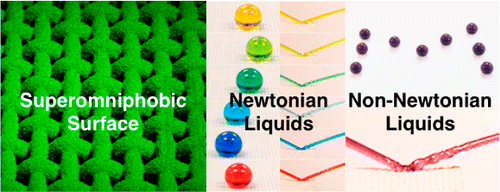
(Phys.org)—Researchers from the University of Michigan working in collaboration with associates from the US Air Force have created a new type of surface cover that repels oils, water, alkali solutions, acids and even non-Newtonian fluids. In their paper published in Journal of the American Chemical Society, the researchers describe their new material and the different ways it can repel various liquids.

The material they've created works due to two separate aspects: its and its physical layout. It's based on a very small gauge steel mesh which has been coated with polymer ( and POSS) beads. The unique pattern laid down limits surface area and has an overhanging structure that limits adhesion. Also, tiny air pockets between the beads prevent materials from actually touching other parts of the surface, preventing liquids from getting a grip.

The researchers explain that surface repellents work in general by limiting the wetting hysteresis – the amount of deformation that occurs when a liquid hits a surface. Ideally the at both the front and rear of a drop remain the same – the result is a lessened impact area. In practical terms this means that the more a drop remains formed like a drop when it strikes, the less likely it is to adhere to a surface.

This video is not supported by your browser at this time.
Credit: J. Am. Chem. Soc., Article ASAP, DOI: 10.1021/ja310517s

Researchers have found it particularly difficult to develop surface covers that repel liquids that contain polymers, particularly non-Newtonian fluids. This is because such substances tend to deform almost immediately on contact. Thus, the challenge has been to discover a way to cause such fluids to retain their shape as they drop onto a surface. With the new material, the overhanging, eave-like edges of the beads prevent the liquid drop from distending while also preventing it from reaching an adjacent part of the surface. That limits the amount of distension and thus the deformation of the drop.

This video is not supported by your browser at this time.
Credit: J. Am. Chem. Soc., Article ASAP, DOI: 10.1021/ja310517s

This video is not supported by your browser at this time.
Credit: J. Am. Chem. Soc., Article ASAP, DOI: 10.1021/ja310517s

The researchers demonstrated the material's ability to repel liquids by shooting various liquids through a small jet at a covered surface and filming it as it bounced off instead of adhered. They also demonstrated that the covering also provides protection from chemical attack by dunking a coated aluminum plate into several acidic solutions. Its strength in doing so, the team explains, comes about from the same properties that prevent adhesion. If an acid cannot touch a surface (because of the air pockets) it cannot destroy it.

Explore further: Research duo discover why non-Newtonian fluids harden on impact

More information: Superomniphobic Surfaces for Effective Chemical Shielding, J. Am. Chem. Soc., Article ASAP, DOI: 10.1021/ja310517s

Abstract
Superomniphobic surfaces display contact angles >150° and low contact angle hysteresis with essentially all contacting liquids. In this work, we report surfaces that display superomniphobicity with a range of different non-Newtonian liquids, in addition to superomniphobicity with a wide range of Newtonian liquids. Our surfaces possess hierarchical scales of re-entrant texture that significantly reduce the solid–liquid contact area. Virtually all liquids including concentrated organic and inorganic acids, bases, and solvents, as well as viscoelastic polymer solutions, can easily roll off and bounce on our surfaces. Consequently, they serve as effective chemical shields against virtually all liquids—organic or inorganic, polar or nonpolar, Newtonian or non-Newtonian.

Related Stories

Repelling the drop on top

Jun 04, 2012

It would make life a lot easier if the surfaces of window panes, corrosion coatings or microfluidic systems in medical labs could keep themselves free of water and other liquids. A new simulation program can ...

'Bed of nails' material for clean surfaces

Sep 17, 2012

(Phys.org)—Scientists at the University of Twente's MESA+ Institute for Nanotechnology have developed a new material that is not only extremely water-repellent but also extremely oil-repellent. It contains ...

Recommended for you

Kinks and curves at the nanoscale

May 19, 2013

One of the basic principles of nanotechnology is that when you make things extremely small—one nanometer is about five atoms wide, 100,000 times smaller than the diameter of a human hair—they are going ...

Snake's ultra-black spots may aid high-tech quest

May 16, 2013

Scientists have identified nanostructures in the ultra-black skin markings of an African viper which they said Thursday could inspire the quest to create the ultimate light-absorbing material.

User comments : 4

Adjust slider to filter visible comments by rank

Display comments: newest first

grondilu
5 / 5 (1) Jan 09, 2013
Potential applications for this stuff are just mind-blowing.
ValeriaT
5 / 5 (2) Jan 09, 2013
It depends on how these surfaces are sensitive to mechanical abrasion or contamination.
Mike_Massen
5 / 5 (2) Jan 10, 2013
Would be a great liner for a dry toilet bowl system ;-)

Covering for electronic equipment, interested to know how well it deals with surface charges re static electricity, might it be a good material for generating static charges and especially so with fluids made of molecules with no dipoles such as benzene etc or something far less carcinogenic... is it UV stable in full sunlight to stand the 49 deg C days we get in summer in Australia !

Yeah heap of applications, cool :-)

Whats the cost, application methods etc ?
h20dr
not rated yet Jan 14, 2013
This would be incredibly useful in so many different applications if is robust and economically feasible. It would certainly help a product I work with perform better.

More news stories

Engineers' nanoantennas improve infrared sensing

(Phys.org) —A team of University of Pennsylvania engineers has used a pattern of nanoantennas to develop a new way of turning infrared light into mechanical action, opening the door to more sensitive infrared ...

Advance in nanotech gene sequencing technique

(Phys.org) —The allure of personalized medicine has made new, more efficient ways of sequencing genes a top research priority. One promising technique involves reading DNA bases using changes in electrical ...

Protein study suggests drug side effects are inevitable

A new study of both computer-created and natural proteins suggests that the number of unique pockets – sites where small molecule pharmaceutical compounds can bind to proteins – is surprisingly small, meaning drug side ...

Do salamanders hold the solution to regeneration?

Salamanders' immune systems are key to their remarkable ability to regrow limbs, and could also underpin their ability to regenerate spinal cords, brain tissue and even parts of their hearts, scientists have ...