'Sexual networks' reveal complex mating game
Jan 22, 2013

(Phys.org)—Social networks can be used to describe the sexual interactions in animal populations and reveal which individuals are directly competing in the 'mating game', according to new Oxford University research.

These 'sexual networks' can unlock how operates in where females often mate with multiple males. The network-based approach could also help to study the spread of sexually-transmitted diseases.

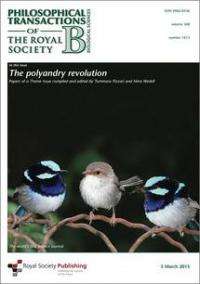
A report of the research appears in a specially-themed issue of Philosophical Transactions of the Royal Society B.

'For centuries naturalists believed that most organisms played a very simple in which a subset of in the population would form monogamous reproductive pairs,' said Dr Tom Pizzari of Oxford University's Department of Zoology who led the research with Oxford colleague Grant McDonald. 'Darwin identified sexual selection, the selection of this successful subset, as the agent responsible for the evolution of a bewildering diversity of extravagant traits utilised in competition over reproductive opportunities.'

Yet recent studies have undermined this simple view of sexual interactions. They show that, far from being monogamous, females often mate with multiple males – a process called polyandry – and that the sexual dynamics within polyandrous societies are typically highly-structured with being far from random as individuals choose and compete over mates within non-random groups.

'By using the information gained from studying 'sexual networks' we can dissect the way that sexual selection operates on a particular trait both in the local and ,' said Dr Pizzari. 'The study demonstrates that this new approach allows for more accurate estimates of sexual selection particularly at intermediate levels of polyandry. We can also use our approach to examine the spread and impact of sexually-transmitted diseases across a particular population.'

The study, entitled 'Sexual networks: measuring sexual selection in structured, polyandrous populations' is part of a themed issue of Philosophical Transactions of the Royal Society B edited by Tom Pizzari of Oxford University and Nina Wedell of Exeter University. The issue shows how polyandry is emerging as a lens through which scientists can better resolve their understanding of a diverse range of ecological and evolutionary processes, from selfish genetic elements to extinction risk and conservation.

Explore further: Bittersweet: Bait-averse cockroaches shudder at sugar

More information: rstb.royalsocietypublishing.org/content/368/1613/20120356.full

Related Stories

Sex in the morning or the evening?

Jun 26, 2007

Most research on sexual conflict ignores the fact that the fitness pay-offs of mating may change drastically over a short timescale, for example over a single day.

Studies suggest males have more personality

Nov 18, 2009

(PhysOrg.com) -- Males have more pronounced personalities than females across a range of species - from humans to house sparrows - according to new research. Consistent personality traits, such as aggression ...

Old males win sex battle

Jun 25, 2010

(PhysOrg.com) -- Old roosters can still dominate the sexual pecking order even when their ability to fertilise eggs drastically declines, new Oxford University research has shown.

In spiders, size matters: Small males are more often meals

Sep 10, 2008

Female spiders are voracious predators and consume a wide range of prey, which sometimes includes their mates. A number of hypotheses have been proposed for why females eat males before or after mating. Researchers ...

Why do we choose our mates? Ask Charles Darwin, prof says

Jun 16, 2009

Charles Darwin wrote about it 150 years ago: animals don't pick their mates by pure chance - it's a process that is deliberate and involves numerous factors. After decades of examining his work, experts agree that he pretty ...

Promiscuity pays in the frog world

Feb 17, 2011

(PhysOrg.com) -- New research shows that the offspring of promiscuous female frogs have a higher rate of survival than those who remain monogamous, according to Macquarie University biologist, Associate Professor ...

Recommended for you

Bittersweet: Bait-averse cockroaches shudder at sugar

1 hour ago

Sugar isn't always sweet to German cockroaches, especially to the ones that avoid roach baits. In a study published May 24 in the journal Science, North Carolina State University entomologists show the ne ...

White tiger mystery solved

3 hours ago

White tigers today are only seen in zoos, but they belong in nature, say researchers reporting new evidence about what makes those tigers white. Their spectacular white coats are produced by a single change ...

Scientists announce Top 10 New Species from 2012

10 hours ago

An amazing glow-in-the-dark cockroach, a harp-shaped carnivorous sponge and the smallest vertebrate on Earth are just three of the newly discovered top 10 species selected by the International Institute for ...

User comments : 0

More news stories

White tiger mystery solved

White tigers today are only seen in zoos, but they belong in nature, say researchers reporting new evidence about what makes those tigers white. Their spectacular white coats are produced by a single change ...

Ferrets, pigs susceptible to H7N9 avian influenza virus

Chinese and U.S. scientists have used virus isolated from a person who died from H7N9 avian influenza infection to determine whether the virus could infect and be transmitted between ferrets. Ferrets are often used as a mammalian ...

Scientists develop cheaper, more efficient fuel cells

(Phys.org) —Using the Canadian Light Source (CLS) synchrotron, researchers have discovered a way to create cheaper fuel cells by dividing normally expensive platinum metal into nanoparticles (or even single ...