'Sensorless sensing' technology enables accurate correction of temperature effects on LED performance
Jan 10, 2013

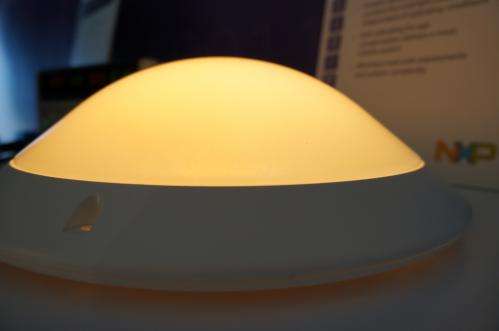
When comparing LEDs to incandescent light bulbs, there is a noticeable difference in light quality: LED lamps when dimmed are perceived to be "colder" than incandescents. At CES 2013 this week, NXP Semiconductors is demonstrating a groundbreaking solution that allows LED lamps to closely mimic the traditional incandescent light bulb, to produce a warmer, cozier white light as they are dimmed. Featuring "sensorless sensing" technology, developed and patented by NXP, this solution also has the advantage of driving down LED system costs by eliminating external temperature sensors, reducing the size of the heat sinks required for LED system cooling, and significantly improving reliability.

's tunable dimmable white LED demo can be viewed in its "Future Innovations" area of its booth (CP8), and in this demo video:

This video is not supported by your browser at this time.

With , the light color becomes warmer and more atmospheric as they are dimmed and become less bright. In contrast, LED today are typically unable to match the colors experienced by the users of conventional light bulbs, over the entire dimming range.

To enable the LED to mimic an incandescent when dimming, the NXP solution has integrated three key features into the driving :

  • Combining white and amber LEDs as a cost-effective way to create colors most pleasing to the , following the black-body radiation curve
  • Implementing logarithmic correction for eye sensitivity using an analytical model that allows the desired color points to be achieved while dimming
  • Using sensorless sensing to measure LED junction temperature directly, enabling accurate, efficient real-time temperature correction, which is critical for reliable control of LED performance in any conditions
Through these features, the smart LED driver developed by NXP is able to provide color and light output stability at any temperature and regardless of the age of the LED. By directly measuring the LED junction temperature through the two existing wires to the LED, sensorless sensing tackles the challenge of LED temperature drift, and delivers further benefits over conventional methods of LED temperature measurement. Using sensorless sensing, no external sensors or wiring is required, reducing the total number of components and enabling more compact heat sinks. In addition, sensorless sensing enables fast performance; accurate temperature measurement (~ 1°C res.); dynamic light control; independence from the heat sink; independence from operating conditions; no need for thermal modeling; and self-calibration to compensate for age.

"Our research team originally set out to answer the question: What would it take to inspire consumers to finally embrace LED lighting with the same affection they have for incandescents? With sensorless , we're demonstrating a new way to achieve the warm quality of light we associate with incandescent light bulbs, using dimmable LED lamps. By reducing the number of components required, sensorless sensing also helps to reduce total system costs, removing another significant barrier to widespread LED adoption," said Michael Bruno, senior director of business development, Advanced Technologies and Future Innovations, NXP Semiconductors. "The elegance of this approach significantly improves LED reliability and lifetimes, and there is tremendous potential for sensorless sensing in other areas, such as automotive SSL and commercial applications."

For further information, please contact your NXP account manager, or visit NXP this week at Central Plaza 8, CES 2013.

Explore further: LEDs winning light race to save energy, the environment: report

add to favorites email to friend print save as pdf

Related Stories

Building a better light bulb

Feb 01, 2012

Scientists study the movement of charge carriers to design an organic LED that is energy efficient and still casts a warm, natural glow.

NXP Sets New Benchmarks for LED Drivers

Nov 05, 2009

NXP Semiconductors today announced three major developments in its portfolio of mains connected LED driver solutions: the success of its SSL2101 LED driver IC in matching LED lifetimes in an accelerated lifetime test; the ...

Bright idea illuminates LED standards

Nov 25, 2008

The lack of common measurement methods among light-emitting diode (LED) and lighting manufacturers has affected the commercialization of solid-state lighting products. In a recent paper, researchers at the National Institute ...

Researchers create a smaller, flexible LED

Jun 20, 2011

University of Miami professor at the College of Engineering, Jizhou Song, has helped design an light-emitting diode (LED) light that uses an array of LEDs 100 times smaller than conventional LEDs. The new device has flexibility, ...

Recommended for you

Sensitive bomb detector to rove in search of danger

7 hours ago

European researchers have developed and tested a light-weight device capable of detecting extremely minute quantities of explosives from up to 20 metres away, providing an invaluable law-enforcement tool ...

How soon could car seats enter the 3-D comfort zone?

May 23, 2013

New 3D textiles made of recyclable polyester fibres could contribute help cars be easier to recycle. But recycling technology has yet to progress in separating seat material from other car components.

NASA: Austin, calling Austin. 3-D pizzas to go

May 22, 2013

(Phys.org) —The idea of living with 3-D printed food is neither unthinkable nor new; designers and futurists have been looking to 3-D printing as food's next frontier. In 2012, there was news that the Thiel ...

User comments : 1

Adjust slider to filter visible comments by rank

Display comments: newest first

Eikka
5 / 5 (1) Jan 10, 2013
What would it take to inspire consumers to finally embrace LED lighting with the same affection they have for incandescents?


Drop the price to 50p a bulb, make them tolerate high temperatures, fit them in existing bulb sockets and lamps, make the light omnidirectional like in regular bulbs instead of a spot with colored fringes, increase the CRI.

These are the foremost problems. Most people don't care about dimmability - they just switch the lights on and off.

More news stories

Mobile app to help fight against racism in France

A French anti-racism association is launching a mobile application it hopes will help eradicate racist graffiti by enabling users to take photos of offensive tags, geo-locate them and get them removed.

Storm chasers: born to be wild?

(HealthDay)—We've all seen them: the surfers who race to the beach when a hurricane hits, the guy who decides to ride out the storm in his overmatched boat, the tornado chasers who fearlessly steer their ...