NASA sees a coronal mass ejection erupt from the sun
Jan 31, 2013
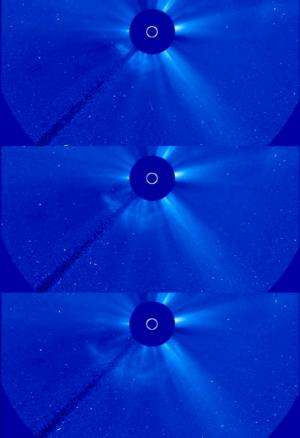
The Solar and Heliospheric Observatory (SOHO) captured these image of a coronal mass ejection, erupting on the left side of the sun early in the morning of Jan 31, 2013, as it was moving away from the sun into space. These images from SOHO are called coronagraphs, in which the bright light of the sun is blocked in order to make the dimmer structures in the sun's atmosphere, or corona, visible. Credit: Credit: ESA&NASA/SOHO

On Jan. 31, 2013 at 2:09am EST, the sun erupted with an Earth-directed coronal mass ejection or CME. Experimental NASA research models, based on observations from the Solar Terrestrial Relations Observatory (STEREO) and ESA/NASA's Solar and Heliospheric Observatory, show that the CME left the sun at speeds of around 575 miles per second, which is a fairly typical speed for CMEs. Historically, CMEs at this speed are mild.

Not to be confused with a solar flare, a CME is a solar phenomenon that can send solar particles into space and reach Earth one to three days later.

Earth-directed CMEs can cause a space called a geomagnetic storm, which occurs when they connect with the outside of the Earth's magnetic envelope, the magnetosphere, for an extended period of time. In the past, CME's such as this have caused auroras near the poles but didn't disrupt electrical systems on Earth or interfere with GPS or satellite-based communications systems.

NOAA's Space Weather Prediction Center is the United States Government official source for space weather forecasts, alerts, watches and warnings.

Explore further: Sun shoots out two coronal mass ejections

add to favorites email to friend print save as pdf

Related Stories

Sun shoots out two coronal mass ejections

Jan 24, 2013

On Jan. 23, 2013, at 9:55 a.m. EST, the sun erupted with an Earth-directed coronal mass ejection, or CME. Experimental NASA research models, based on observations from the Solar Terrestrial Relations Observatory ...

Continuing Thanksgiving eruptions on the Sun

Nov 26, 2012

On Nov. 23, 2012, at 8:54 a.m. EST, the sun erupted with an Earth-directed coronal mass ejection or CME. Experimental NASA research models, based on observations from the Solar Terrestrial Relations Observatory ...

NASA spacecraft observe Nov. 20 solar eruption

Nov 20, 2012

On Nov. 20, 2012, at 7:09 a.m. EST, the sun erupted with a coronal mass ejection or CME. Not to be confused with a solar flare, a CME is a solar phenomenon that can send solar particles into space and can ...

NASA spacecraft observe a Thanksgiving CME

Nov 23, 2012

(Phys.org)—On Nov. 21, 2012, at 11:24 a.m. EST, the sun erupted with an Earth-directed coronal mass ejection or CME. Experimental NASA research models, based on observations from the Solar Terrestrial Relations ...

Sun releases slow moving CME

Nov 12, 2012

On Nov. 9, 2012, at 10:24 a.m. EST, the sun emitted an Earth-directed coronal mass ejection (CME). A CME is a solar phenomenon that can send billions of tons of solar particles into space and can reach Earth ...

New sunspots producing space weather

Jan 14, 2013

On Jan. 13, 2013, at 2:24 a.m. EST, the sun erupted with an Earth-directed coronal mass ejection or CME. Not to be confused with a solar flare, a CME is a solar phenomenon that can send solar particles into ...

Recommended for you

Forecast for Titan: Wild weather could be ahead

21 hours ago

(Phys.org) —Saturn's moon Titan might be in for some wild weather as it heads into its spring and summer, if two new models are correct. Scientists think that as the seasons change in Titan's northern hemisphere, ...

SDO observes mid-level solar flare

21 hours ago

UPDATE 16:30 p.m. EDT: The M7-class flare was also associated with a coronal mass ejection or CME, another solar phenomenon that can send billions of tons of particles into space. While this CME was not Ea ...

NASA's IRIS mission readies for a new challenge

May 22, 2013

(Phys.org) —The time draws near. NASA is getting ready to launch a new mission, a mission to observe a largely unexplored region of the solar atmosphere that powers its dynamic million-degree outer atmosphere and drives ...

User comments : 1

Adjust slider to filter visible comments by rank

Display comments: newest first

cantdrive85
1 / 5 (5) Jan 31, 2013
"Magnetic reconnection is pseudo-science." Hannes Alfven

More news stories

A hidden population of exotic neutron stars

(Phys.org) —Magnetars – the dense remains of dead stars that erupt sporadically with bursts of high-energy radiation - are some of the most extreme objects known in the Universe. A major campaign using ...

Russia evacuates drifting Arctic research station

Russia has ordered the urgent evacuation of the 16-strong crew of a drifting Arctic research station after ice floe that hosts the floating laboratory began to disintegrate, officials said Thursday.

Century-old science helps confirm global warming

(Phys.org) —Ocean measurements taken more than 135 years ago during the scientific expedition of HMS Challenger have provided further confirmation of human-produced global warming over the past century.

A quantum simulator for magnetic materials

Physicists understand perfectly well why a fridge magnet sticks to certain metallic surfaces. But there are more exotic forms of magnetism whose properties remain unclear, despite decades of intense research. An important ...

Review: Google music plan solid, serendipitous

Google's new music service offers a lot of eye candy to go with the tunes. The song selection of around 18 million tracks is comparable to popular services such as Spotify and Rhapsody, and a myriad of playlists ...