Research on lithium coatings unlocks mystery surrounding the harnessing of fusion energy
Jan 31, 2013
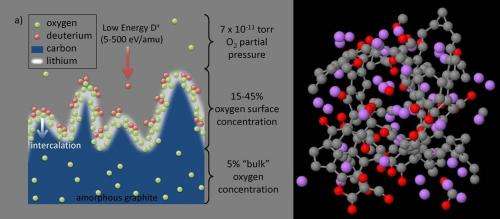
Dynamic in lithiated graphite: a) Experiments show that deuterium bombardment dramatically increases the surface oxygen; b) Simulation shell for the D-impact chemistry in lithiated and oxidized carbon

(Phys.org)—The research of a multi-institutional team from the U.S., Japan, and France, led by Predrag S. Krstic of the Joint Institute for Computational Sciences and Jean Paul Allain of Purdue University has answered the question of how the behavior of plasma—the extremely hot gases of nuclear fusion—can be controlled with ultra-thin lithium films on graphite walls lining thermonuclear magnetic fusion devices.

"It is remarkable that seemingly insignificant lithium depositions can profoundly influence the behavior of something as powerful as fusion plasmas," Krstic said.

Krstic and his team explain their research in a paper titled "Deuterium Uptake in Devices with Lithium Conditioned Carbon Walls," recently accepted for publication in Physical Review Letters.

"How lithium coatings on graphite surfaces control plasma behavior has largely remained a mystery until our team was able to combine predictions from quantum-mechanical on the Kraken and Jaguar systems at Oak Ridge National Laboratory and in situ experimental results from the Purdue group to explain the causes of the delicate tunability of plasma behavior by a complex lithiated graphitic system," Krstic said. "Surprisingly, we find that the presence of oxygen in the surface plays the key role in the bonding of deuterium, while lithium's main role is to bring the oxygen to the surface. preferentially bind with oxygen and carbon-oxygen when there is a comparable amount of oxygen to lithium at the surface. That finding well matches a number of controversial experimental results obtained within the last decade."

The performance demands on plasma-facing components and the other materials that would surround future reactors is one of the reasons the U.S. National Academy of Engineering has ranked the quest for fusion as one of the top for engineering in the 21st Century. Harnessing energy from thermonuclear magnetic fusion has been challenged in part by the extreme environment of hot and dense plasma interacting with the boundary fusion reactor walls. The strong coupling between the plasma edge and the wall surface, which causes erosion of the wall material, retention of radioactive tritium, and pollution of the plasma, has been hampered by a lack of fundamental understanding of what takes place at the interface where the plasma and solid material meet.

Recent research in which lithium coatings have been deposited on a variety of metallic and graphitic surfaces has provided evidence that plasma strongly responds on the deposited films. In fact, the use of ultra-thin coatings of lithium on graphite has resulted in an unprecedented influence on plasma behavior, including control of hydrogen recycling—one of the most important issues in the construction of future magnetic fusion-energy devices—and extraordinary improvements in energy confinement.

The study of the lithium coatings also impacts many areas beyond magnetic fusion, including nanoelectronics, lithium batteries, computational materials science, bioengineering and biophysics, plasma physics, and theoretical physics and chemistry.

"This work can lead to improvement of the hydrogen-recycling properties of the materials facing , as well as advancements in other areas," Krstic said. "We hope that our finding will inspire future theoretical and experimental work in diverse applications not only with lithium coatings on various materials but also with combinations of other types of materials that are potentially good 'oxygen-getters'—for example elements of the first two groups of the periodic system."

Explore further: Breakthrough calls time on bootleg booze

Related Stories

With lithium, more is definitely better

Nov 10, 2011

A team of scientists working at the U.S. Department of Energy's Princeton Plasma Physics Laboratory (PPPL) has found that increasing the amount of lithium coating in the wall of an experimental fusion reactor ...

Findings show promise for nuclear fusion test reactors

Jul 27, 2010

Researchers have discovered mechanisms critical to interactions between hot plasma and surfaces facing the plasma inside a thermonuclear fusion reactor, part of work aimed at developing coatings capable of ...

New probe to uncover mechanisms key to fusion reactor walls

Aug 26, 2011

(PhysOrg.com) -- A new tool developed by nuclear engineers at Purdue University will be hitched to an experimental fusion reactor at Princeton University to learn precisely what happens when extremely hot plasmas touch and ...

Taming thermonuclear plasma with a snowflake

Nov 08, 2010

Physicists working on the National Spherical Torus Experiment (NSTX) at the Princeton Plasma Physics Laboratory are now one step closer to solving one of the grand challenges of magnetic fusion research -- ...

Tokamak experiments come clean about impurity transport

Nov 10, 2011

A fusion reactor operates best when the hot plasma inside it consists only of fusion fuel (hydrogen's heavy isotopes, deuterium and tritium), much as a car runs best with a clean engine. But fusion fuel reactions ...

Recommended for you

Breakthrough calls time on bootleg booze

4 hours ago

(Phys.org) —Using a laser, the St Andrews scientists can now carry out detailed analysis of a spirit sample no bigger than a teardrop and can even confirm whether it is toxic or not. It's hoped the testing ...

Bringing life into focus

May 17, 2013

Spinning-disk confocal microscopy is an optical imaging technique that can be used to generate detailed three-dimensional fluorescence images of living cells and their contents. Although a powerful tool for ...

World's smallest droplet

May 17, 2013

(Phys.org) —Physicists may have created the smallest drops of liquid ever made in the lab. That possibility has been raised by the results of a recent experiment conducted by Vanderbilt physicist Julia Velkovska and her ...

User comments : 3

Adjust slider to filter visible comments by rank

Display comments: newest first

EyeNStein
1 / 5 (1) Feb 07, 2013
Hope this gets incorporated into ITER. Last time I contacted the folk at Culham they were trying to minimise the Lithium in JET; Viewing it as an undesirable contaminant. Despite the Princeton results in Nov 2011.
natello
1 / 5 (1) Feb 07, 2013
ITER is just a waste of tax payers money in the situation, when the cold fusion experiments are routinely replicated at the universities or private companies over the whole world. Actually the main reason which is keeping the ITER alive, is the lobby of private companies and researchers, who are participating on it. Another source of cold fusion ignorance is the fear of governments from distributed sources of energy, which would limit their power.
EyeNStein
1 / 5 (1) Feb 07, 2013
ITER and its decendants represent the future energy needs of mankind. We currently consume more than the earth can give. Fosil fuels cannot last forever. Unless you advocate return to a semi-pre-industrial society.

More news stories

Breakthrough calls time on bootleg booze

(Phys.org) —Using a laser, the St Andrews scientists can now carry out detailed analysis of a spirit sample no bigger than a teardrop and can even confirm whether it is toxic or not. It's hoped the testing ...

Competition in the quantum world

Innsbruck physicists led by Rainer Blatt and Peter Zoller experimentally gained a deep insight into the nature of quantum mechanical phase transitions. They are the first scientists that simulated the competition ...

New principle may help explain why nature is quantum

Like small children, scientists are always asking the question 'why?'. One question they've yet to answer is why nature picked quantum physics, in all its weird glory, as a sensible way to behave. Researchers ...

Advance in nanotech gene sequencing technique

(Phys.org) —The allure of personalized medicine has made new, more efficient ways of sequencing genes a top research priority. One promising technique involves reading DNA bases using changes in electrical ...

Finnish start-up launches smartphone to rival giants

A group of ex-Nokia employees who quit over the company's decision to abandon the planned MeeGo operating system in favour of Windows presented their own smartphone on Monday, hoping to rival the sector's ...