Japan scientists breed salmon from surrogates
Jan 15, 2013
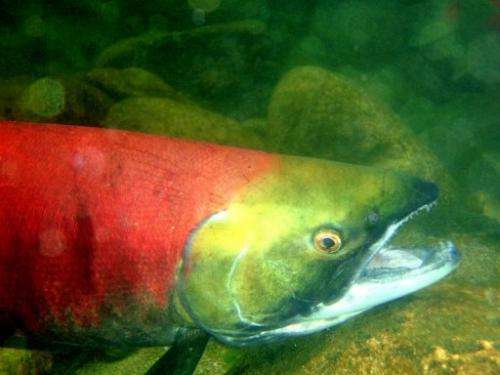
Photo illustration obtained January 13, 2011 shows a Fraser River sockeye salmon in the North Pacific Ocean. Japanese scientists have successfully bred a type of salmon using surrogate parents of a different species.

Japanese scientists have successfully bred a type of salmon using surrogate parents of a different species, in a breakthrough that could help preserve endangered creatures, the chief researcher said Tuesday.

Researchers froze the testes of the yamame salmon, a fish indigenous to Japan that lives its entire life in rivers, before extracting primordial germ cells and implanting them into otherwise sterile hatchlings.

These primordial cells, called spermatogonia, were used by the fish's growing body to develop fully functional sperm in males and viable eggs in females, said Goro Yoshizaki at Tokyo University of Marine Science and Technology.

The eggs and sperm can be fused in vitro to produce a healthy yamame salmon, he told AFP.

"As far as these kinds of trout and salmon are concerned, I can say this methodology is complete, and we can recreate sperm and eggs, and individuals, of the original species any time," Yoshizaki told AFP.

"We have confirmed the technology can also apply to tiger pufferfish as well," he said, referring to the popular—but poisonous—Japanese delicacy.

Yoshizaki and his team are already working on a project aimed at preserving species and would like to see if the same process is also possible in amphibians.

"I want to upgrade one class to another so that this technology can be applied eventually to reptiles and mammals," he said.

"But the hurdle is still high because the sets of genes are much more different between male and female mammals."

The study was published online in the of the United States of America.

Explore further: Virus discovered in Cultus Lake sport fish

add to favorites email to friend print save as pdf

Related Stories

Making sperm from stem cells in a dish

Aug 04, 2011

Researchers have found a way to turn mouse embryonic stem cells into sperm. This finding, reported in the journal Cell in a special online release on August 4th, opens up new avenues for infertility research and treatment. A Kyo ...

Virus discovered in Cultus Lake sport fish

Jul 19, 2012

A Simon Fraser University fish-population statistician, working in collaboration with non-government organization scientists, has uncovered evidence of a potentially deadly virus in a freshwater sport fish ...

Japanese sperm cell breakthrough offers hope to infertile men

Mar 24, 2011

(PhysOrg.com) -- In what can only be described as cosmic forces at work, Japanese scientists working at Yokohama University, just south of Tokyo, have in the midst of a national crises, announced a major breakthrough in fertility ...

Recommended for you

City-life changes blackbird personalities, study shows

17 hours ago

The origins of a young animal might have a significant impact on its behavior later on in life. Researchers at the Max Planck Institute for Ornithology in Radolfzell, Germany, have been able to demonstrate ...

Origins of 'The Hoff' crab revealed (w/ Video)

17 hours ago

The history of a new type of crab, nicknamed 'The Hoff' because of its hairy chest, which lives around hydrothermal vents deep beneath the Southern Ocean and Indian Ocean, has been revealed for the first ...

User comments : 2

Adjust slider to filter visible comments by rank

Display comments: newest first

Tenche
1 / 5 (1) Jan 15, 2013
FrankenFish.
obama_socks
1 / 5 (2) Jan 15, 2013
Big profits to be made? The process could help to save the species if they ever become endangered. But there is no indication that they are.

More news stories

Surprise species at risk from climate change

(Phys.org) —Most species at greatest risk from climate change are not currently conservation priorities, according to an International Union for Conservation of Nature (IUCN) study that has introduced a ...

Tech companies eye security that goes beyond passwords

In late February, a thief or thieves cracked into Evernote's digital vault filled with log-ins, passwords and email addresses belonging to 50 million users. It was a shocking cyberattack considering the Redwood City, Calif., ...

Validating maps of the brain's resting state

Kick back and shut your eyes. Now stop thinking. You have just put your brain into what neuroscientists call its resting state. What the brain is doing when an individual is not focused on the outside world ...

No danger of cancer through gene therapy virus

In fall 2012, the European Medicines Agency (EMA) approved the modified adeno-associated virus AAV-LPL S447X as the first ever gene therapy for clinical use in the Western world. uniQure, a Dutch biotech company, had developed ...