Google unveils detailed N. Korea map... with gulags
Jan 29, 2013 by Giles Hewitt
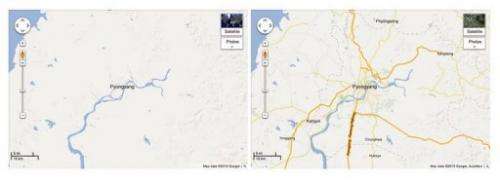
A two-picture series obtained January 29, 2013 courtesy of Google shows before (L) and after (R) Google Maps images of North Korea. Weeks after its chairman Eric Schmidt's secretive visit to North Korea, Google has rolled out a detailed map of the isolated state that even labels some of its remote and infamous gulags.

Weeks after its chairman Eric Schmidt's secretive visit to North Korea, Google has rolled out a detailed map of the isolated state that even labels some of its remote and infamous gulags.

Until now North Korea was pretty much a blank canvas to users of Google's "Map Maker", which creates maps from data that is provided by the public and fact-checked in a similar process to that used by Wikipedia.

"For a long time, one of the largest places with limited map data has been North Korea. But today we are changing that," Jayanth Mysore, a senior product manager at Google Map Maker said in a blog posting on Monday.

Mysore said the North Korea section had been completed with the help of a "community of citizen cartographers" working over a period of several years.

"While many people around the globe are fascinated with North Korea, these maps are especially important for the citizens of South Korea who have ancestral connections or still have family living there," he added.

With the two countries still technically at war, decent maps of the North are almost impossible to come by in South Korea.

The people least able to benefit from the Google publication will be the North Koreans themselves, who live in one of the most isolated and highly censored societies on the planet.
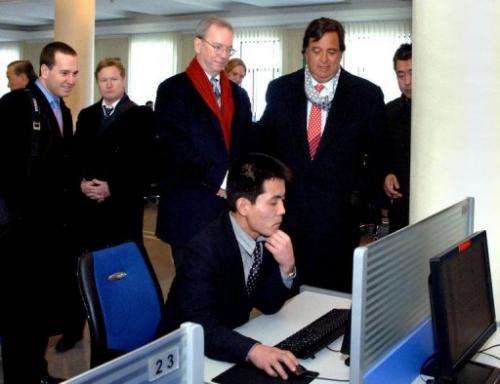
Former New Mexico governor Bill Richardson (2nd R) and US Internet giant Google executive chairman Eric Schmidt (C) visit the E-library at the computer centre at Kim Il-Sung University in Pyongyang, January 8, 2013. The North has a domestic Intranet, but it is cut off from the rest of the world, allowing its very limited number of users to exchange state-approved information and little more.

The North has a domestic Intranet, but it is cut off from the rest of the world, allowing its very limited number of users to exchange state-approved information and little more.

Access to the full-blown Internet is for the super-elite only, meaning a few hundred people or maybe 1,000 at most, experts estimate.

The Google version offers a detailed map of the capital Pyongyang, showing hospitals, subway stops and schools.

Outside the capital, the detail is sketchier, but noticeable on an overview of the country are a series of city-sized, grey-coloured areas which, when zoomed in on, are identified as sprawling re-education camps.

In the largest gulag of all—Camp 22 near Hoeryong near the North's northeast border with China—Google Map Maker identifies a number of units including an armoury, a food factory and a guards' restroom.

As many as 200,000 people are estimated to be detained in the North's vast gulag system, many under a guilt-by-association system that punishes those related to someone perceived as an enemy of the state.

Google has helped cast a light on the location of these camps before, through its popular Google Earth satellite imagery service.

Groups and individuals involved with human rights research on North Korea have used the satellite pictures to confirm the location of known camps and uncover the existence of new ones.
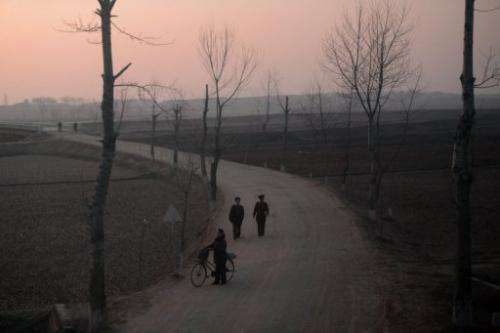
North Koreans are seen from the window of a train on a line between Pyongyang and the North Phyongan Province, April 8, 2012. As many as 200,000 people are estimated to be detained in the North's vast gulag system, many under a guilt-by-association system that punishes those related to someone perceived as an enemy of the state.

The release of Google's new North Korea map came just weeks after Schmidt returned from a controversial trip to Pyongyang as part of a US "humanitarian" mission.

On his return, Schmidt said he had told officials in the North that the country would never develop unless it embraces Internet freedom.

Schmidt's trip was criticised by the US State Department, which said it was ill-timed in the wake of the North's recent banned rocket launch.

South Korean officials on Tuesday welcomed the Google map initiative.

"We think that this could be an opportunity for the world to know more about North Korea and an opportunity for the North to open itself more," a unification ministry spokeswoman said.

And the concept also drew praise from some of the South Koreans, cited by Mysore, with family roots in the North.

"It sounds great. I'll be happy to see the map of my hometown," said Lee Nak-Ye, who heads an association for Koreans who moved from North to South.

Lee, 80, left his home in the eastern port city of Hamhung when the 1950-53 Korean War broke out and can "only dream" of reuniting with the relatives he left behind.

"I'll tell other friends at the association about this," Lee said. "Most of them are too old to learn how to use the Internet thing though."

Explore further: Google chief's daughter on 'strange' N.Korea visit

add to favorites email to friend print save as pdf

Related Stories

Google chief's daughter on 'strange' N.Korea visit

Jan 21, 2013

The teenage daughter of Google chairman Eric Schmidt has shed some light on her father's secretive trip to North Korea, writing a first-hand account of the visit to a "very, very strange" country.

NKorea loosens restrictions on foreign cellphones

Jan 21, 2013

North Korea is loosening some restrictions on foreign cellphones by allowing visitors to bring their own phones into the country. However, security regulations still prohibit mobile phone calls between foreigners ...

The challenge of Googling North Korea

Jan 09, 2013

What is one of the world's most prominent advocates of Internet freedom doing in a country where unregulated access to information is generally either impossible or criminal?

Recommended for you

Bernanke forecasts gains from computer technology

9 hours ago

(AP)—Federal Reserve Chairman Ben Bernanke says pessimists who are forecasting that the economy will not reap sizable benefits from the computer revolution are likely to be proven wrong.

Yahoo Japan suspects 22 million IDs stolen

12 hours ago

Yahoo Japan Corp. has said it suspects up to 22 million user IDs may have been stolen during an unauthorised attempt to access the administrative system of its Yahoo! Japan portal.

US seizes Bitcoin operator accounts

20 hours ago

US authorities seized the accounts of a Bitcoin digital currency exchange operator, claiming it was functioning as an "unlicensed money service business," court documents showed Friday.

Italian police raid hackers who took on Vatican

May 17, 2013

Italian police on Friday arrested four alleged hackers believed to belong to the activist group Anonymous for attacking websites, including those of the Vatican and the parliament in Rome.

User comments : 1

Adjust slider to filter visible comments by rank

Display comments: newest first

Grallen
not rated yet Jan 29, 2013
Wow, the speculation regarding why Google was going to N.Korea was way off.

More news stories

Morocco to harness the wind in energy hunt

Morocco is ploughing ahead with a programme to boost wind energy production, particularly in the southern Tarfaya region, where Africa's largest wind farm is set to open in 2014.

US seizes Bitcoin operator accounts

US authorities seized the accounts of a Bitcoin digital currency exchange operator, claiming it was functioning as an "unlicensed money service business," court documents showed Friday.

Galaxy's Ring of Fire

Johnny Cash may have preferred this galaxy's burning ring of fire to the one he sang about falling into in his popular song. The "starburst ring" seen at center in red and yellow hues is not the product of ...

Alaska volcano shoots ash 15,000 feet into the air

(AP)—One of Alaska's most restless volcanoes has shot an ash cloud 15,000 feet into the air in an ongoing eruption that has drawn attention from a nearby community but isn't expected to threaten air traffic.