Experiment confirms existence of odd particle
Dec 04, 2012 by Kurt Riesselmann
Experiment confirms existence of odd particle
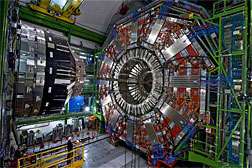
CMS experiment. Credit: CERN

Scientists working on the CMS experiment at the Large Hadron Collider have confirmed the existence of an odd, puzzling particle first observed a few years ago at DOE's Tevatron particle collider. Members of the CMS collaboration announced on Nov. 14 that they had spotted the curious object, dubbed Y(4140), which scientists had discovered at the CDF experiment at Fermilab.

The particle has a mass of 4.1 billion electronvolts (GeV) and seems to be related to a handful of X and Y particles previously found at other laboratories. These particles are well measured but poorly understood. They don't fit the common pattern in which quarks and antiquarks bind together to form protons, neutrons, pions and other particles.

Some theorists think that X and Y particles resemble molecular structures. Perhaps they are made of two quark-antiquark pairs bound together for a short period of time. Or they could be something completely different.

With additional data, CMS scientists hope to understand the exact composition of the Y(4140) and get to the bottom of this mystery.

Explore further: Tevatron scientists announce their final results on the Higgs particle

add to favorites email to friend print save as pdf

Related Stories

Particle oddball surprises physicists

Mar 18, 2009

(PhysOrg.com) -- Scientists of the CDF experiment at the Department of Energy's Fermi National Accelerator Laboratory announced yesterday that they have found evidence of an unexpected particle whose curious ...

Fermilab's CDF observes Omega-sub-b baryon

Jun 29, 2009

(PhysOrg.com) -- At a recent physics seminar at the Department of Energy’s Fermi National Accelerator Laboratory, Fermilab physicist Pat Lukens of the CDF experiment announced the observation of a new particle, ...

Tevatron experiments close in on favored Higgs mass range

Jul 21, 2011

(PhysOrg.com) -- Experiments at the Department of Energy’s Fermilab are close to reaching the critical sensitivity that is necessary to look for the existence of a light Higgs particle. Scientists from both the CDF and ...

Recommended for you

Bringing life into focus

May 17, 2013

Spinning-disk confocal microscopy is an optical imaging technique that can be used to generate detailed three-dimensional fluorescence images of living cells and their contents. Although a powerful tool for ...

World's smallest droplet

May 17, 2013

(Phys.org) —Physicists may have created the smallest drops of liquid ever made in the lab. That possibility has been raised by the results of a recent experiment conducted by Vanderbilt physicist Julia Velkovska and her ...

User comments : 1

Adjust slider to filter visible comments by rank

Display comments: newest first

vacuum-mechanics
1 / 5 (3) Dec 05, 2012
The particle has a mass of 4.1 billion electronvolts (GeV) and seems to be related to a handful of X and Y particles previously found at other laboratories. These particles are well measured but poorly understood. They don't fit the common pattern in which quarks and antiquarks bind together to form protons, neutrons, pions and other particles….


May be they are not true particles (something like electrons), because we do not know their mechanism explaining how it works. But rather they are just 'condensed disturbed vacuum fields'! The reason behind is that conventionally, they are coherent states of vacuum fields (this is why they are unstable). To visualize the mechanism which explains how it works, see…
http://www.vacuum...=9〈=en

More news stories

New principle may help explain why nature is quantum

Like small children, scientists are always asking the question 'why?'. One question they've yet to answer is why nature picked quantum physics, in all its weird glory, as a sensible way to behave. Researchers ...

Expectations high for next Xbox

It's almost time for a new Xbox. Eight years have passed since Microsoft unveiled the Xbox 360, double the amount of time between the original Xbox debut in 2001 and its high-definition successor's launch ...

US adviser on board of firm that sold anthrax drug

(AP)—Former Navy Secretary Richard J. Danzig, who has served as a bio-warfare adviser to the president, the Pentagon, and the Department of Homeland Security, urged the government to stockpile an anti-anthrax drug while ...