NASA infrared data shows Typhoon Bopha re-strengthened in South China Sea
Dec 07, 2012
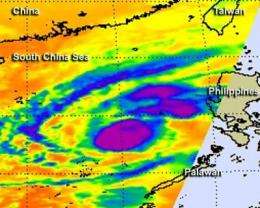
On Dec. 6 at 1:11 p.m. EST/U.S., NASA AIRS infrared data revealed the strongest thunderstorms (purple) within Typhoon Bopha surrounded the center of circulation and were in bands of thunderstorms north and northeast of the center, just skirting the west coast of Luzon, the northern Philippines. AIRS is an instrument that flies aboard NASA's Aqua satellite. Credit: NASA JPL, Ed Olsen

The deadly typhoon that caused almost 300 deaths in the southern Philippines is making a loop in the South China Sea, and infrared NASA satellite data indicated that Bopha re-intensified.

's Aqua satellite passed over Bopha on Dec. 6 at 1811 UTC (1:11 p.m. EST, U.S.) and the Atmospheric Infrared Sounder (AIRS) instrument aboard captured an infrared look at the storm. The revealed where the coldest, highest cloud tops were. The coldest indicate the strongest storms with the heaviest rain, and AIRS data revealed they surrounded the center of circulation and were in bands of north and northeast of the center, just skirting the west coast of Luzon, the northern Philippines. Cloud top temperatures in those areas were colder than -63 Fahrenheit (-52 Celsius). Satellite data showed the Bopha's eye on Dec. 7 was about 11 nautical miles in diameter.

On Dec. 7 at 1500 UTC (10 a.m. EST, U.S.), Typhoon Bopha's were back up to 110 knots (126 mph/203.7 kph). Bopha was in the South China Sea near 15.7 north latitude and 116.3 east longitude about 280 nautical miles (322.2 miles/518.6 km) west of Manila, the Philippines. Bopha was moving to the north-northeast at 9 knots (10.3 mph/16/6 kph), but is expected to make a cyclonic loop over the weekend of Dec. 8 and 9, with its center staying at sea. The west coast of Luzon may experience rough surf over the next several days as Bopha makes its circle.

After Bopha loops over open ocean, it is expected to weaken and turn southwest after the weekend.

Explore further: NASA satellites analyze Typhoon Bopha inside and out

add to favorites email to friend print save as pdf

Related Stories

NASA satellites analyze Typhoon Bopha inside and out

Dec 05, 2012

Typhoon Bopha proved deadly to residents in the Mindanao region of the Philippines after ravaging islands in Micronesia. NASA's Aqua and TRMM satellites peered at the storm inside and out, providing forecasters ...

Recommended for you

NASA's BARREL mission launches 20 balloons

9 hours ago

(Phys.org) —In Antarctica in January, 2013 – the summer at the South Pole – scientists released 20 balloons, each eight stories tall, into the air to help answer an enduring space weather question: ...

Power of US tornado dwarfs Hiroshima bomb

10 hours ago

Wind, humidity and rainfall combined precisely to create Monday's massive killer tornado in Oklahoma. The awesome amount of energy released dwarfed the power of the atomic bomb that leveled Hiroshima.

Origins of human culture linked to rapid climate change

16 hours ago

Rapid climate change during the Middle Stone Age, between 80,000 and 40,000 years ago, during the Middle Stone Age, sparked surges in cultural innovation in early modern human populations, according to new research.

User comments : 0

More news stories

NASA's BARREL mission launches 20 balloons

(Phys.org) —In Antarctica in January, 2013 – the summer at the South Pole – scientists released 20 balloons, each eight stories tall, into the air to help answer an enduring space weather question: ...

If you can remember it, you can remember it wrong

(Medical Xpress)—Native peoples in regions where cameras are uncommon sometimes react with caution when their picture is taken. The fear that something must have been stolen from them to create the photo ...

B vitamins could delay dementia

(Medical Xpress)—Despite spending billions of dollars on research and development, drug companies have been unable to come up with effective treatments for dementia and Alzheimer's Disease (AD). Now, A. ...

Encouraging signs for bee biodiversity

Declines in the biodiversity of pollinating insects and wild plants have slowed in recent years, according to a new study. Researchers led by the University of Leeds and the Naturalis Biodiversity Centre in the Netherlands ...