Key pathological mechanism found in plague bacterium
Dec 03, 2012
Key pathological mechanism found in plague bacterium

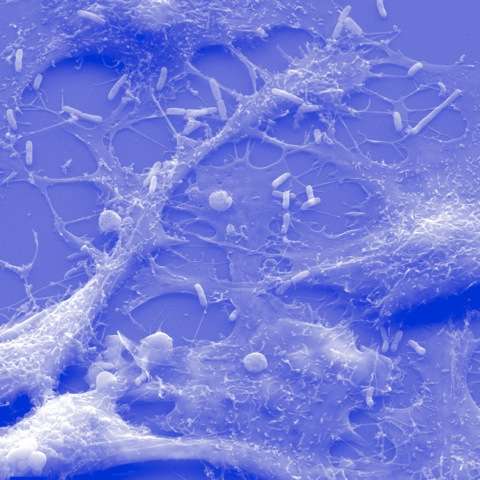
(Phys.org)—A more than 50-year-old question has now been answered. Chemists and microbiologists at the Biological Chemistry Center at Umeå University in Sweden are now able to describe in detail the role of calcium in the ability of the plague bacterium Yersinias to cause disease.

In the 14th century, the Black Death claimed the lives of one third of the population of Europe. Even though the bacterium Yersinia pestis, which causes the disease, is regarded as eradicated in Europe, the World Health Organization is still reporting epidemics in Africa, Asia, and America. Bacteria in the Yersinia family can also lead to severe and diarrheas.

A key question that originated in research done in the 1950s is how calcium can play a critical role in the ability of Yersinia to cause disease. This long-lived issue has now been resolved by an interdisciplinary research team at Umeå University who are revealing the underlying the importance of calcium.

"It was previously known that calcium inhibits an important step during the infection process. We have now identified a specific protein called YscU, which binds calcium, and we believe that this is an important part of the calcium effect," says Hans Wolf-Watz, a senior professor at the Department of .

Together with Magnus Wolf-Watz, an assistant professor at the Department of Chemistry, he has shown that the breakdown of the protein YscU is a necessary step in the infection process.

"With NMR experiments, we have been able, on the one hand, to study the details surrounding this degradation and, on the other hand, to identify which part of YscU binds to calcium," says Magnus Wolf-Watz.

is a method used by researchers to determine the structure and composition of molecules. At the joint NMR Center at the Center, a new high-field 850 MHz instrument was inaugurated a week ago.

"This new instrument will provide opportunities for exciting new discoveries in our research field and in other fields, and the resource is available to scientists at other Swedish higher-education institutions," says Magnus Wolf-Watz.

The research findings are published in the journal PLOS ONE.

Explore further: Researchers discover turbo switch of calcium pump in biological cells

More information: Frost, S. et al., Autoproteolysis and Intramolecular dissociation of Yersinia YscU precedes secretion of its C-terminal polypeptide YscUCC, PLOS ONE, 2012. dx.plos.org/10.1371/journal.pone.0049349

add to favorites email to friend print save as pdf

Related Stories

Protein structures give disease clues

Feb 01, 2012

Using some of the most powerful nuclear magnetic resonance equipment available, researchers at the University of California, Davis, are making discoveries about the shape and structure of biological molecules ...

US approves new treatment for ancient plague

Apr 27, 2012

Hardly anyone succumbs to the bubonic plague these days, but US health authorities on Friday approved a new treatment for it and other forms of the potentially deadly bacterial infection.

Squeeze play: Protein's grip like a baseball bunter's

Oct 10, 2006

Like all good baseball players, the protein calmodulin appreciates the importance of maintaining a good grip. A vital regulatory protein in all plants and animals, calmodulin is known to grab hold of hundreds of different ...

Recommended for you

Intestinal bacteria protect against E. coli O157:H7

10 hours ago

A cocktail of non-pathogenic bacteria naturally occurring in the digestive tract of healthy humans can protect against a potentially lethal E. coli infection in animal models according to research presented today at the 11 ...

Explainer: What are stem cells?

16 hours ago

In a paper published in Cell yesterday, scientists from the US and Thailand have, for the first time, successfully produced embryonic stem cells from human skin cells. ...

Cattle disease bacteria widespread in the UK

17 hours ago

A new study has found that bacteria responsible for chronic intestinal inflammation in cattle, which have also been implicated in Crohn's disease in humans, are widespread in the UK countryside.

Mapping a route to stem cell therapies

18 hours ago

Monash University researchers are shedding light on the complex processes that underpin the creation and differentiation of stem cells, bringing closer the promise of 'miracle' therapies.

X-ray tomography on a living frog embryo

May 16, 2013

Classical X-ray radiographs provide information about internal, absorptive structures of organisms such as bones. Alternatively, X-rays can also image soft tissues throughout early embryonic development of ...

User comments : 0

More news stories

New immune system discovered

(Medical Xpress)—A research team, led by Jeremy Barr, a biology post-doctoral fellow, unveils a new immune system that protects humans and animals from infection.

Lab sets a new record for creating heralded photons

(Phys.org) —Entanglement, by general consensus of physicists, is the weirdest part of quantum science. To say that two particles, A and B, are entangled means that they are actually two parts of an inseparable ...