A cosmic holiday ornament, Hubble-style
Dec 18, 2012
Credit: NASA, ESA, and the Hubble Heritage Team (STScI/AURA)

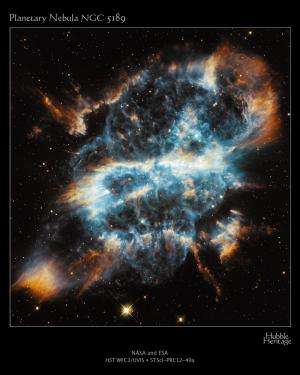
(Phys.org)—'Tis the season for holiday decorating and tree-trimming. Not to be left out, astronomers using NASA's Hubble Space Telescope have photographed a festive-looking nearby planetary nebula called NGC 5189. The intricate structure of this bright gaseous nebula resembles a glass-blown holiday ornament with a glowing ribbon entwined.

Planetary nebulae represent the final brief stage in the life of a medium-sized star like our Sun. While consuming the last of the fuel in its core, the dying star expels a large portion of its outer envelope. This material then becomes heated by the radiation from the and radiates, producing glowing clouds of gas that can show complex structures, as the ejection of mass from the star is uneven in both time and direction.

A spectacular example of this beautiful complexity is seen in the bluish lobes of NGC 5189. Most of the nebula is knotty and filamentary in its structure. As a result of the mass-loss process, the has been created with two nested structures, tilted with respect to each other, that expand away from the center in different directions.

This video is not supported by your browser at this time.
This is a video zoom into the region of sky containing the planetary nebula NGC 5189. The nebula has a knotty and filamentary structure surrounding bluish lobes. The nebula was formed by gases escaping from a dying Sun-like star. The nebula is located several thousand light-years away in the southern constellation Musca. Credit: NASA, ESA, and G. Bacon (STScI)

This double bipolar or quadrupolar structure could be explained by the presence of a orbiting the central star and influencing the pattern of mass ejection during its nebula-producing death throes. The remnant of the central star, having lost much of its mass, now lives its final days as a white dwarf. However, there is no visual candidate for the possible companion.

The bright golden ring that twists and tilts through the image is made up of a large collection of radial filaments and cometary knots. These are usually formed by the combined action of photo-ionizing radiation and stellar winds.

This image was taken with Hubble's 3 on October 8, 2012, in filters tuned to the specific colors of fluorescing sulfur, hydrogen, and . Broad filters in the visible and near-infrared were used to capture the star colors.

Explore further: Image: Hubble's 'smoky' shells

Related Stories

The Last Confessions of a Dying Star

Mar 04, 2008

Probing a glowing bubble of gas and dust encircling a dying star, NASA's Hubble Space Telescope reveals a wealth of previously unseen structures.

The Colorful Demise of a Sun-Like Star

Feb 13, 2007

This image, taken by NASA's Hubble Space Telescope, shows the colorful "last hurrah" of a star like our Sun. The star is ending its life by casting off its outer layers of gas, which formed a cocoon around ...

Image: Hubble's 'smoky' shells

Dec 17, 2012

(Phys.org)—Located in a relatively vacant region of space about 4,200 light-years away and difficult to see using an amateur telescope, the lonesome planetary nebula NGC 7354 is often overlooked. However, ...

Hubble serves up a holiday snow angel

Dec 15, 2011

(PhysOrg.com) -- NASA’s Hubble Space Telescope presents a festive holiday greeting that’s out of this world. The bipolar star-forming region, called Sharpless 2-106, looks like a soaring, celestial ...

Hubble Captures Stars Going Out in Style

Sep 11, 2007

The colorful, intricate shapes in these NASA Hubble Space Telescope images reveal how the glowing gas ejected by dying Sun-like stars evolves dramatically over time.

Recommended for you

Three centaurs follow Uranus through the solar system

Jun 18, 2013

Astrophysicists from the Complutense University of Madrid have confirmed that Crantor, a large asteroid with a diameter of 70 km has an orbit similar to that of Uranus and takes the same amount of time to ...

Final curtain for Europe's deep-space telescope

Jun 17, 2013

The deep-space telescope Herschel took its final bow on Monday, climaxing a successful four-year mission to observe the birth of stars and galaxies, the European Space Agency (ESA) said.

Hubble spots a very bright contortionist

Jun 17, 2013

(Phys.org) —The contorted object captured by Hubble in this picture is IRAS 22491-1808, also known as the South America Galaxy. It is an ultra-luminous infrared galaxy (ULIRG) that emits a huge amount of ...

Study explains decades of black hole observations

Jun 14, 2013

(Phys.org) —A new study by astronomers at NASA, Johns Hopkins University and Rochester Institute of Technology confirms long-held suspicions about how stellar-mass black holes produce their highest-energy ...

User comments : 1

Adjust slider to filter visible comments by rank

Display comments: newest first

lengould100
not rated yet Dec 18, 2012
I love seeing the product of these powerful telescopes. Very impressive.

More news stories

Metamorphosis of moon's water ice explained

Using data gathered by NASA's Lunar Reconnaissance Orbiter (LRO) mission, scientists believe they have solved a mystery from one of the solar system's coldest regions—a permanently shadowed crater on the ...

Looking at sachet water consumption in Ghana

Many of West Africa's largest cities continue to lag in their provision of piped water to residents. Filling the service gap are plastic water sachets, which have become an important source of drinking water ...

LA to give every student an iPad; $30M order

Los Angeles' school system, the second largest in the United States, is ordering iPads for all its students, handing Apple a major success in its quest to make the tablet computer a replacement for textbooks.