Video-article shows how to purify magnetic bacteria
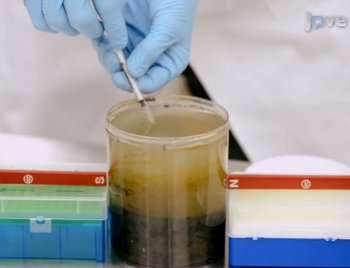
Magnetotactic bacteria, like Magnetospirillum magneticum, have evolved cellular processes that allow them to take up iron molecules to produce magnetic nanocrystals like magnetite. Since they were first discovered and isolated in 1975 by Robert Blakemore, scientists continue to be fascinated by these unique bacteria, whether as a means to isolate biogenic magnetite or to understand the evolutionary advantages of producing these minerals. A new video-article in JoVE (Journal of Visualized Experiments) details a procedure to purify and enrich samples of magnetotactic bacteria from aquatic environments, developed in the laboratory of Dr. Brian Lower at The Ohio State University.
Magnetotactic bacteria are microorganisms, typically found in stratified water columns or aquatic sediments all over the world. Though many of these bacteria tend to thrive in environments with low levels of oxygen, the defining characteristic they share are small, magnetic, membrane bound nanocrystals of either the iron oxide magnetite or the iron sulfide greigite.
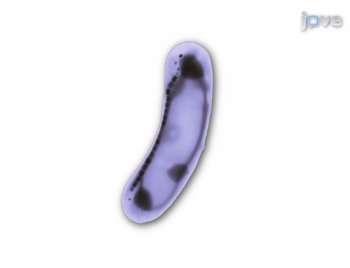
"These nanocrystals allow the organisms to align themselves with the earth's magnetic field and swim up or down based on the geomagnetic field to find their microenvironments," Dr. Lower explains. "These bacteria are fairly ubiquitous. They can be found all over the world, and interestingly they can be found in sediment samples from millions of years ago."
These bacteria are a valuable anomaly to the scientific community. Their fossil record gives geologists accurate representations of the Earth's past magnetic field, when combined with carbon dating, and could potentially provide other clues about earth's geological history. The magnetotactic minerals may also have medical or other novel applications. "You can coat these minerals with antibodies and target specific cancer cell lines or heat the magnets with an alternating magnetic field to kill a cancer cell line," says Dr. Lower.
"We decided to publish in JoVE because it will allow a wide variety of scientists to see how easy it is to isolate and enrich these species. We hope the video-protocol will spur other collaborations or new research," Dr. Lower said. The article will be published on November 15, 2012 in JoVE's General section. JoVE acquisition editor Rachelle Baker stated, "We are very excited for this article not only because it is our first featuring magnetotactic bacteria but we believe it will lay a foundation for other groups to build expand upon this work and share their methods with the community, which is the founding principle of JoVE."
More information: Lower et. al. www.JoVE.com/video/50123/colle … urring-magnetotactic
Journal information: Journal of Visualized Experiments
Provided by The Journal of Visualized Experiments


