Solar minimum; solar maximum
Nov 27, 2012 by Karen C. Fox

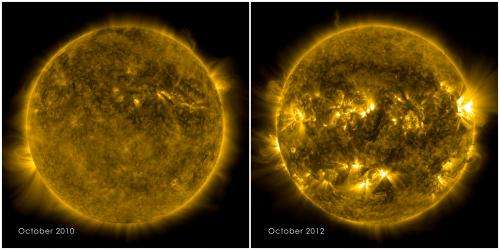
(Phys.org)—The picture on the left shows a calm sun from Oct. 2010. The right side, from Oct. 2012, shows a much more active and varied solar atmosphere as the sun moves closer to peak solar activity, a peak known as solar maximum, predicted for 2013. Both images were captured by NASA's Solar Dynamics Observatory (SDO) observing light emitted from the 1 million degree plasma, which is a good temperature for observing the quiet corona. Credit: NASA/SDO

The sun goes through a natural solar cycle approximately every 11 years. The cycle is marked by the increase and decrease of sunspots—visible as dark blemishes on the sun's surface, or photosphere. The greatest number of sunspots in any given solar cycle is designated as "." The lowest number is "solar minimum."

The solar cycle provides more than just increased sunspots, however. In the sun's atmosphere, or corona, bright active regions appear, which are rooted in the lower sunspots. Scientists track the active regions since they are often the origin of eruptions on the sun such as or coronal mass ejections.

The most recent occurred in 2008, and the sun began to ramp up in January 2010, with an M-class flare (a flare that is 10 times less powerful than the largest flares, labeled X-class). The sun has continued to get more active, with the next solar maximum predicted for 2013.

The journey toward solar maximum is evident in current images of the sun, showing a marked difference from those of 2010, with bright active regions dotted around the star.

Explore further: Sun emit a mid-level flare

add to favorites email to friend print save as pdf

Related Stories

The Sun Loses its Spots

Jul 24, 2007

While sidewalks crackle in the summer heat, NASA scientists are keeping a close eye on the sun. It is almost spotless, a sign that the Sun may have reached solar minimum. Scientists are now watching for the ...

Sun emit a mid-level flare

Nov 13, 2012

(Phys.org)—On Nov. 13, 2012, the sun emitted a mid-level solar flare, peaking at 9:04 p.m. EST.

Space Image: Sunspots and solar flares

Mar 21, 2012

(PhysOrg.com) -- NASA's Solar Dynamics Observatory (SDO) captured this image of an M7.9 class flare on March 13, 2012 at 1:29 p.m. EDT. It is shown here in the 131 Angstrom wavelength, a wavelength particularly ...

NASA sees Sun send out mid-level solar flare

Jul 19, 2012

The sun emitted a mid-level solar flare on July 19, 2012, beginning at 1:13 AM EDT and peaking at 1:58 AM. Solar flares are gigantic bursts of radiation that cannot pass through Earth's atmosphere to harm ...

NASA sees active region on the sun emit another flare

Oct 23, 2012

The sun emitted a significant solar flare on Oct. 22, 2012, peaking at 11:17 p.m. EDT. The flare came from an active region on the left side of the sun that has been numbered AR 1598, which has already been ...

Recommended for you

NASA head views progress on asteroid lasso mission

11 hours ago

Surrounded by engineers, NASA chief Charles Bolden inspected a prototype spacecraft engine that could power an audacious mission to lasso an asteroid and tow it closer to Earth for astronauts to explore.

Ecuador satellite collides with Russian space junk

11 hours ago

A small Ecuadoran satellite collided in orbit with the remains of a Russian rocket, but it is too soon to know how much damage it might have sustained, Quito's space agency said Thursday.

Forecast for Titan: Wild weather could be ahead

May 22, 2013

(Phys.org) —Saturn's moon Titan might be in for some wild weather as it heads into its spring and summer, if two new models are correct. Scientists think that as the seasons change in Titan's northern hemisphere, ...

SDO observes mid-level solar flare

May 22, 2013

UPDATE 16:30 p.m. EDT: The M7-class flare was also associated with a coronal mass ejection or CME, another solar phenomenon that can send billions of tons of particles into space. While this CME was not Ea ...

User comments : 0

More news stories

A hidden population of exotic neutron stars

(Phys.org) —Magnetars – the dense remains of dead stars that erupt sporadically with bursts of high-energy radiation - are some of the most extreme objects known in the Universe. A major campaign using ...

Hubble reveals the ring nebula's true shape

(Phys.org) —The Ring Nebula's distinctive shape makes it a popular illustration for astronomy books. But new observations by NASA's Hubble Space Telescope of the glowing gas shroud around an old, dying, ...

NASA head views progress on asteroid lasso mission

Surrounded by engineers, NASA chief Charles Bolden inspected a prototype spacecraft engine that could power an audacious mission to lasso an asteroid and tow it closer to Earth for astronauts to explore.

Controlling mood through the motions of mitochondria

(Medical Xpress)—Regulating the distribution of power in neurons is done by a system that makes the national electric grid look simple by comparison. Each neuron has several thousand mitochondria confined ...

A quantum simulator for magnetic materials

Physicists understand perfectly well why a fridge magnet sticks to certain metallic surfaces. But there are more exotic forms of magnetism whose properties remain unclear, despite decades of intense research. ...