Researchers identify a simple way to precipitate phosphorus from the wastewater of a pulp mill
Nov 21, 2012
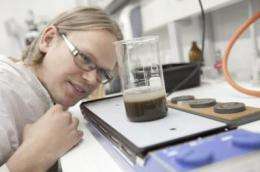
Background researcher Timo Laukkanen, D.Sc. (Tech.). Credit: Adolfo Vera

Researchers at Aalto University have developed a simple method for reducing the amount of phosphorus in the wastewater of a pulp mill. The method is called simultaneous precipitation using iron sulphate. A separate treatment stage is not required, as the precipitation takes place simultaneously with the actual biological wastewater treatment.

Iron sulphate is added to the wastewater prior to the biological wastewater treatment process, and the dissolved into the water is precipitated with the at the treatment plant. Finally, the phosphorus is removed from the plant with the sludge. In Finland, sludge is generally burned, in which case the phosphorus would end up in the ashes and would thus be reusable in the form of , for example.

"At best, the amount of phosphorus in the wastewater was reduced by more than 80 per cent, when the amount of iron fed into the process was 10 per liter," commented researcher Sakari Toivakainen, who is currently preparing his doctoral dissertation.

Simultaneous precipitation creates savings in wastewater treatment costs

Public authorities are calling for the lowering of phosphorus emissions. For this reason, many have adopted an additional post-treatment precipitation stage, which is usually implemented using aluminium.

"Post-treatment precipitation using produces difficult-to-process . On the whole, simultaneous precipitation would seem to be a more advantageous option," Timo Laukkanen, Doctor of Science (Technology), concludes.

Simultaneous precipitation does not require additional wastewater treatment units, so there is no need for additional energy in the treatment of the water, either. An additional benefit of the method is that iron sulphate is an inexpensive chemical. A municipal in Saint Petersburg constructed a few years ago employs simultaneous precipitation, among other methods. The industry, on the other hand, is only just waking up to the possibility of applying simultaneous precipitation. Wastewater from the forestry industry contains less phosphorus than municipal wastewater, so the dosage of the iron chemical remains within reasonable limits.

Experiments at the pulp mill

Initially, the research was carried out in the laboratories of Otaniemi and at the plant using pilot equipment. The results were so promising that, later on; iron precipitation was also successfully tested at the wastewater treatment section of a pulp mill.

"From the viewpoint of comprehensive environmental protection and sustainable development, the best method is always the one that saves energy and minimises the amount of waste. With the help of the studied simultaneous precipitation method, it is possible to completely avoid additional stages of wastewater treatment, reduce the amount of solid waste and save energy. Simultaneous precipitation produces hundreds of thousands of euros worth of savings in operating costs, as energy consumption and the need for additional chemicals is reduced," Professor Olli Dahl crystallises.

The research has been published in the Water Science & Technology journal.

Explore further: Using wastewater as fertilizer

add to favorites email to friend print save as pdf

Related Stories

'Bacterial shock' to recapture essential phosphate

Mar 27, 2012

Bacteria could be exploited to recapture dwindling phosphate reserves from wastewater according to research presented at the Society for General Microbiology's Spring Conference in Dublin this week.

Using wastewater as fertilizer

Aug 03, 2012

Sewage sludge, wastewater and liquid manure are valuable sources of fertilizer for food production. Fraunhofer researchers have now developed a chemical-free, eco-friendly process that enables the recovered ...

Household sewage: Not waste, but a vast new energy resource

Jan 05, 2011

In a finding that gives new meaning to the adage, "waste not, want not," scientists are reporting that household sewage has far more potential as an alternative energy source than previously thought. They say the discovery, ...

Wastewater: Energy of the future?

Nov 14, 2005

Professor Jurg Keller at Australia's University of Queensland said he and his colleagues have discovered how to turn wastewater into electricity.

New methods for better purification of wastewater

Mar 05, 2012

Before wastewater reaches recipient waters, nutrients must be removed in order to avoid eutrophication and large algal blooms, which may result in serious damage to animal and plant life. Robert Almstrand at the University ...

Recommended for you

New method for producing clean hydrogen

8 hours ago

Duke University engineers have developed a novel method for producing clean hydrogen, which could prove essential to weaning society off of fossil fuels and their environmental implications.

Making ice-cream more nutritious with meat left-overs

15 hours ago

Food industries are now turning meat left-over into high-protein content ingredients for food supplements, or to be added to processed food. But a EU-wide regulation covering them is still lacking.

Non-wetting fabric drains sweat

May 20, 2013

(Phys.org) —Waterproof fabrics that whisk away sweat could be the latest application of microfluidic technology developed by bioengineers at the University of California, Davis.

Protein study suggests drug side effects are inevitable

May 20, 2013

A new study of both computer-created and natural proteins suggests that the number of unique pockets – sites where small molecule pharmaceutical compounds can bind to proteins – is surprisingly small, meaning drug side ...

Attacking MRSA with metals from antibacterial clays

May 17, 2013

In the race to protect society from infectious microbes, the bugs are outrunning us. The need for new therapeutic agents is acute, given the emergence of novel pathogens as well as old foes bearing heightened antibiotic resistance.

User comments : 0

More news stories

New method for producing clean hydrogen

Duke University engineers have developed a novel method for producing clean hydrogen, which could prove essential to weaning society off of fossil fuels and their environmental implications.

Protein study suggests drug side effects are inevitable

A new study of both computer-created and natural proteins suggests that the number of unique pockets – sites where small molecule pharmaceutical compounds can bind to proteins – is surprisingly small, meaning drug side ...

Beautiful 'flowers' self-assemble in a beaker

By simply manipulating chemical gradients in a beaker of fluid, materials scientists at Harvard have found that they can control the growth behavior of crystals to create precisely tailored structures—such ...

Attacking MRSA with metals from antibacterial clays

In the race to protect society from infectious microbes, the bugs are outrunning us. The need for new therapeutic agents is acute, given the emergence of novel pathogens as well as old foes bearing heightened antibiotic resistance.

If you can remember it, you can remember it wrong

(Medical Xpress)—Native peoples in regions where cameras are uncommon sometimes react with caution when their picture is taken. The fear that something must have been stolen from them to create the photo ...

B vitamins could delay dementia

(Medical Xpress)—Despite spending billions of dollars on research and development, drug companies have been unable to come up with effective treatments for dementia and Alzheimer's Disease (AD). Now, A. ...