Researchers discover how mole rat wards off cancer
Nov 05, 2012
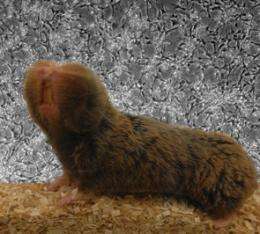
A blind mole rat is shown on the background of dying necrotic blind mole rat cells. Credit: University of Rochester

Biologists at the University of Rochester have determined how blind mole rats fight off cancer—and the mechanism differs from what they discovered three years ago in another long-lived and cancer-resistant mole rat species, the naked mole rat.

The team of researchers, led by Professor Vera Gorbunova and Assistant Professor Andrei Seluanov, found that abnormally growing cells in blind mole rats secrete the protein, which causes those cells to rapidly die. Seluanov and Gorbunova hope the discovery will eventually help lead to new cancer therapies in humans. Their findings are being published this week in the .

Blind mole rats and naked mole rats—both subterranean rodents with long life spans—are the only mammals never known to develop cancer. Three years ago, Seluanov and Gorbunova determined the anti-cancer mechanism in the . Their research found that a specific gene—p16—makes the in naked mole rats hypersensitive to , and stops them from proliferating when too many crowd together.

"We expected blind mole rats to have a similar mechanism for stopping the spread of cancerous cells," said Seluanov. "Instead, we discovered they've evolved their own mechanism."

Gorbunova and Seluanov made their discovery by isolating cells from blind mole rats and forcing them to proliferate in culture beyond what occurs in the animal. After dividing approximately 15-20 times, all of the cells in the culture dish died rapidly. The researchers determined that the rapid death occurred because the cells recognized their pre-cancerous state and began secreting a suicidal protein, called interferon beta. The died by a mechanism which kills both and their neighbors, resulting in a "clean sweep."

"Not only were the cancerous cells killed off, but so were the adjacent cells, which may also be prone to tumorous behavior," said Seluanov.

"While people don't use the same cancer-killing mechanism as blind mole rats, we may be able to combat some cancers and prolong life, if we could stimulate the same clean sweep reaction in cancerous human cells," said Gorbunova.

The research team also included Christopher Hine, Xiao Tian, and Julia Ablaeva in Rochester, Andrei Gudkov at Roswell Park Cancer Institute in Buffalo, NY, and Eviatar Nevo at the University of Haifa in Israel.

Gorbunova and Seluanov say they next want to find out exactly what triggers the secretion of interferon beta after cancerous cells begin proliferating in blind mole rats.

Gorbunova believes the anti-cancer mechanism is an adaptation to subterranean life. "Blind mole rats spend their lives in underground burrows protected from predators," said Gorbunova. "Living in this environment, they could perhaps afford to evolve a long lifespan, which includes developing efficient anti-cancer defenses."

Explore further: Naked mole-rats may hold clues to pain relief

More information: "Cancer resistance in the blind mole rat is mediated by concerted necrotic cell death mechanism," by Vera Gorbunova et al. www.pnas.org/content/early/2012/10/31/1217211109.short

Related Stories

Naked mole-rats bear lifesaving clues

Feb 23, 2012

Could blind, buck-toothed, finger-sized naked mole-rats harbor in their brain cells a survival secret that might lead to better heart attack or stroke treatments?

A new soldier in the war on cancer: The blind mole rat

Mar 04, 2009

If someone ever calls you a "dirty rat," consider it a compliment. A new discovery published online in the FASEB Journal shows that cellular mechanisms used by the blind mole rat to survive the very low oxygen environment of its ...

Naked mole-rats may hold clues to pain relief

Sep 22, 2012

Naked mole-rats evolved to thrive in an acidic environment that other mammals, including humans, would find intolerable. Researchers at the University of Illinois at Chicago report new findings as to how ...

Recommended for you

Unlocking secrets of cell reproduction

6 hours ago

Research published in Open Biology today identifies, for the first time, nearly all the genes required for reproduction of a cell in a living organism.

What the smallest infectious agents reveal about evolution

18 hours ago

Radically different viruses share genes and are likely to share ancestry, according to research published in BioMed Central's open access journal Virology Journal this week. The comprehensive phylogenomic analysis compar ...

User comments : 4

Adjust slider to filter visible comments by rank

Display comments: newest first

Jeddy_Mctedder
2.3 / 5 (3) Nov 05, 2012
If they evolved a method to defeat cancer perhaps its beccause they at one point had to survive in conditions that required them to obtain cancer to succesfully reproduce.
chromosome2
3.7 / 5 (3) Nov 05, 2012
If they evolved a method to defeat cancer perhaps its beccause they at one point had to survive in conditions that required them to obtain cancer to succesfully reproduce.


That's true in a completely different way than you realize. When the engine your genetic progress is mutation and death, there's going to be a cancer tax.
Sinister1811
1 / 5 (1) Nov 06, 2012
There must have been a reason for the adaptation. They might live in conditions that would promote or encourage the development of cancer. Maybe living underground would expose them to more radioactive elements or carcinogens. It would be amazing if they could reproduce this type of adaptation in humans, perhaps through genetic engineering.
Birger
5 / 5 (1) Nov 06, 2012
If technology develops the ability to insert these anti-cancer genes into the human genome, the opposition to human germline GM will evaporate. Even if such practices were outlawed, rich parents would pay labs abroad to get children immune from cancer.

More news stories

White tiger mystery solved

White tigers today are only seen in zoos, but they belong in nature, say researchers reporting new evidence about what makes those tigers white. Their spectacular white coats are produced by a single change ...

Unlocking secrets of cell reproduction

Research published in Open Biology today identifies, for the first time, nearly all the genes required for reproduction of a cell in a living organism.

Amazon expands Kindle tablet sale to 170 countries

Online retail titan Amazon announced Thursday it is expanding sales of its Kindle tablet computers to "over 170 countries and territories around the world," and its Appstore in nearly 200 countries.

Google to add Galapagos Islands to Street View

Few have explored the remote volcanic islands of the Galapagos archipelago, an otherworldly landscape inhabited by the world's largest tortoises and other fantastical creatures that inspired Charles Darwin's theory of evolution.