Waste plant materials remaining from palm oil extraction processes can now be converted into a useful sugar
Nov 21, 2012
Green chemistry: The sweet conversion of a by-product
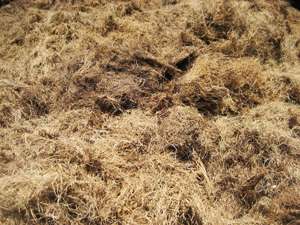
After the extraction of oil from the oil palm plant, the remaining plant matter (above) can be converted into useful chemicals, including xylose. Credit: 2012 A*STAR Institute of Chemical & Engineering Sciences

Palm oil extraction annually produces approximately 13 million tons of waste plant matter. Some of this by-product, known as empty fruit bunch (EFB), is currently incinerated to produce heat and electricity to run palm oil mills, but it is now on the path to a sweeter use. By adapting and optimizing an established technique to convert sugarcane bagasse and corn stover to the useful sugar xylose, a research team in Singapore, led by Jin Chuan Wu from the A*STAR Institute of Chemical and Engineering Sciences, has  experimentally extracted high yields of xylose from EFB.

EFB contains xylan, which is a carbohydrate made up of units of xylose. Xylan is very susceptible to being broken down to these individual in the presence of mild acid. Known as , this process is not widely applied to EFB—despite its well-established use for converting sugarcane bagasse and —because of difficulties in making it cost effective. The key to Wu and his team's success was the combination of acids they selected for hydrolyzing EFB: sulfuric (H2SO4) and phosphoric acid (H3PO4). "The combined use of H2SO4 and H3PO4 has a synergistic effect in improving sugar yields," explains Wu.

Since the elements sulfur and phosphorus are essential for the fermentation of xylose using microbes, the researchers' combination of acids will play a fundamental role in the further conversion of xylose into other useful chemicals, such as the sugar substitute xylitol, lactic acid and ethanol. After hydrolysis and neutralization, these acid components can be used directly in a microbial fermentation. Hydrolysis requires the levels of these elements to be low, with higher levels being detrimental. In previous EFB hydrolysis techniques, higher concentrations of acids were used, but the levels of sulfur and phosphorous were too high for the microbial fermentation stage.

After discerning the right combination of mild acids, Wu and his team used computer modeling followed by supporting experiments to find the optimal conditions for hydrolysis. They obtained xylose yields of 80–90%. The conditions they optimized included the concentrations of the two acids, the reaction temperature, the dilution of the solution and the size of the EFB particles.

"Next, we will convert the sugars into lactic acids by microbial fermentation using lactic acid bacteria," explains Wu. This lactic acid will be used for producing polylactic acid: a renewable and completely biodegradable biopolymer, that he says is stable at high temperatures and has broad applications.

Explore further: Beating the fuel prices: Using yeast for economic production of bioethanol

More information: Zhang, D., Ong, Y. L., Li, Z. & Wu, J. C. Optimization of dilute acid-catalyzed hydrolysis of oil palm empty fruit bunch for high yield production of xylose. Chemical Engineering Journal 181–182, 636–642 (2012). www.sciencedirect.com/science/article/pii/S1385894711015488

add to favorites email to friend print save as pdf

Related Stories

Novel gene increases yeast's appetite for plant sugars

Jul 25, 2011

For thousands of years, bakers and brewers have relied on yeast to convert sugar into alcohol and carbon dioxide. Yet, University of Wisconsin-Madison researchers eager to harness this talent for brewing biofuels have found ...

Nature's own chemical plant

Nov 10, 2008

Petroleum is the feedstock for many products in the chemical industry. However, this fossil fuel is becoming increasingly scarce and expensive. Renewable raw materials are an alternative. But can the likes of bioethanol be ...

Recommended for you

Attacking MRSA with metals from antibacterial clays

May 17, 2013

In the race to protect society from infectious microbes, the bugs are outrunning us. The need for new therapeutic agents is acute, given the emergence of novel pathogens as well as old foes bearing heightened antibiotic resistance.

Keeping fruit, vegetables and cut flowers fresh longer

May 15, 2013

New technology offers the promise of reducing billions of dollars of losses that occur each year from the silent, invisible killer of fruits, vegetables and cut flowers—a gas whose effects are familiar to everyone who has ...

Why don't beetles freeze in the winter?

May 14, 2013

For 37 years, Queen's University Biochemistry professor Peter Davies has been unraveling the mystery of why some organisms including insects and fish don't freeze in the winter. His research into insect antifreeze protein ...

The molecular basis of strawberry aroma

May 13, 2013

You know that summer is here when juicy red strawberries start to appear on the shelves. In Germany, this seasonal fruit has never been more popular: on average 3.5 kilos per head were consumed in 2012—a ...

A new dimension for 3-D protein structures

May 13, 2013

(Phys.org) —3D structures of biological molecules like proteins directly affect the way they behave in our bodies. EPFL scientists have developed a new infrared-UV laser method to more accurately determine ...

User comments : 0

More news stories

Attacking MRSA with metals from antibacterial clays

In the race to protect society from infectious microbes, the bugs are outrunning us. The need for new therapeutic agents is acute, given the emergence of novel pathogens as well as old foes bearing heightened antibiotic resistance.

Beautiful 'flowers' self-assemble in a beaker

By simply manipulating chemical gradients in a beaker of fluid, materials scientists at Harvard have found that they can control the growth behavior of crystals to create precisely tailored structures—such ...

Making gold green: New non-toxic method for mining gold

Northwestern University scientists have struck gold in the laboratory. They have discovered an inexpensive and environmentally benign method that uses simple cornstarch—instead of cyanide—to isolate gold from raw materials ...