US rejects report of hacking at French presidency
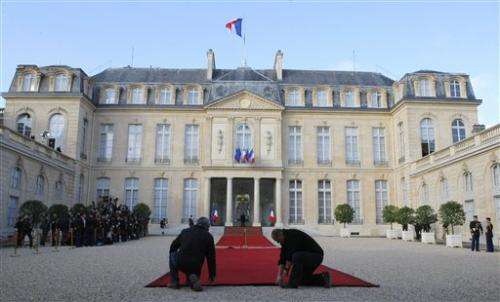
(AP)—The U.S. Embassy in Paris on Wednesday "categorically" denied claims in a French magazine report that the U.S. government was behind a hacking attack against computers in the French president's palace earlier this year.
The French government also played down the report in L'Express magazine. Many countries—including France and the United States—see cyber-attacks as a major threat in the 21st century, and have sought to boost their defenses against intrusions into their computer systems. An array of reported hacking attacks recently in places like Iran and Saudi Arabia have highlighted the menace.
According to L'Express, hackers masquerading as Facebook friends of presidential palace employees duped them into giving up internal passcodes, then used them to spread a computer worm on Elysee Palace computers in May, including one used by then-President Nicolas Sarkozy's chief-of-staff.
In a statement Wednesday, the U.S. Embassy said the report was not based on facts and pointed to the article's own language that said the magazine's unidentified sources suspected the U.S. role in part because of "a bundle of presumptions."
While the U.S. and France are known to share intelligence, notably in their joint efforts to fight terrorism, it's not uncommon for governments to try to keep tabs on their allies' internal discussions.
The report said French experts narrowed down the list of possible attackers based on the technical complexity of the intrusion, and said it bore some hallmarks of Flame—a cutting-edge computer worm discovered earlier this year that has been linked to a secretive cyber-warfare campaign aimed at Iran. Russian anti-virus firm Kaspersky said the program had a full suite of espionage technologies, including the capability to turn computer microphones into listening devices and wirelessly siphon data from nearby smartphones.
"We categorically refute the allegations of unidentified sources, which appeared in an article in L'Express, by which the United States government would have participated in a cyber-attack against the French government," said the embassy statement, which was written in French.
The U.S. Embassy said France was "one of the best allies of the United States" and pointed to remarkable bilateral cooperation between the countries on issues like intelligence, security and cyber-defense.
The alleged hacking took place in May, just days before the conservative Sarkozy—whose affinity for the United States once garnered him the nickname "Sarko the American" in France—lost his re-election bid to Socialist Francois Hollande.
Alluding to a possible motive, L'Express quoted an anonymous source close to the case who said a country could still want to make sure of the "unswerving support" of an ally "especially during a political transition."
Despite efforts to cloak the intrusion, the malicious code left a trail, L'Express reported. The magazine said several unidentified sources with knowledge of the case pointed to "France's oldest ally: The United States" as the culprit.
Speaking to reporters after a weekly Cabinet meeting Wednesday, French government spokeswoman Najat Vallaud-Belkacem said she didn't have precise information about the alleged attack, "but I don't believe we have any particular worries" that the United States might have been behind any such hacking.
Asked whether the government had taken any steps to boost its cyber-defenses, she replied: "To my knowledge, this was all repaired very quickly. There was no difficulty."
A spokeswoman for France's National Agency for the Security of Information Systems, or ANSSI, which was created under Sarkozy and is in charge of helping France defend against cyberattacks, declined to comment.
The report said the intruders combed through the computers of Sarkozy's closest advisers—including that of his chief-of-staff, Xavier Musca—pilfering secret notes and "strategic plans" off hard drives, without elaborating.
Copyright 2012 The Associated Press. All rights reserved. This material may not be published, broadcast, rewritten or redistributed.


