CO2 storage and enhanced oil recovery can aid economy
Nov 20, 2012

Combining carbon storage with enhanced oil recovery techniques in key fields could generate up to £2.7bn in extra economic output, a report has claimed.

The report was produced for Scottish Enterprise by Element Energy with Dundas Consulting and the Institute of Petroleum Engineering (IPE) at Heriot-Watt University.

It proposed that a combination of and enhanced recovery techniques could generate between £300m and £2.7bn in additional gross value added for the economy, which could help to create and sustain hundreds of jobs. If fully exploited, it estimated that 19 potentially suitable oil fields on the UK Continental Shelf (UKCS) could contribute 15% of all UKCS oil production by 2030.

Support for carbon capture storage technology

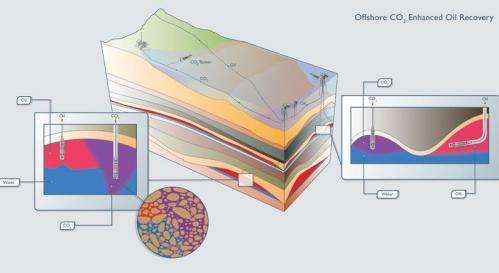
The report suggested extra tax receipts generated by additional extraction could be used to offset initial financial support for capture (CCS), and help it compete better with other low carbon power generation technologies. The national government is supportive of developments in CCS technology, which could in time lead to CO2 gas being pumped to North Sea oil fields for . The basic concept is that by pushing carbon dioxide in to a field, more oil can be extracted.

Professor Eric MacKay, from IPE clarified: "There are challenges ahead, including ensuring a secure and stable supply of CO2 to candidate fields, and indeed in identifying which fields provide the best opportunity - and how this opportunity can be maximised. Government must play a role on the former, and researchers in industry and academia must collaborate on the latter. The Institute of at Heriot-Watt is uniquely placed to contribute to this effort, drawing on over 30 years of research activity into Enhanced Oil Recovery techniques in general and CO2 injection in particular, and with a complement of world renowned experts in the field, backed up by state of the art experimental and modelling facilities."

Energy Minister Fergus Ewing said: "With more than half of the value of the North Sea's oil and gas reserves yet to be extracted - up to 24 billion recoverable barrels with a potential wholesale value of £1.5 trillion - oil and gas will remain an enormous economic resource for decades to come.

and implemented on a commercial scale would drive a significant reduction in carbon emissions from fossil fuels, increasing our security of supply, and presenting enormous opportunities for Scotland."

He added: "Maximising oil recovery will lead to huge gains for Scotland - recovering just 1% more oil could lead to an increase of £22bn in the total oil recovered."

David Rennie, director of CCS at Scottish Enterprise, said: "This report provides strong evidence of the significant economic potential in developing carbon capture and storage on the UK Continental Shelf, particularly when combined with enhanced techniques."

Explore further: Could pond waste be the 'new' fertiliser?

add to favorites email to friend print save as pdf

Related Stories

Oil boom possible but time is running out

Oct 14, 2010

Oil recovery using carbon dioxide could lead to a North Sea oil bonanza worth £150 billion ($240 billion) – but only if the current infrastructure is enhanced now, according to a new study published ...

Carbon sequestration field test begins

May 16, 2007

The U.S. Department of Energy says its Midwest Geological Sequestration Consortium has started its first enhanced oil recovery field test in Illinois.

Recommended for you

Farmers plant rice near crippled Fukushima site

7 hours ago

Farmers have resumed planting rice for market only 15 kilometres (nine miles) from Japan's crippled Fukushima Daiichi nuclear power station, a local official said Wednesday.

Meeting the 'grand challenge' of a sustainable water supply

7 hours ago

Scientists and engineers must join together in a major new effort to educate the public and decision makers on a crisis in providing Earth's people with clean water that looms ahead in the 21st century. That's the focus of ...

Could pond waste be the 'new' fertiliser?

8 hours ago

The University of Stirling is to lead a new project to develop a strategy for using nutrient-rich aquatic biomass waste – from ponds, wetlands and other water-bodies – in farming, as an environmentally ...

Eco database to map landscape projects

8 hours ago

Environmental projects which map some of the most important benefits we get from nature have been brought together for the first time in an online database, following national survey work by researchers in the University ...

Climate change and wildfire: Synthesis of recent findings

May 21, 2013

Concerns continue to grow about the effects of climate change on fire. Wildfires are expected to increase 50 percent across the United States under a changing climate, over 100 percent in areas of the West by 2050 as projected ...

User comments : 2

Adjust slider to filter visible comments by rank

Display comments: newest first

nappy
2 / 5 (5) Nov 20, 2012
This is sad. Value is what a man or woman is willing to give of their work, their sweat, their risk, to get a good or service they want or percieve they need. Taxes do not have a place in the "value" paradigm except in the negative. Keynes was wrong, people. Carbon capture and carbon credits are just ways to steal from the productive and will wind up creating HUGE negative externalities.
thermodynamics
3.7 / 5 (3) Nov 20, 2012
This is sad. Value is what a man or woman is willing to give of their work, their sweat, their risk, to get a good or service they want or percieve they need. Taxes do not have a place in the "value" paradigm except in the negative. Keynes was wrong, people. Carbon capture and carbon credits are just ways to steal from the productive and will wind up creating HUGE negative externalities.


You might just as well quote the discredited economic views of Ayn Rand.

CCS is, probably, the best approach for the short-term. Everyone agrees that we can't just cut off fossil fuels. However, the majority of scientists agree that we should stop increasing GHGs. An incentive to industry to do that is a good short-term approach.

More news stories

NASA: Austin, calling Austin. 3-D pizzas to go

(Phys.org) —The idea of living with 3-D printed food is neither unthinkable nor new; designers and futurists have been looking to 3-D printing as food's next frontier. In 2012, there was news that the Thiel ...