Blocking iodide transport by inhibiting the sodium iodide symporter
Nov 08, 2012
Blocking iodide transport by inhibiting the sodium iodide symporter

(Phys.org)—Iodide entrapment in the thyroid gland is essential, and plays a key role in dysfunctions such as thyroid and breast cancers, thyroiditis, Graves–Basedow disease, and Hashimoto's disease. The accidents at Chernobyl and Fukushima have revealed growing public concerns, as exposure to radioactive iodine increases the risk of cancer and birth defects. There is an urgent need to find radioprotective molecules to prevent and treat body contamination.

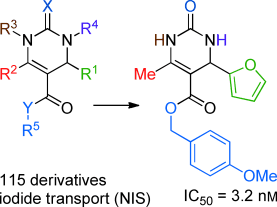
Yves Ambroise and colleagues at the Biology and Technology Institute (IBiTecS, France) identified an important class of compounds that efficiently block iodide transport by inhibiting the symporter, and their results are reported in ChemMedChem.

During a hit optimization program, they synthesized and tested more than 100 molecules for their capacity to block iodide entrapment in rat thyroid cells. They identified a new lead compound with nanomolar activity and low toxicity.

This discovery opens new perspectives for the development of novel anti-thyroid drugs and radioprotective molecules, as well as pharmacological tools for further investigation of iodide traffic at the cellular level.

Explore further: Overcoming resistance to anti-cancer drugs by targeting cell 'powerhouses'

More information: Ambrose, Y. Synthesis and Evaluation of 3,4-Dihydropyrimidin-2(1H)-ones as Sodium Iodide Symporter Inhibitors. ChemMedChem 2013, 8, No. 1. dx.doi.org/10.1002/cmdc.201200417

add to favorites email to friend print save as pdf

Related Stories

BUSM researchers encourage use of potassium iodide

Feb 25, 2009

Researchers from Boston University School of Medicine (BUSM) are strongly encouraging prenatal vitamin manufacturers to use only potassium iodide and not other sources of iodine in their products. According to the researchers, ...

Recommended for you

DNA damage: The dark side of respiration

9 hours ago

(Phys.org) —Adventitious changes in cellular DNA can endanger the whole organism, as they may lead to life-threatening illnesses like cancer. Researchers at LMU now report how byproducts of respiration cause mispairing ...

Protein study suggests drug side effects are inevitable

May 20, 2013

A new study of both computer-created and natural proteins suggests that the number of unique pockets – sites where small molecule pharmaceutical compounds can bind to proteins – is surprisingly small, meaning drug side ...

User comments : 0

More news stories

DNA damage: The dark side of respiration

(Phys.org) —Adventitious changes in cellular DNA can endanger the whole organism, as they may lead to life-threatening illnesses like cancer. Researchers at LMU now report how byproducts of respiration cause mispairing ...

Forecast for Titan: Wild weather could be ahead

(Phys.org) —Saturn's moon Titan might be in for some wild weather as it heads into its spring and summer, if two new models are correct. Scientists think that as the seasons change in Titan's northern hemisphere, ...