Twin Galileo satellites fuelled and ready for launch
Oct 02, 2012
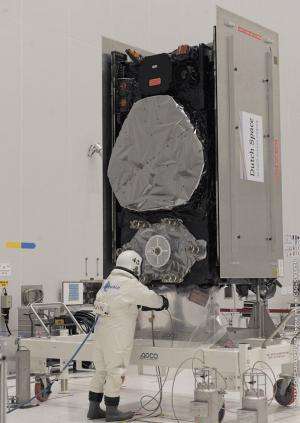
Galileo FM3 in the clean room at Europe's Spaceport, French Guiana. The fuelling process has begun ahead of the next Galileo launch in early October 2012. Credit: ESA/CNES/Arianespace/Optique Video du CSG

The twin Galileo satellites are now fully fuelled and mated together atop the upper stage that will haul them most of the way up to their final orbit. The launch is now planned for the evening of 12 October.

Technicians donned protective suits to fill the two satellites' tanks with hydrazine fuel, used to maintain the satellites' attitude and orbital position during their planned 12-year lifetime.

Rather than carry a significant amount of extra fuel to insert themselves into their planned orbits – like typical or Galileo's US GPS equivalents – the Galileo satellites are transported to medium by the Fregat fourth stage of their Soyuz ST-B launcher.

Doing without this extra fuel and orbital thrusters means that Galileo satellites are small enough to be launched in pairs aboard the Soyuz – or in fours by the new variant currently being prepared.  

The Galileo satellites are attached to a special dispenser that holds them securely in position during launch, before pyrotechnic mechanisms release them sideways in opposite directions once their set 23 222 km altitude is reached.
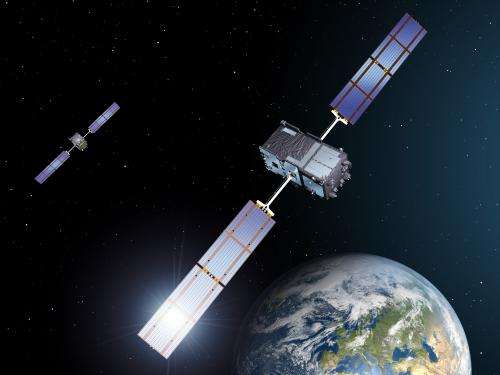
The first two of four Galileo In-Orbit Validation satellites were launched on 21 October 2011. Credit: ESA – P. Carril

The aluminium plates on each side of the satellites are temporary additions to protect their delicate ; these will be removed later.

The combined satellites, dispenser and Fregat will now be carefully checked ahead of the next major milestone, the fitting of the protective launch fairing on Thursday.

The mission's satellite launch readiness review will begin at the start of the following week. If that goes well, the combined 'Upper Composite' will be moved from the Fregat Integration Building to the , where it will be attached to the Soyuz launcher.

Completing Galileo's validation phase 

The launch will see these two new Galileo In-Orbit Validation satellites joining the first two that have been orbiting since October 2011.

This is a significant milestone for Europe's Galileo programme because four is the minimum number required for navigational fixes, enabling full system testing whenever they are all visible in the sky.
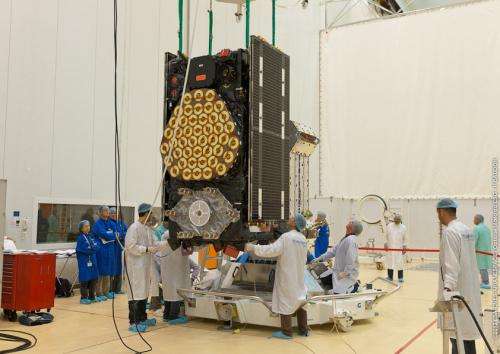
Galileo FM3 (Flight Model 3) undergoes a fitcheck for its dispenser at CSG, Kourou, French Guiana. FM3 will travel into orbit onboard Soyuz flight VS03, alongside Galileo FM4. Credit: ESA/CNES/Arianespace/Optique Video du CSG

This validation phase will be followed by the deployment of more satellites and ground segment components to achieve 'Full Operational Capability'. After that, users on the ground can exploit the services.

The first four satellites were built by a consortium led by EADS Astrium, Germany, with Astrium producing the platforms and Astrium UK responsible for the payloads. They were assembled and tested in Rome by Thales Alenia Space.

Explore further: Preparing for Galileo's next launch

add to favorites email to friend print save as pdf

Related Stories

Preparing for Galileo's next launch

Sep 11, 2012

(Phys.org)—After arriving at the launch site last month, the second pair of Galileo navigation satellites is being prepared for launch from Europe's Spaceport in October. 

Galileo's Soyuz launchers arrive at French Guiana

Jun 22, 2011

(PhysOrg.com) -- The two Soyuz launchers that will fly the first four satellites of Europe’s Galileo navigation system into orbit have arrived at Kourou harbour in French Guiana, completing a journey ...

First Galileo satellite travels to launch site

Dec 01, 2005

GIOVE A, the first Galileo satellite, departed from ESA's test facility at the European Space Research and Technology Centre in The Netherlands on the morning of 29 November, bound for the Baikonur Cosmodrome ...

Recommended for you

Proba-V opens its eyes

3 hours ago

(Phys.org) —Earth watcher Proba-V is in good health following its launch last week. The Vegetation imager has been switched on and the first image has been captured over western France.

Mice, gerbils perish in Russia space flight

May 19, 2013

A number of mice and eight gerbils sent into space in a Russian capsule destined to find out how well organisms can withstand extended flights perished during their journey, scientists said Sunday as the ...

Mars rover Opportunity examines clay clues in rock

May 18, 2013

(Phys.org) —NASA's senior Mars rover, Opportunity, is driving to a new study area after a dramatic finish to 20 months on "Cape York" with examination of a rock intensely altered by water.

NASA's STEREO detects a CME from the sun

May 17, 2013

On 5:24 a.m. EDT on May 17, 2013, the sun erupted with an Earth-directed coronal mass ejection or CME, a solar phenomenon that can send billions of tons of solar particles into space that can reach Earth ...

User comments : 0

More news stories

Slow earthquakes: It's all in the rock mechanics

(Phys.org) —Earthquakes that last minutes rather than seconds are a relatively recent discovery, according to an international team of seismologists. Researchers have been aware of these slow earthquakes, ...

Proba-V opens its eyes

(Phys.org) —Earth watcher Proba-V is in good health following its launch last week. The Vegetation imager has been switched on and the first image has been captured over western France.

Diabetes drug tested in Parkinson's disease patients

Parkinson's disease (PD) is a degenerative neurological disorder marked by a progressive loss of motor control. Despite intensive research, there are currently no approved therapies that have been demonstrated to alter the ...

Philippines approves three new wind farms

The Philippines has approved three wind farm projects that will generate 208 megawatts, enough to power more than 40,000 middle-class homes, an energy official said on Monday.