Scientists fight 'super weeds' with sustainability
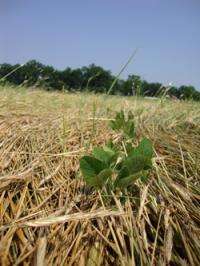
(Phys.org)—Across the United States, fields of genetically engineered crops have become laboratories for the evolution of glyphosate-resistant (GR) weeds. These fast-growing "super weeds"—resistant to the highly effective herbicide glyphosate—are cutting crop yields and raising costs for farmers, whose only recourse is to spray more and different chemicals.
The issue, according to Matthew Ryan, assistant professor of crop and soil sciences, isn't going away; three new GR weed species have been documented since January, bringing the total to 24. To combat GR weeds, the agrichemical industry has developed new transgenic crops that are resistant to multiple herbicides. But Ryan and Thomas Bjorkman, associate professor of horticultural sciences, believe this is not a long-term solution.
"The industry's solution doesn't get at the problem of using a single tactic for weed management," said Ryan. "It's not just herbicides. Overusing any one method of weed management, even hand weeding, can create selection pressure on weeds to build resistance."
Just as the overuse of certain antibiotics led to resistant bacteria strains, "super weeds" emerged shortly after transgenic GR crops were introduced in 1996 and farmers began relying almost exclusively on glyphosate to control weeds in those crops. This is why Ryan and Bjorkman are investing instead in preventing the evolution and spread of GR weeds by using diverse integrated weed management (IWM) strategies.
"Prevention involves killing weeds with multiple modes of action, and preventing movement of any potentially resistant weeds from field to field, or from field margins into fields," Bjorkman said.
Integrated weed management includes tactics such as cover cropping, mechanical cultivation, mowing, mulching, crop rotation and targeted herbicide application. Ryan's research shows that using multiple IWM strategies is most effective for managing weeds. IWM strategies also help lower the selection pressure on weeds, preventing them from easily developing resistance.
But Ryan said prevention is a tough sell to farmers who aren't currently battling GR weeds. Bjorkman believes this is because most farmers' finances don't take into account the benefits of avoiding future uncontrollable weed infestations. Also, the industry has pushed their transgenic seed and herbicide development research toward simplicity.
"There are instructions on bottles of herbicides, but not on integrated weed management plans," said Ryan. "IWM can be economical and feasible, but we need more on-the-ground research and work with farmers."
To fill this gap, Ryan and Bjorkman are refining IWM techniques to make them easier for farmers to adapt to their locations and cropping schedules. Ryan is conducting cover crop seeding rate experiments on farms in New York, Massachusetts, Pennsylvania, Maryland and North Carolina. He is also leading a newly funded multistate project to research pre-harvest interseeding of cover crops in corn and soybean fields.
Bjorkman's cover crop research has fueled development of two online decision tools that help farmers narrow down to a small number myriad choices for cover-cropping by situation. Bjorkman designed one tool for New York vegetable farmers; the other, developed in conjunction with the Midwest Cover Crops Council, covers several states with an emphasis on field crops.
Ryan and Bjorkman hope their research and aggressive outreach will encourage more farmers to shift away from rote applications of glyphosate herbicides to more diversified weed management strategies. Large-scale farmers remain skeptical about whether IWM is practical for their size. But Bjorkman said there is nothing inherent about large-scale farms that make tactics such as cover cropping impossible or less effective.
"There are large farms that cover crop successfully and, in their analysis, profitably," Bjorkman said.
Provided by Cornell University


